

Abstract
Due to their impressive clinical success, CAR-T therapies are becoming a more mainstream treatment for patients with hematologic malignancies. In order to make this promising form of therapy accessible to patients in need worldwide, a robust scale-up of such a complex supply chain, that is also affordable worldwide, is essential. Already a challenging endeavor in most privileged countries, but a chimerical undertaking in the more logistically challenged regions and emerging markets across the globe. For example, cryopreserving the fresh apheresis starting material soon after collection will maintain cell viability through longer hold-times while providing the necessary logistical flexibility. However, this logistical de-risking comes at a cost. If not designed well, a cryopreservation step performed on starting material to stabilize cell viability for transportation can be characterized as a manufacturing step bringing unnecessary regulatory requirements to the cost of this treatment. Fortunately, some health agencies have provided risk-based guidance on characterizing individual process steps that do not require rigorous controls and associated regulatory requirements. Other health agencies, however, still require the same controls as needed for drug product manufacturing. Emerging markets with limited experience or regulatory oversight looking at highly industrial markets for guidance, are at risk for establishing requirements that offer no additional risk reduction. We present a non-substantially manipulating cryopreservation process of CAR-T apheresis starting material with risks that can be mitigated under Tissue and Cell legislations (EP Directive 2004/23/EC) versus guidelines of Good Manufacturing Practices. The simplicity of this fully closed process can also enable hospitals to perform the cryopreservation locally in their own cell processing laboratory, without the need for expensive cleanrooms or additional GMP requirements. What can take us one step closer to a truly global roll-out of this innovative treatment is that both manufacturers and health authority inspectors embrace this concept and work together on a harmonized implementation of the existing regulatory framework for cellular starting materials. The proposed combination of the EU Blood Directives and Tissue and Cell Directives into regulation may serve as a model worldwide to help optimize patient access to advanced therapies globally.
Keywords
CAR-T, Apheresis starting material, Cryopreservation, Regulatory requirements, GTP
Introduction
Over the past two decades, there have been significant advances in the treatment of hematological malignancies, with the promise of long?term patient survival. One of the most advanced treatments that is bringing hope to refractory patients are cellular therapies [1]. Autologous cell therapies have found their way to the market with several Chimeric Antigen Receptor T-cell (CAR-T) products approved and hundreds of clinical trials ongoing [2]. This form of personalized medicine, however, requires a challenging supply chain compared to the more conventional treatments. The individualized nature of these cell therapies, demand a different operating model ensuring end-to-end traceability (Figure 1) where the hospitals are both suppliers of starting materials as well as customers [3].
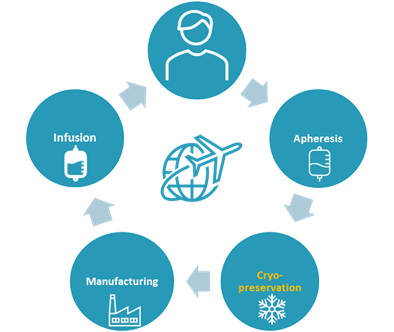
Figure 1. Typical CAR-T supply chain. A perfect orchestration of this unique supply chain requires different teams at hospitals, manufacturers, and authorities to work together providing this treatment to the right patient in a timely matter. If designed right, cryopreservation of the fresh apheresis material facilitates centralized manufacturing and hence scale up of the process for global deployment.
A major challenge for a CAR-T cell therapy supply chain is the limited stability of fresh starting material. This leukapheresis material has a limited viability once outside the patient’s circulation, making the subsequent shipment to the manufacturing site very time sensitive. In addition, the manufacturing slot planning as well as local logistical infrastructure may not always support an on-time delivery of fresh starting materials. With the impending global scale-up and centralized CAR-T manufacturing, there is a clear need to de-risk this part of the supply chain. Cryopreserving the fresh apheresis material seems to be compelling, stabilizing the cells and reducing the variability of the material [4]. This extra process step, however, comes at a price. It adds both time and costs, which both vary significantly based on the complexity of the process. To balance this against the logistical risk mitigation it offers, a carefully designed process with controls established to manage risks while leveraging the existing regulations is critical. If done well, it yields a simple yet compliant process that can be implemented similarly in large central facilities as well as in small hospital laboratories under similar regulatory requirements and quality standards [5]. This will facilitate fair patient access globally using comparable standards between patients across regions.
The Cryopreservation Process and Its Requirements in Relation to Global Deployment
Making cell therapies widely accessible proves to be challenging even in developed countries with established infrastructure and sufficient financial and qualified human resources [6,7]. The high demand drives the need for large-scale centralized Advanced Therapy Medicinal Products (ATMP) manufacturing facilities. However, the previously described non-frozen viability of fresh apheresis material puts patients from emerging markets at risk or fully out of reach for these innovative treatments. In order to allow for scale-up while safeguarding fair patient access irrespective of a country’s economic or logistical infrastructure, the apheresis cryopreservation process needs to be simple and developed utilizing a risk-based approach. Fortunately, regulators have already provided guidance to allow for a risk-based approach mitigating only those risks relevant to the process. In line with this, the key success factors for global cryopreservation processes are: simplicity, closed process, speed, low costs and non-manipulating (Figure 2). As stated in Directive 2009/120/EC of the European Parliament and Regulation 1394/2007 Annex 1, cryopreservation is considered a non-substantial manipulation acknowledging that the process does not alter the biological characteristics of the cells. Further characterization of the process can be achieved by filing both the fresh and cryopreserved leukapheresis material as starting material. The applicable Tissue and Cell regulations (2004/23/EC and implementing Directives) allow for a risk-based approach specific for this type of materials and accompanying risks. For example, if the cryopreservation process can be designed as a fully closed system, then facility design and room classification can allow for a Controlled Non-Classified (CNC) space instead of a Grade D cleanroom. This will reduce the costs, cycle times and tailors the quality oversight to the material being processed. A nice to have for large facilities in the wealthier countries, but absolutely essential for smaller hospital cryopreservation laboratories in less privileged regions.
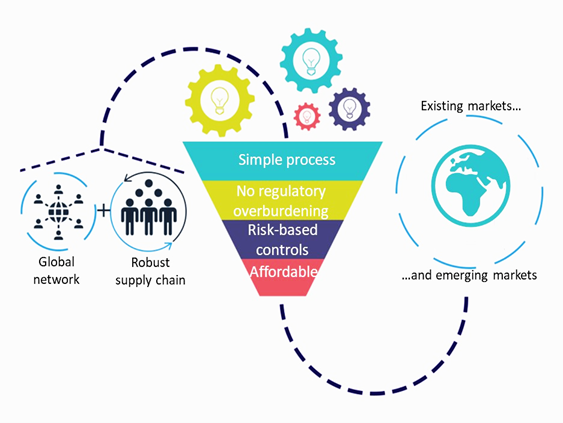
Figure 2. Schematic overview of key cryopreservation assets to enable global cell therapy deployment. Key factors such as simplicity, no regulatory overburden, risk-based controls and affordability facilitate the cryopreservation implementation globally.
While manufactures and developers are working on technical solutions like automation [8], standard kits and standardization tools that will further simplify the cryopreservation process, securing a robust supply of reagents and equipment can be a challenge depending on the country [9,10]. Having a protocol with raw material flexibility as well as readily available equipment will facilitate a straightforward global implementation. Cell therapies bring a new way of thinking, where manufacturers, clinical sites, regulators and inspectors are ideally collaborating to benefit the patients regardless of the socioeconomic status of the country they live in. A key facilitator for this is harmonized regulatory guidance with clear direction for inspectors, where perhaps a future framework such as in the European Union (EU) may serve as a basis for next in line countries.
Regulations as an Enabler for Efficiency and Robustness of the Supply Chain
Cell therapies are still a relatively new concept, even in countries that are at the forefront of receiving those innovative treatments. As such, inspectors may take a conservative approach, for example by applying Good Manufacturing Practices (GMP) for starting materials [11]. This brings extra administrative and regulatory burden for both hospitals and cell processing laboratories while adding substantial costs. Although the richer countries may be able to afford it, the less fortunate economies pay a hemic price for this desired conventionalism. European Regulators acknowledge this and recently issued a proposal for the Regulation of the European Parliament and of the Council on standards of quality and safety for substances of human origin intended for human application (SoHO). This intends to combine the successful yet outdated Blood Directives (2002/98/EC) and Tissue and Cell Directives (2004/23/EC and implementing Directives) into proposed regulation. Although not always consistent with the existing EU regulations, it aims to use the latest scientific and technical experience replacing the Tissue and Cell Directives. Unfortunately, the lack of demarcation has been transferred to this draft EU regulation where it misses a clear hierarchy for entities dealing with borderline cases. The delineation criteria of when cells should be considered engineered and thus fall under the scope of the ATMP legislation remains somewhat elusive. It even further stretches the boundaries where genetically modified cells (such as CAR-T cells) could not be considered an ATMP anymore but rather are regulated under the SoHO regulation. This cannot be seen as an improvement in terms of providing clarity for inspectors who are experienced in using the substantial manipulation or non-homologous use definition as a flexible, yet stable regulatory framework. In the current Commission Directive 2009/120/EC, cells or tissues that have been subject to substantial manipulation resulting in change of their biological characteristics, physiological functions, or structural properties relevant for the intended clinical use still fulfill the definition of medicinal product regulated by the GMP for ATMPs. In synch with this, in 2009/120/EC and Regulation 1394/2007 Annex 1, manipulations such as cryopreservation, concentration, filtering, centrifugation or freezing are considered non-substantial manipulations (not further engineered) which can further support characterizing cryopreserved apheresis material as a starting material regulated leveraging the Tissue and Cell directives or future SoHO regulation. This is also supported by the scientific recommendation in ‘Reflection paper on classification of advanced therapy medicinal products’ published by Committee for Advanced Therapies (CAT). Revision of the reflection paper from 2014 aims to provide clarity for borderline cases and guidance towards correct procedures and requirements so all possible cell-based products are not regulated as a medicine.
In any case, the proposed regulation aims to regionally harmonize and minimize the need for countries to implement more stringent measures that can create barriers for cross border exchange of materials. Even though it is not intended to interfere with the Member states’ right to introduce such measures, the aim is to make the regulatory management more fit for purpose in order to facilitate patient access within the EU and beyond. Regulators also acknowledge that current EU and local rules for safety and quality are often outdated and come at unnecessary cost, so common risk-proportionate measures based on recent scientific evidence must be introduced. If implemented right, this could raise the level of trust between countries and facilitate truly global deployment while inspiring regulators in other regions. The proposed SoHO regulation is not fundamentally different from 2004/23/EC, nor are any changes to the description of borderline cases covered in 1394/2007 Annex 1 introduced. Following such principles allows for scalability and risk-based requirements for cryopreservation. Such initiatives can be an inspiration for emerging markets where regulatory systems are still maturing for cellular therapies and likely to be challenged by legal, social, and ethical questions around new therapies [12].
Conclusion
The cell therapy field is fast developing, continuing to offer hope to patients in need. Access to these cell therapies, however, is still limited to countries with an abundantly resourced health care system. While this unique supply chain is maturing and the reliability of the ‘hospital as supplier’ network is improving, efficiency gains and cost reductions are key in expanding patient access globally. Cryopreservation of the apheresis starting material is an enabler in creating a more widely available and affordable product. Current and proposed regulations fortunately allow a fit for purpose framework to deliver these high-quality starting materials without unnecessary regulatory complexities that offer no additional value. However, the current room for interpretation has led to a non-unified approach between inspectors, even within the same region. Where some appreciate the opportunities and quality framework within the tissue and cell regulations, others take a more conservative approach mandating GMP for non-manipulative cellular processing. This does not only create a different set of standards between patients, it is also a missed opportunity given the emerging market countries looking for guidance. With new legislation being introduced, regulators have a unique chance to define specific processes such as cryopreservation to be not considered a borderline case. Further clarification in implementing directives or supporting documentation could prevent double measures being applied to the identical process. In the end, regulators, inspectors, and manufacturers positively want the same: to work together and enable a harmonized and low-risk approach in providing innovative new forms of cellular therapies to patients in need globally.
References
2. Cuende NA, Rasko JE, Koh MB, Dominici M, Ikonomou L. Cell, tissue and gene products with marketing authorization in 2018 worldwide. Cytotherapy. 2018 Nov 1;20(11):1401-13.
3. Mebarki M, Madelaine I, Larghero J, de Jorna R. Advanced therapy medicinal products: Regulatory framework, hospital and pharmaceutical circuits in Europe and France. Therapies. 2022 Mar 1;77(2):185-90.
4. Tyagarajan S, Schmitt D, Acker C, Rutjens E. Autologous cryopreserved leukapheresis cellular material for chimeric antigen receptor-T cell manufacture. Cytotherapy. 2019 Dec 1;21(12):1198-205.
5. Adriaansen J, Stanton J, Schaut W, Bowden R. Compliance and cost control for cryopreservation of cellular starting materials: An industry perspective. Cytotherapy. 2022 Mar 15.
6. Hendricks CL, Alessandrini M, Pepper MS. Equitable access to cell and gene therapies in South Africa: opportunities and hurdles. Gene Therapy. 2022 Jan 8:1-7.
7. Jackson CS, Pepper MS. Opportunities and barriers to establishing a cell therapy programme in South Africa. Stem Cell Research & Therapy. 2013 Sep;4(5):1-7.
8. Moutsatsou P, Ochs J, Schmitt RH, Hewitt CJ, Hanga MP. Automation in cell and gene therapy manufacturing: from past to future. Biotechnology Letters. 2019 Nov;41(11):1245-53.
9. O'SULLIVAN GM, Velickovic ZM, Keir MW, Macpherson JL, Rasko JE. Cell and gene therapy manufacturing capabilities in Australia and New Zealand. Cytotherapy. 2019 Dec 1;21(12):1258-73.
10. Ravindranath A, Dubey A, Suresh S, Chaudhuri G, Chirmule N. CAR-T cell therapy in India requires a paradigm shift in training, education and health care processes. Cytotherapy. 2021 Nov 6:1384.
11. Petricciani J, Hayakawa T, Stacey G, Trouvin JH, Knezevic I. Scientific considerations for the regulatory evaluation of cell therapy products. Biologicals. 2017 Nov 1;50:20-6.
12. Pepper MS, Alessandrini M, Pope A, Van Staden W, Green RJ. Cell and gene therapies at the forefront of innovative medical care: Implications for South Africa. South African Medical Journal. 2019 Mar 7;109(1):20-2.