

Abstract
We present a case of an Allurion gastric balloon complicated by significant symptoms requiring prompt decompression. As the patient declined endoscopic intervention under general anesthesia, percutaneous ultrasound-guided catheter aspiration was performed to deflate the balloon. Complete decompression was achieved, followed by presumed spontaneous passage of the collapsed device without endoscopic intervention. This case illustrates a potential rescue alternative for managing symptomatic gastric balloon complications when conventional endoscopic treatment is not feasible or is declined.
Keywords
Intragastric balloon, Allurion balloon, Ultrasound-guided percutaneous aspiration, Non-endoscopic, Bariatric
Introduction
The Allurion gastric balloon is a swallowable, non-endoscopic device designed to promote weight loss over 16 weeks, after which it is expected to spontaneously deflate and pass through the gastrointestinal tract [1]. It represents a significant advance over earlier devices, which required endoscopy, anesthesia, and were often poorly tolerated. With a serious adverse event rate of approximately 0.2%, Allurion is safer than legacy balloons such as Spatz3, ReShape, and Orbera, which have rates of 5–10% [2–5].
Despite its safety profile, complications occur. In a multicenter study of 5,003 patients, pancreatitis occurred in 0.01%, gastric outlet obstruction in 0.07%, small bowel obstruction in 0.08%, and balloon intolerance requiring early removal in 2.1% of cases [2]. The standard of care for balloon removal while still intragastric, whether for intolerance, migration, or other complications, remains endoscopic deflation and retrieval under general anesthesia for airway protection [1,6].
Ultrasound-guided percutaneous needle aspiration has been described as an alternative but carries risks, including downstream migration of a partially deflated balloon leading to small bowel obstruction [7]. Needle-only access may also risk premature dislodgement before complete deflation. These risks underpin Allurion’s formal recommendation for endoscopic removal [1].
We report a catheter-based aspiration modification that aims to improve procedural stability and facilitate full deflation, enabling a minimally invasive salvage approach to Allurion gastric balloon decompression.
Case Presentation
A 58-year-old woman with obesity (body mass index [BMI] 41.8 kg/m², weight 107 kg) and no significant associated medical problems underwent Allurion balloon placement. Her surgical history was limited to a remote open appendectomy for non-perforated appendicitis.
By week 5 post-insertion, she had lost 5 kg (total body weight loss [TBWL] 4.7%) and developed intermittent bloating, diarrhea, and regurgitation, progressing to persistent nausea, early satiety, and daily vomiting. Protein and fluid intake were suboptimal. Her symptoms initially improved but by week 11, she was admitted with intractable vomiting and epigastric discomfort. She had lost 11 kg (TBWL 10.3%). Laboratory results showed a lipase of 1,245 U/L (normal 23–300) and C-reactive protein (CRP) of 21.76 mg/L (normal 0–5). CT imaging revealed balloon hyperinflation, characterized by intraballoon gas occupying over 50% of its volume, in contrast to the minimal meniscus of air typically seen on imaging following filling. The balloon was displaced into the gastric body rather than its expected fundal position. No further abnormalities were detected (Figure 1). Ultrasound revealed moderate hepatic steatosis and the absence of cholelithiasis or other biliary tract abnormalities.
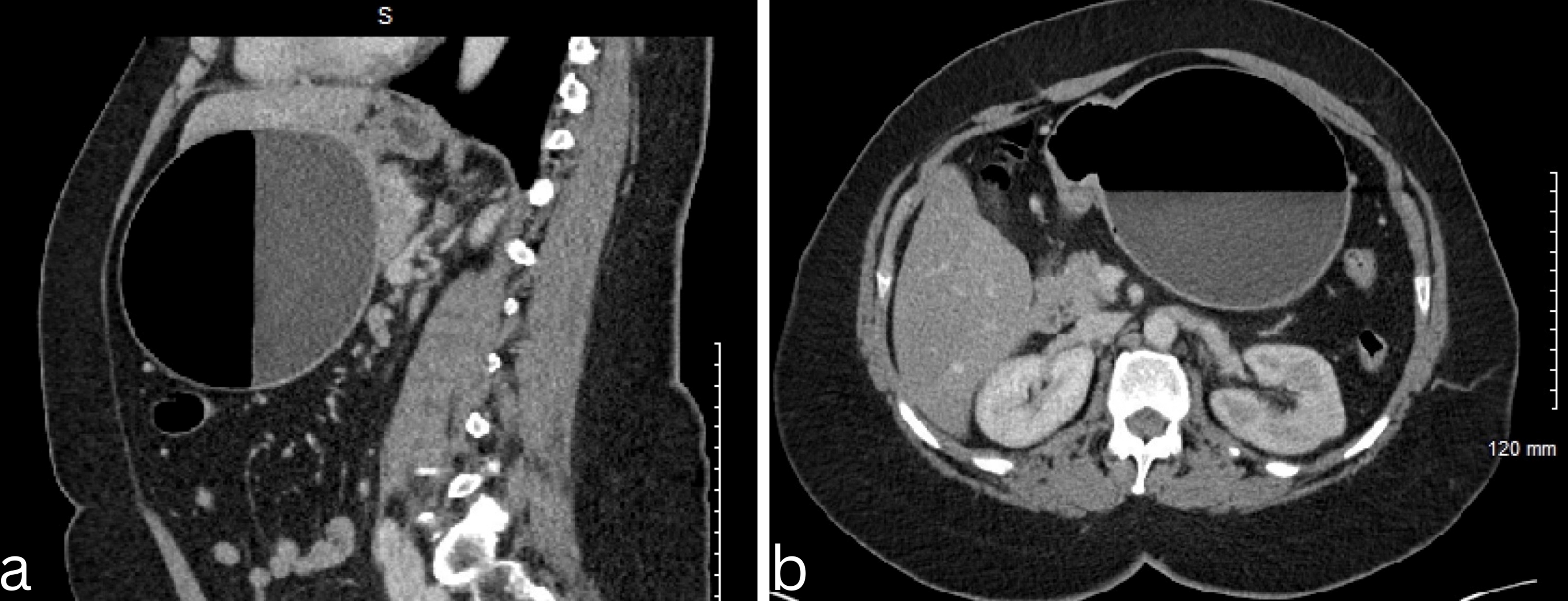
Figure 1. (a) Sagittal and (b) axial computed tomography of the abdomen showing the hyperinflated gastric balloon.
Extrinsic compression of the pancreatic head, resulting from balloon hyperinflation and downward displacement, was suspected as the cause of pancreatitis. In view of the patient’s longstanding symptoms and the risk of further deterioration, endoscopic removal under general anesthesia with endotracheal intubation for airway protection was recommended. However, the patient declined general anesthesia and wished to avoid endoscopy. Following multidisciplinary discussion and explicit informed consent, catheter-based percutaneous aspiration was offered as an alternative.
Intervention
Under local anesthesia and sterile conditions, real-time ultrasound identified the balloon at 4 cm depth and measured about 12 cm in diameter. Using a modified Seldinger technique, a 16 cm, 18-gauge catheter was advanced into the balloon (Figure 2). Approximately 510 mL of fluid was aspirated, resulting in complete collapse to less than 3 cm in diameter. The catheter’s length helped maintain position during aspiration, minimizing the risk of premature disengagement. No immediate complications occurred. Microbiological analysis of the aspirated balloon fluid grew Candida glabrata on culture and sensitivity testing. This may be associated with balloon hyperinflation, but a causal relationship cannot be established.
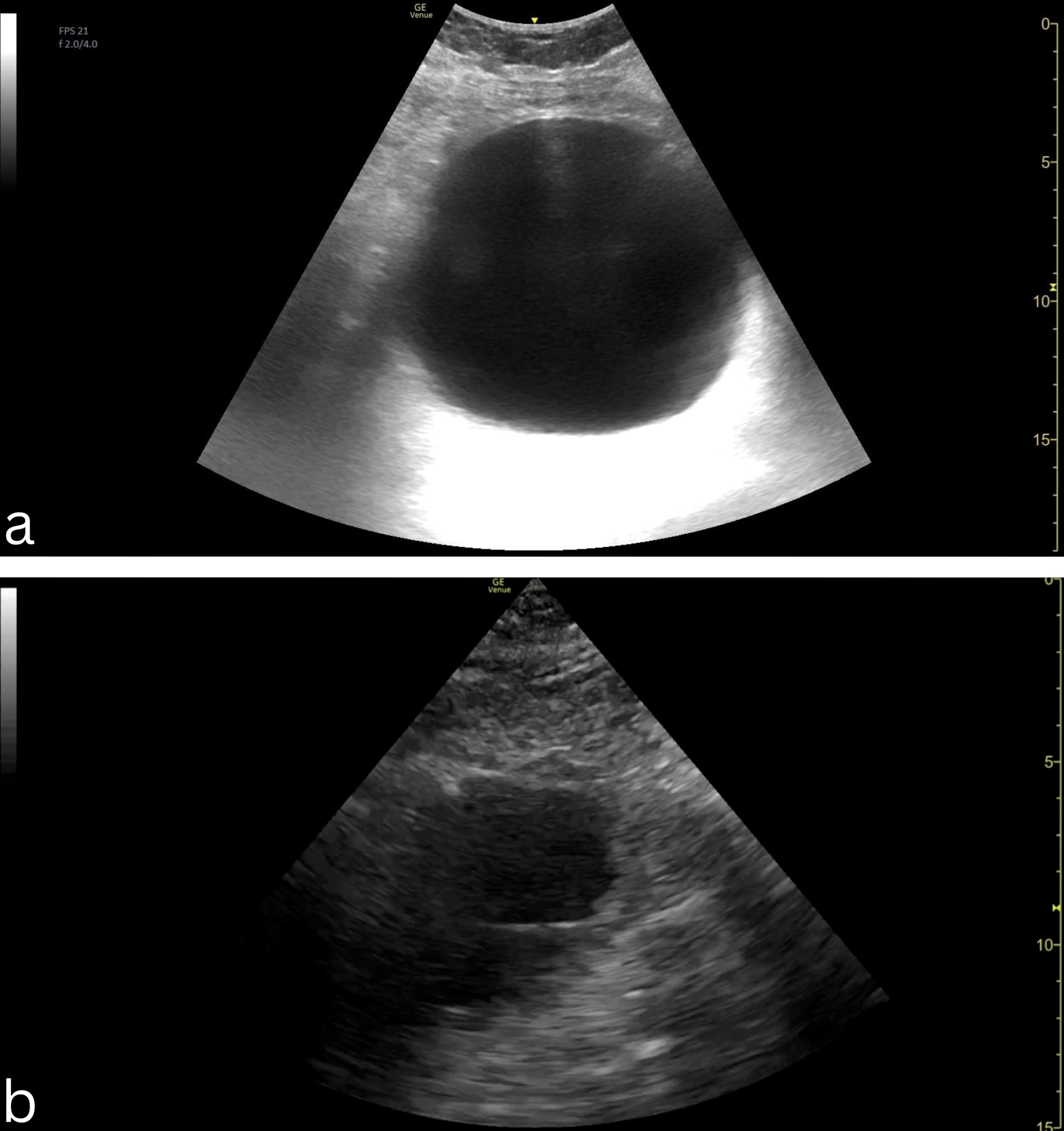
Figure 2. (a) Transabdominal ultrasound showing the gastric balloon within the stomach. (b) Ultrasound image showing the catheter within the partially collapsed balloon during aspiration.
Results
The following day, the patient was tolerating fluids without symptoms and was discharged. At one week and one month follow-up, she remained symptom-free, with no signs of small bowel obstruction. She did not confirm visual passage of the balloon, a frequent occurrence in our clinical practice.
Discussion
Urgent removal of gastric balloons is uncommon but occasionally necessary for complications such as intolerance, obstruction, or less often pancreatitis [8]. When the balloon remains intragastric, the standard approach is endoscopic removal, generally under general anesthesia [1]. While effective, this is invasive, resource-dependent, and may be declined by patients.
Ultrasound- or CT-guided percutaneous aspiration can be a minimally invasive method to remove gastric balloons, but it has been rarely used in recent decades, in part due to technical challenges and risks inherent to needle-only access [7]. Previous reports describe needle aspiration of deflated balloons obstructing the small bowel, with spontaneous passage when successful, although most cases were managed surgically, and one attempt with a multilayered balloon failed after distal re-impaction [7]. Endoscopic needle aspiration of an Allurion balloon, under general anesthesia, has also been described [6]. In contrast, our patient had an intact, hyperinflated balloon within the stomach, and the indwelling catheter allowed sustained access until full decompression, which may reduce the risk of partial collapse and distal migration.
Percutaneous access carries risks, including gastric wall injury, bleeding, perforation, peritonitis, and gastro-cutaneous fistula. In this case, access was performed under real-time ultrasound guidance with the balloon 4 cm from the skin, and no immediate complication occurred. This approach should be considered a rescue option for selected patients when endoscopy is declined or unavailable, not first-line therapy.
Limitations
This is a single case with one month of follow-up and no imaging confirmation of balloon passage. The Candida glabatra finding cannot establish a causal role in hyperinflation. This approach is a rescue option, not first-line therapy.
Conclusion
Catheter-based percutaneous aspiration of Allurion gastric balloons is a feasible, minimally invasive alternative when endoscopic removal is declined or unavailable.
Declarations
Patient consent
The patient has consented to the submission of the case report to the journal.
Conflicts of interest
The authors declare that they have no conflict of interest.
Funding
None.
References
2. Ienca R, Oyola C, Giardiello C, Caballero A, Taha OY, Jarallah M, et al. The Swallowable Gastric Balloon: Global Experience in 5003 Consecutive Patients – The Largest Gastric Balloon Study in the World. In: IFSO 2023: Proceedings of the 26th World Congress of the International Federation for the Surgery of Obesity and Metabolic Disorders; 2023 Aug 30-Sep 1; Naples, Italy; International Federation for the Surgery of Obesity and Metabolic Disorders (IFSO), 2023.
3. U.S. Food and Drug Administration. Summary of safety and effectiveness data (SSED): Spatz3 Adjustable Balloon System. Report No.: P190012. Silver Spring (MD): Center for Devices and Radiological Health, FDA; 2021 Oct 15. Available from: https://www.accessdata.fda.gov/cdrh_docs/pdf19/P190012B.pdf
4. U.S. Food and Drug Administration. Summary of safety and effectiveness data (SSED): ReShape Integrated Dual Balloon System. Report No.: P140012. Silver Spring (MD): Center for Devices and Radiological Health, FDA; 2015 Jul 28. Available from: https://www.accessdata.fda.gov/cdrh_docs/pdf14/P140012c.pdf
5. U.S. Food and Drug Administration. Summary of safety and effectiveness data (SSED): ORBERA Intragastric Balloon System. Report No.: P140008. Silver Spring (MD): Center for Devices and Radiological Health, FDA; 2015 Aug 5. Available from: https://www.accessdata.fda.gov/cdrh_docs/pdf14/P140008b.pdf
6. Al Tali M, Lam RKY, Ma ASC, Ochieng AO. Safe removal of an Allurion swallowable intragastric balloon using an EUS aspiration needle at a non-specialist centre. BMJ Case Rep. 2025 Feb 22;18(2):e263664.
7. Brooks J, Rimon U, BenSaid P, Lang A, Nadler M, Schwartz C, Bar Meir S. Percutaneous Needle Aspiration of a Partially Deflated Intragastric Balloon: a Forgotten Modality? Review of the Literature. Obes Surg. 2018 Jun;28(6):1781–4.
8. Gore N, Ravindran P, Chan DL, Das K, Cosman PH. Pancreatitis from intra-gastric balloon insertion: Case report and literature review. Int J Surg Case Rep. 2018;45:79–82.