

Abstract
Background: Idiopathic normal pressure hydrocephalus (iNPH) is a neurological disorder and one of the few potentially reversible causes of dementia and disability in older adults. A recent systematic review and meta-analysis reports that apathy occurs in roughly 69% and depression in about 30% of affected patients. Because these neuropsychiatric manifestations are prominent early, iNPH may be mistaken for a primary psychiatric disorder, sometimes for years.
Objective: To equip emergency physicians (EPs) caring for older adults with behavioral or cognitive complaints with a practical framework for recognizing iNPH as a neuropsychiatric mimic, and for trauma-informed assessment of shunt-dependent patients presenting with new psychiatric symptoms.
Discussion: Frontal-subcortical circuit dysfunction in iNPH produces apathy, psychomotor slowing, depression, anxiety, and, in a minority of cases, agitation or psychotic phenomena. A 2025 placebo-controlled NEJM trial demonstrated significant gait improvement after shunting. A pooled estimate suggested a modest reduction in depression scores, although its confidence interval included no effect. In emergency settings, brief structured gait assessment combined with explicit screening for apathy versus sadness can help distinguish iNPH from depression and Alzheimer disease. Shunted patients who present with anxiety, hypervigilance, or activity restriction warrant careful, trauma-informed evaluation before a primary psychiatric diagnosis is assumed; their somatic concerns may be valid signals of mechanical malfunction or appropriate responses to permanent device dependence.
Conclusions: Older adults presenting to the ED with depression, dementia, or new behavioral symptoms warrant a brief gait examination and a focused review for the iNPH triad. EPs play a pivotal role in recognizing this treatable neurological disorder when neuropsychiatric manifestations dominate the presentation, and in honoring the embodied knowledge of patients living with a permanent intracranial device. The screening approach described here is an expert-derived educational framework that awaits prospective validation.
Keywords
Idiopathic normal pressure hydrocephalus, Emergency psychiatry, Apathy, Depression, Diagnostic error, Trauma-informed care, Ventriculoperitoneal shunt
Introduction
Older adults presenting to emergency departments (EDs) with depression, anxiety, behavioral change, or unexplained cognitive decline are often funneled into a psychiatric pathway. That pathway is usually correct. Sometimes it is not. Among the most reliably missed diagnoses when behavioral symptoms dominate is idiopathic normal pressure hydrocephalus (iNPH) — a treatable disorder whose earliest neuropsychiatric features routinely impersonate major depression, Alzheimer disease, or simple senescence [1,2].
The pattern was first formally described in 1976, when Rosen and Swigar called depression and NPH a “dilemma in neuropsychiatric differential diagnosis,” noting that apathy, inattentiveness, agitation, and poverty of thought could delay structural diagnosis for years [3]. Half a century later, a 2026 systematic review and meta-analysis confirmed how common these features are: apathy in roughly 69% of iNPH patients, depression in about 30%, anxiety in 22%, agitation in 23%, and psychotic syndromes in 8% (Table 1) [4]. A retrospective Colombian series of 35 patients referred for suspected normal pressure hydrocephalus after diagnostic delay found that five were considered shunt candidates after lumbar-puncture evaluation, but none ultimately underwent surgery [5].
|
Neuropsychiatric feature |
Pooled prevalence in iNPH |
95% confidence interval |
|
Apathy |
69.2% |
63.1–74.6% |
|
Depression or depressive symptoms |
30.1% |
20.1–42.3% |
|
Agitation |
22.6% |
11.8–39.1% |
|
Anxiety |
21.9% |
13.2–34.2% |
|
Disinhibition |
21.0% |
11.8–34.7% |
|
Psychotic syndromes |
8.0% |
3.3–18.3% |
|
Data adapted from a 2026 systematic review and meta-analysis of 22 studies; denominators varied by outcome (apathy, n = 293; depression, n = 7,670) [4]. |
||
Emergency physicians (EPs) sit at the structural choke point of this delay. Falls, confusion, incontinence, and behavioral change in older adults present preferentially to the ED, often after a primary care or psychiatric encounter has already labeled the symptoms [6]. This article — prepared for the psychiatry-focused issue of Trauma and Emergency Medicine — reframes iNPH not as a niche neurosurgical curiosity but as a neurological disorder with prominent neuropsychiatric manifestations that the emergency physician is uniquely positioned to recognize, and, with equal importance, to manage compassionately in its post-surgical form. Terminology is used consistently throughout: “neuropsychiatric manifestations” denotes the behavioral, affective, and cognitive features arising from iNPH itself; “psychiatric symptoms” denotes the presenting complaints that prompt emergency psychiatric evaluation, whatever their cause; and “primary psychiatric disorder” denotes a psychiatric diagnosis established on its own terms rather than as a manifestation of structural disease.
The Neuropsychiatric Phenomenology of iNPH
iNPH is a communicating hydrocephalus with ventriculomegaly despite normal opening pressures. Recent work has moved beyond the classic model of impaired arachnoid-granulation absorption to implicate aberrant glymphatic clearance, altered cerebrospinal fluid pulsatility, and vascular dysfunction [7]. What matters clinically is where the resulting injury concentrates: in frontal-subcortical circuits whose disruption produces a recognizable neurobehavioral signature — psychomotor slowing, impaired initiation, reduced working memory, and apathy [8].
Several features deserve emergency-physician attention because they are systematically misread (Table 2):
- Apathy versus depression: Apathy is reduced goal-directed behavior without subjective sadness. Patients (or caregivers) describe “not caring” rather than feeling “down.” Standard depression screens (PHQ-2/9) ask about sadness, hopelessness, and anhedonia and often miss pure apathy. The 2026 meta-analysis identified apathy as the single most prevalent neuropsychiatric feature of iNPH (≈69 %), more common than depression itself [4].
- Psychomotor and processing slowing: Patients may appear to think, speak, and act in low gear. This neurobehavioral profile is well described, but improvement after cerebrospinal fluid diversion varies; selected patients improve [8,9,24].
- Anxiety and agitation: About one in five iNPH patients shows clinically significant anxiety, and a similar proportion shows agitation [4]. In the ED, these can be misread as a primary anxiety disorder or, in older men, as the agitation of vascular dementia.
- Psychotic phenomena: A minority — about 8% in pooled data — develop psychotic syndromes [4]. A first-episode psychotic presentation in a previously well older adult should prompt consideration of an organic cause and structural imaging when clinically indicated.
- Behavioral disinhibition: Shoplifting, mania-like presentations, and personality change can all emerge in iNPH, reflecting frontal-circuit disinhibition rather than a primary psychiatric disorder [8].
|
Feature |
iNPH |
Major depression |
Alzheimer disease |
|
Dominant mood feature |
Apathy without sadness; flat affect |
Sustained low mood, anhedonia, guilt |
Variable; agitation, paranoia in later stages |
|
Cognitive profile |
Psychomotor slowing, executive and attentional deficits; memory relatively spared early |
Pseudodementia: reversible slowing; effortful but reasonable performance |
Episodic memory loss with progressive decline across domains |
|
Gait |
Magnetic, wide-based, short shuffling steps; en bloc turning |
Usually normal; may be slowed by psychomotor retardation |
Preserved until late disease |
|
Urinary symptoms |
Urgency, frequency, incontinence (often early) |
Uncommon without comorbidity |
Late-stage feature |
|
Symptom sequence |
Gait first, then cognition or continence |
Mood and sleep precede cognitive complaints |
Memory first, motor changes last |
|
Imaging |
Ventriculomegaly disproportionate to atrophy; Evans Index ≥0.30; DESH pattern |
Generally unremarkable |
Medial temporal atrophy; ventriculomegaly proportionate to sulcal widening |
|
Response to treatment |
CSF diversion can improve selected patients; pooled evidence for improvement in depression scores is uncertain |
Responds to antidepressants/psychotherapy; structural imaging not contributory |
Symptomatic agents only; progressive course |
|
CSF: Cerebrospinal Fluid; DESH: Disproportionately Enlarged Subarachnoid-space Hydrocephalus. The table summarizes features that, taken together rather than individually, differentiate iNPH from a primary psychiatric disorder. |
|||
Why iNPH is Under-Recognized
Why does a condition described in 1965 by Hakim and Adams remain under-recognized [1]? Several factors converge. First, its symptoms overlap with those of much more common conditions — depression, Alzheimer disease, Parkinson disease, vascular dementia, and urinary tract infection — so the differential may be narrowed before iNPH is considered [11]. Second, ED workflow privileges the supine patient: a patient who is never asked to walk hides a highly informative physical-examination finding. Third, ventriculomegaly on head computed tomography may be attributed to atrophy without correlation with the clinical picture [11].
iNPH also belongs to a broader group of potentially reversible contributors to cognitive and behavioral decline in older adults, and it is most useful to the emergency physician when considered alongside them rather than in isolation (Table 3). Hypothyroidism characteristically produces slowed cognition and speech, fatigue, cold intolerance, and constipation, and is identified by thyroid-stimulating hormone testing. Vitamin B12 deficiency may pair cognitive slowing and low mood with paresthesias, large-fiber sensory loss, or macrocytosis. Medication-induced cognitive impairment — most often from anticholinergics, benzodiazepines, sedating antihistamines, or opioids — frequently follows a recent prescription change and may improve with deprescribing. Chronic subdural hematoma can cause headache, fluctuating alertness, gait disturbance, or focal deficits, sometimes weeks after a fall the patient does not recall and is evident on non-contrast head computed tomography. Each of these can generate apathy, psychomotor slowing, or confusion that resembles both a primary psychiatric disorder and iNPH. A focused evaluation — thyroid-stimulating hormone, vitamin B12, a structured medication review, and attention to ventricular and extra-axial findings on any available imaging — helps distinguish these conditions from one another and situates iNPH within the differential of reversible cognitive decline rather than isolating it [11,24]. These contributors are not mutually exclusive, and more than one may operate in the same patient.
|
Condition |
Features that point toward it |
Initial emergency evaluation |
|
Hypothyroidism |
Slowed cognition and speech, fatigue, cold intolerance, constipation, dry skin; gait usually normal |
Thyroid-stimulating hormone |
|
Vitamin B12 deficiency |
Cognitive slowing with paresthesias, large-fiber sensory loss, or macrocytosis; may coexist with low mood |
Serum vitamin B12; complete blood count |
|
Medication-induced cognitive impairment |
Temporal link to a recent prescription or dose change; anticholinergics, benzodiazepines, sedating antihistamines, opioids |
Structured medication reconciliation; consider deprescribing trial |
|
Chronic subdural hematoma |
Headache, fluctuating alertness, focal deficit, or gait disturbance; antecedent fall may not be recalled |
Non-contrast head computed tomography |
|
Idiopathic normal pressure hydrocephalus |
Magnetic, wide-based gait preceding cognitive change; apathy without sadness; urinary urgency or incontinence |
Direct gait observation; review imaging for ventriculomegaly, Evans Index ≥0.30, DESH pattern |
|
DESH: Disproportionately Enlarged Subarachnoid-space Hydrocephalus. Listed features are suggestive rather than diagnostic, and more than one contributor may be present in the same patient. The table is an educational summary intended to situate iNPH within the differential of reversible cognitive decline; it is not an exhaustive list and does not constitute a diagnostic protocol [11,24]. |
||
Diagnostic-error scholarship frames this partly as a limitation of differential generation rather than of knowledge. Atypical and uncommon presentations are a well-recognized driver of diagnostic error, and metacognitive approaches — structured differential generation and cognitive-forcing strategies — can help mitigate these errors without necessarily lengthening the encounter [12–14]. The consequences of under-recognition are clinically meaningful. Even when iNPH is recognized and treated, outcomes vary: a 2024 systematic review and meta-analysis pooling 4,811 patients across 54 studies found symptom improvement in approximately 74% of those who reached surgery [15]. Population-based data show that iNPH is not rare among older adults, making under-recognition clinically important [10].
Older adults whose functional decline is attributed to “normal aging” alone risk having a treatable disorder overlooked — a concern consistent with the literature on age-related assumptions in clinical assessment [16]. The remedy is not exotic. It is a brief gait observation, an explicit caregiver question about apathy versus sadness, and a willingness to correlate ventricular size with clinical findings before the patient leaves the department.
A Practical Bedside Approach for the Emergency Physician
Figure 1 summarizes the integrated ED pathway developed in this section and extended to shunted patients in the section that follows.
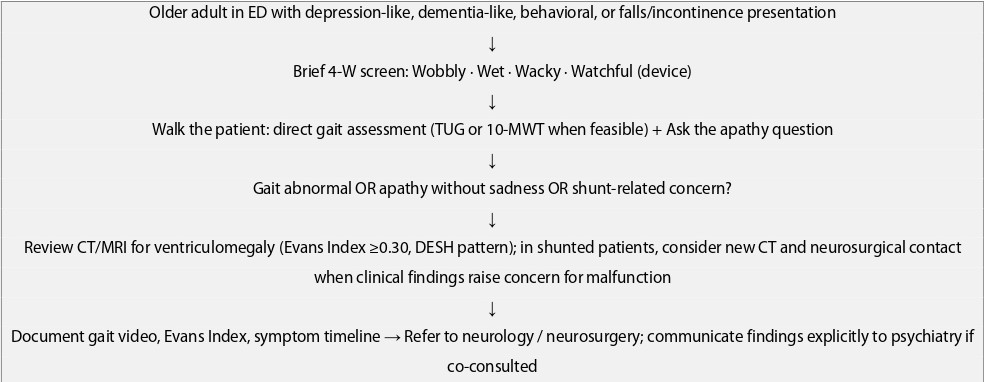
Figure 1. Integrated emergency pathway for neuropsychiatric presentations potentially related to iNPH. This pathway is an educational framework intended to support structured bedside reasoning; it is not a formal clinical guideline or validated protocol. TUG: Timed Up and Go; 10-MWT: 10-Meter Walk Test; DESH: Disproportionately Enlarged Subarachnoid-space Hydrocephalus. The pathway integrates psychiatric and structural reasoning rather than separating them.
Screen with intent
The classic mnemonic “Wobbly, Wet, Wacky” captures gait disturbance, urinary symptoms, and cognitive change but flattens the neuropsychiatric dimension. For a psychiatry-aware ED, I propose adding a fourth “W” — Watchful — to anchor explicit screening for apathy and, in shunted patients, for device-related distress (Table 4). The four-W screen is an expert-derived educational aid, not a validated diagnostic instrument: it has not been evaluated for sensitivity, specificity, or interrater reliability in any population. It is offered to prompt structured bedside observation and is not a substitute for formal neurological or psychiatric assessment.
|
Domain |
Bedside screen |
Psychiatric pitfall to consider |
|
Wobbly |
Walk patient 5–10 meters. Record TUG or 10-meter walk performance when feasible; note a wide base, short or magnetic steps, and multistep or en bloc turning. |
Slowed gait attributed to depression or medication; a supine-only examination misses motor signs. |
|
Wet |
New or worsening urgency, frequency, or incontinence within the past 1–2 years. |
Mislabeled as somatization, neglect, or recurrent UTI; obscured in patients with cognitive impairment. |
|
Wacky |
Apathy, psychomotor slowing, reduced initiation; ask caregiver about flat affect rather than sadness. |
Misread as depression, dementia, or normal aging; apathy lacks self-reported low mood. |
|
Watchful |
Shunted patients: ask explicitly about device-related anxiety, hypervigilance, and activity restriction. |
Distress dismissed as health anxiety; somatic complaints framed as functional rather than evaluated. |
|
TUG: Timed Up and Go test; UTI: Urinary Tract Infection. The screen integrates the classic iNPH triad with explicit attention to psychiatric pitfalls and to patients who already carry a ventricular shunt. It is an expert-derived educational aid that has not been prospectively validated and is not a diagnostic instrument. |
||
Walk the patient
Gait speed is an informative measure of health and function in older adults [17], and direct gait observation is central to iNPH assessment [24]. Have the patient rise from a chair, walk five to ten meters, turn, and sit down. Record Timed Up and Go (TUG) or 10-meter walk performance when feasible as an objective baseline; no single cutoff establishes iNPH. A broad-based, short-stepped or magnetic gait with multistep or en bloc turning should prompt consideration of iNPH [18,24]. Smartphone applications can quantify selected gait parameters, but the available validation derives from ambulatory, laboratory, and research settings; to my knowledge, none has been validated in an emergency department population or in patients with iNPH, and none has an established diagnostic threshold for this condition [19,20]. Such tools should therefore be regarded as optional adjuncts to direct clinical observation — used only where local workflow, device availability, and institutional privacy policy permit — rather than as a routine component of emergency assessment.
In the ED, the immediate task is not to establish a definitive diagnosis of iNPH. It is to identify time-sensitive alternatives and complications, document the pattern, and determine a safe disposition. Abrupt change should broaden the evaluation to delirium, stroke, subdural hematoma, infection, medication toxicity, and shunt malfunction; a slowly progressive triad without acute red flags more often supports expedited outpatient neurology or neurosurgery follow-up [11,24]. This distinction keeps a brief gait assessment clinically useful without allowing it to delay emergency stabilization or evaluation of more immediate threats.
Ask the apathy question
Most depression screens miss apathy. A targeted caregiver question reframes the inquiry: “Has your loved one stopped doing things they used to enjoy because they feel sad, or because they just don’t care anymore?” Sadness points toward depression; not caring points toward apathy and, in this context, toward iNPH or another frontal-subcortical process. Validated instruments such as the Apathy Evaluation Scale [21] or the caregiver-rated Neuropsychiatric Inventory [22] can support more formal assessment when time and informant access permit.
Read the scan correctly
When a head CT or MRI has been obtained, look for ventriculomegaly disproportionate to sulcal prominence, an Evans Index (the ratio of maximal frontal-horn width to maximal internal skull diameter) of 0.30 or greater, and the disproportionately enlarged subarachnoid-space hydrocephalus (DESH) pattern [23,24]. Documenting these findings, even when imaging was ordered for another indication, signals downstream clinicians that ventriculomegaly is being treated as a clinical entity, not background noise.
Refer with structure
Recognition is not diagnosis. The EP’s role is to identify the pattern, document objective findings (gait performance or video when appropriate, Evans Index, and a caregiver-corroborated symptom timeline), and refer to neurology or neurosurgery for confirmatory evaluation, which may include a cerebrospinal fluid tap test or external lumbar drainage [24]. The 2025 PENS trial — a multicenter randomized, double-blind, placebo-controlled trial of cerebrospinal fluid shunting in iNPH — found a between-group gait-velocity treatment difference of 0.21 m/s and greater Tinetti score improvement with active shunting at three months [25].
The Reverse Challenge: Shunted Patients in Psychiatric Crisis
As recognition and treatment of iNPH increase, emergency clinicians will encounter more patients living with programmable ventriculoperitoneal, ventriculoatrial, or lumboperitoneal shunts [24]. These patients may present to the ED with what looks like psychiatric crisis: acute anxiety, somatic hypervigilance, refusal of recommended revision, or activity restriction that families read as depression.
Three principles should guide the emergency evaluation. First, somatic vigilance after shunt placement may be understandable and adaptive. Patients live with a permanent intracranial device whose complications include obstruction, over-drainage, infection, and subdural fluid collections [24]. Their attentiveness to headache, gait change, or cognitive fluctuation should not be dismissed as pathological without appropriate clinical assessment.
Second, embodied knowledge deserves weight. A patient who insists that “something is different” about their gait or thinking may be reporting a real signal that a snapshot CT cannot capture. Prematurely attributing these concerns to “health anxiety” or “somatization” risks both clinical and ethical harm. By analogy, obligations described in the neural-device ethics literature may extend to patients living with cerebrospinal fluid shunts [26], alongside the broader case against testimonial dismissal of ill persons [27]. A more defensible response is: “Even though your scan today looks similar to last time, your experience matters. Let’s figure this out together.”
Third, treat psychiatric symptoms in shunted patients as a differential diagnosis, not a default. New-onset depression in a patient with a programmable valve may reflect over- or under-drainage, subdural hematoma, an unrelated organic process, or genuine major depression. The same is true for new anxiety, agitation, or psychosis. Depending on the clinical picture and local protocols, evaluation before psychiatric disposition may include non-contrast head CT, laboratory studies directed by the differential, confirmation of valve settings when possible, and neurosurgical contact when the presentation raises concern for device malfunction [24]. Neither imaging nor neurosurgical consultation is required for every shunted patient who presents with psychiatric symptoms; universal imaging is not supported by current evidence and is not feasible in many settings. The extent of evaluation should instead be determined by clinical suspicion, the patient’s neurological baseline and shunt history, the availability of prior imaging or valve settings for comparison, and institutional protocol.
Emergency findings that should prompt urgent neuroimaging and neurosurgical discussion include a reduced level of consciousness, severe or progressive headache with vomiting, fever or meningismus, erythema or tenderness along the shunt tract, a new focal neurologic deficit or seizure, and rapid recurrence of gait, cognitive, or continence symptoms [24]. When these features are absent and the patient is discharged, the ED record should document the neurologic and gait examination, comparison with prior imaging or valve settings when available, the follow-up plan, and explicit return precautions. Medical causes and device complications should be reasonably assessed before psychiatric transfer or before new symptoms are attributed primarily to anxiety or somatization.
Implementation in the Emergency-Psychiatry Interface
Three structural changes would meaningfully reduce iNPH misdiagnosis at the ED-psychiatry interface. None requires major capital investment.
- Add gait assessment to the geriatric psychiatric consultation pathway: Patients over 65 referred for ED psychiatric evaluation should have a documented gait observation when safely feasible, with video only when consent and institutional policy permit. This can be completed in minutes and creates an objective record that survives the encounter.
- Distinguish apathy from depression explicitly in screening tools: Adding a single caregiver-rated apathy item to existing PHQ-2/PHQ-9 workflows separates motivational from affective dysfunction — a distinction with direct etiological implications.
- Develop a shunt-aware ED protocol: Patients with intracranial devices who present with new psychiatric symptoms should be considered for device-related evaluation guided by clinical suspicion, institutional protocol, and neurosurgical consultation when indicated [24]. The protocol need not be elaborate; it must exist.
These interventions align with broader diagnostic-error literature and with an ethically informed device-care framework. By analogy to arguments about post-trial obligations for neural-device recipients, ongoing responsibilities to device-dependent patients may extend beyond procedural consent to respectful engagement with their lived experience [26,27]. They are also consistent with the broader project of geriatric emergency medicine, which has emphasized that depression, dementia, delirium, and reversible cognitive disorders must be considered together, not in sequence.
For emergency medicine, implementation also depends on reliable handoffs. If iNPH is suspected but admission is not otherwise indicated, the discharge summary should name the concern explicitly, record objective gait findings, identify the clinician or service responsible for follow-up, and avoid a vague instruction to “see your doctor.” When psychiatry and emergency medicine share the encounter, a joint disposition should state which acute medical causes were considered, what remains uncertain, and what change should trigger return to the ED.
Limitations
This article is a narrative commentary rather than a study of original clinical data, and it carries the attendant limitations. Several of its recommendations — including the four-W screen and the pathway summarized in Figure 1 — reflect expert opinion and synthesis of the existing literature rather than prospectively validated protocols. The proposed screening approach has not been tested in a controlled emergency-department population, so its diagnostic yield, feasibility within ED workflow, and effect on downstream outcomes remain to be established. Several statements — particularly those concerning the interpretation of somatic complaints in shunted patients and the sequencing of device evaluation — rest on expert opinion and ethical reasoning rather than on comparative clinical evidence. As a single-author commentary, the article reflects one clinical perspective, and the supporting literature was selected rather than systematically identified. Prospective validation of the four-W screen and the Figure 1 pathway across varied emergency settings — including assessment of diagnostic yield, interrater reliability, workflow burden, and downstream patient outcomes — is needed before either can be recommended as routine practice.
Conclusion
Idiopathic normal pressure hydrocephalus is fundamentally a neurological disorder — one that can present simultaneously with psychiatric, motor, and urological features in a single patient. The emergency physician who sees only the psychiatric face misses the structural disease underneath; the one who treats the gait and ignores the apathy misses the patient. The 2025 PENS trial has reaffirmed that selected patients improve meaningfully with shunting, and a contemporaneous meta-analysis has confirmed that apathy and depression are not peripheral but central to the iNPH experience. For older adults presenting to the ED with mood, behavior, or cognitive change, a brief gait assessment and a deliberate apathy question are practical, high-leverage interventions. For those already living with a shunt, trauma-informed listening is a clinically and ethically important component of care. Recognition is the work of one shift; the dignity it preserves can last years.
Declarations
Author contributions
The sole author is responsible for all aspects of this paper and agrees to the published version of the manuscript.
Funding
This research received no external funding.
Institutional review board statement
Institutional Review Board approval was not required because this paper did not involve human participants or animals.
Informed consent statement
Not applicable.
Data availability statement
No new data were created or analyzed in this study. Data sharing is not applicable to this article.
Conflicts of interest
The author declares no conflict of interest.
AI statement
AI tools were used only for grammar, spelling, and reference verification. The author reviewed and edited all content and takes full responsibility for the publication.
References
2. Williams MA, Malm J. Diagnosis and treatment of idiopathic normal pressure hydrocephalus. Continuum (Minneap Minn). 2016 Apr;22(2 Dementia):579–99.
3. Rosen H, Swigar ME. Depression and normal pressure hydrocephalus. A dilemma in neuropsychiatric differential diagnosis. J Nerv Ment Dis. 1976 Jul;163(1):35–40.
4. Belessiotis-Richards C, Brady E, Abrol E, Chance V, Joyce E, Toma A, et al. Neuropsychiatric Features in Patients With Idiopathic Normal Pressure Hydrocephalus: A Systematic Review and Meta-Analysis. Neurol Clin Pract. 2026 Apr;16(2):e200586.
5. Saldarriaga-Cantillo A, Yepes-Gaviria V, Rivas JC. Normal pressure hydrocephalus: diagnostic delay. Biomedica. 2020 Dec 2;40(4):656–63.
6. Iserson KV. Emergency physicians’ ethical duty to patients with undiagnosed idiopathic normal pressure hydrocephalus. J Emerg Med. 2026 May;84:102–13.
7. Bubenikova A, Procházka V, Vacínek D, Haratek K, Skalický P, Laczó M, et al. From the past to the present: evolving theories in the pathophysiology of normal pressure hydrocephalus. J Neurol Neurosurg Psychiatry. 2026 Jan 13;97(2):129–45.
8. Horáková, H., Vyhnálek, M., Tegelová, V. Cognitive and Neuropsychiatric Features of Idiopathic Normal Pressure Hydrocephalus. In: Bradac, O. (eds) Normal Pressure Hydrocephalus. Springer, Cham. 2023:169–95.
9. Kito Y, Kazui H, Kubo Y, Yoshida T, Takaya M, Wada T, et al. Neuropsychiatric symptoms in patients with idiopathic normal pressure hydrocephalus. Behav Neurol. 2009;21(3):165–74.
10. Jaraj D, Rabiei K, Marlow T, Jensen C, Skoog I, Wikkelsø C. Prevalence of idiopathic normal-pressure hydrocephalus. Neurology. 2014 Apr 22;82(16):1449–54.
11. Carswell C. Idiopathic normal pressure hydrocephalus: historical context and a contemporary guide. Pract Neurol. 2023 Feb;23(1):15–22.
12. Croskerry P. The importance of cognitive errors in diagnosis and strategies to minimize them. Acad Med. 2003 Aug;78(8):775–80.
13. Croskerry P. Cognitive forcing strategies in clinical decisionmaking. Ann Emerg Med. 2003 Jan;41(1):110–20.
14. Harada Y, Kawamura R, Yokose M, Singh H, Shimizu T. Atypical Presentations at Risk for Diagnostic Errors in Internal Medicine: A Scoping Review. J Gen Intern Med. 2026 May;41(7):1937-56.
15. Salih A, Arif A, Varadpande M, Fernandes RT, Jankovic D, Kalasauskas D, et al. The effectiveness of various CSF diversion surgeries in idiopathic normal pressure hydrocephalus: a systematic review and meta-analysis. EClinicalMedicine. 2024 Oct 30;77:102891.
16. Ayalon L, Tesch-Romer C. Contemporary Perspectives on Ageism. Berlin: Springer Cham; 2018.
17. Studenski S, Perera S, Patel K, Rosano C, Faulkner K, Inzitari M, et al. Gait speed and survival in older adults. JAMA. 2011 Jan 5;305(1):50–8.
18. Hulleck AA, Menoth Mohan D, Abdallah N, El Rich M, Khalaf K. Present and future of gait assessment in clinical practice: towards the application of novel trends and technologies. Front Med Technol. 2022 Dec 16;4:901331.
19. Brognara L. Gait assessment using smartphone applications in older adults: a scoping review. Geriatrics (Basel). 2024 Jul 18;9(4):95.
20. Werner C, Hezel N, Dongus F, Spielmann J, Mayer J, Becker C, et al. Validity and reliability of the Apple Health app on iPhone for measuring gait parameters in children, adults, and seniors. Sci Rep. 2023 Apr 1;13(1):5350.
21. Marin RS, Biedrzycki RC, Firinciogullari S. Reliability and validity of the Apathy Evaluation Scale. Psychiatry Res. 1991 Aug;38(2):143–62.
22. Cummings JL, Mega M, Gray K, Rosenberg-Thompson S, Carusi DA, Gornbein J. The Neuropsychiatric Inventory: comprehensive assessment of psychopathology in dementia. Neurology. 1994 Dec;44(12):2308–14.
23. Evans WA. An encephalographic ratio for estimating ventricular enlargement and cerebral atrophy. Arch Neurol Psychiatry. 1942 Jun 1;47(6):931–7.
24. Nakajima M, Yamada S, Miyajima M, Ishii K, Kuriyama N, Kazui H, et al. Guidelines for management of idiopathic normal pressure hydrocephalus (third edition): endorsed by the Japanese Society of Normal Pressure Hydrocephalus. Neurol Med Chir (Tokyo). 2021;61(2):63–97.
25. Luciano MG, Williams MA, Hamilton MG, Katzen HL, Dasher NA, Moghekar A, et al; PENS Trial Investigators and the Adult Hydrocephalus Clinical Research Network. A randomized trial of shunting for idiopathic normal-pressure hydrocephalus. N Engl J Med. 2025 Dec 4;393(22):2198–209.
26. Goering S, Brown AI, Klein E. Brain pioneers and moral entanglement: an argument for post-trial responsibilities in neural-device trials. Hastings Cent Rep. 2024 Jan;54(1):24–33.
27. Carel H, Kidd IJ. Epistemic injustice in healthcare: a philosophical analysis. Med Health Care Philos. 2014 Nov;17(4):529–40.