

Image Article Open Access
Volume 1 | Issue 1 | DOI: https://doi.org/10.46439/toxicology.1.002
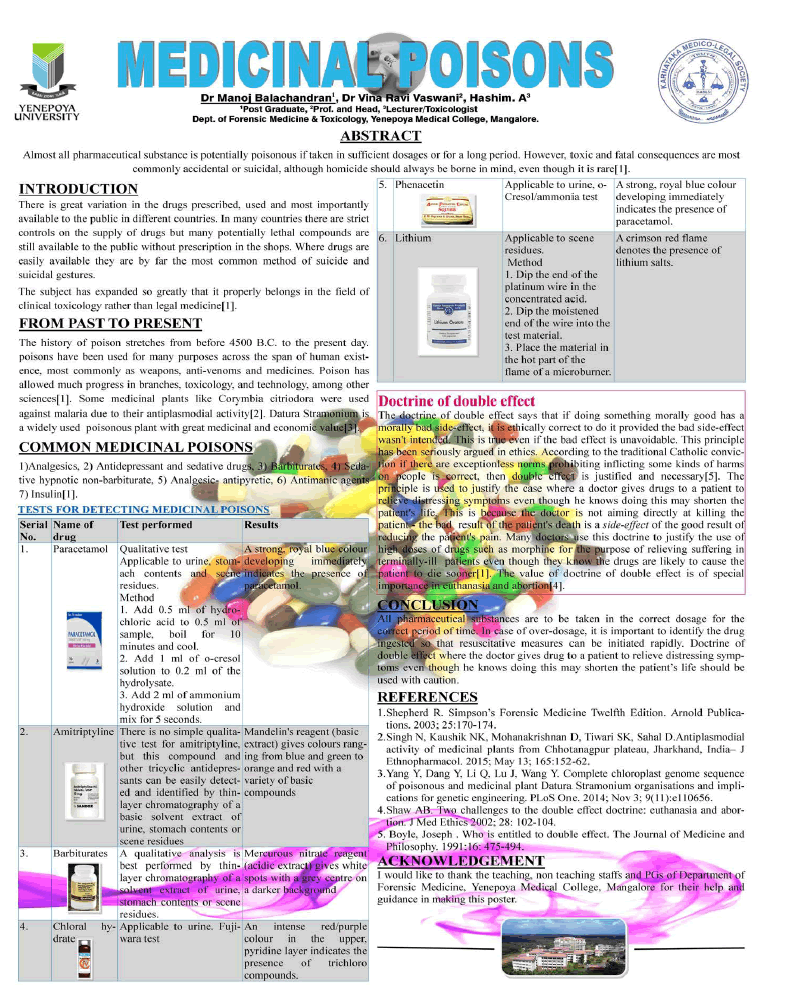
Medicinal Poisons
Manoj Balachandran1,*, Vina Ravi Vaswani1, Hashim A1
- 1Department of Forensic Medicine & Toxicology, Yenapoya Medical College, Manglore, Karnataka, India
*Corresponding Author
Manoj Balachandran, Manoj Balachandran; bmanoj7@yahoo.co.in
Received Date: September 05, 2019
Accepted Date: October 04, 2019
Manoj Balachandran, Vina Ravi Vaswani, Hashim A. Medical Poisons. Arch Clin Toxicol. 2019;1(1):3.
Copyright © 2019 Balachandran M, et al.. This is an open-access article distributed under the terms of the Creative Commons Attribution License, which permits unrestricted use, distribution, and reproduction in any medium, provided the original author and source are credited.
Image Article
Recommended Articles
Association between resilience promotion factors during childhood and risk of drug use disorder during adulthood
Few studies have been conducted on the relationship between “outside-residing” resilience characteristics and the risk of developing drug use disorder later in life. These characteristics include responsive and caring parenting, household routines involving regular family meals and bedtime routines, social support from peers, participation in organized activities, and religious service attendance.
Drug delivery via the upper nasal space: A novel route for anesthesiologists, intensivists and emergency department physicians?
Many drugs are effective systemically, but slow onset of non-intravenous routes of administration may limit their clinical utility. While anesthesiologists usually have intravenous (IV) access for drug delivery, other healthcare professionals in less controlled situations such as acute crises in the emergency room, critical care settings, or urgent needs in the community, may need non-invasive drug delivery [1].
Beyond toxicology: Aryl hydrogen receptor role in physiology
Aryl hydrocarbon receptor (AHR) was initially discovered as a cellular protein involved in the detoxification of xenobiotic compounds. Recently, Kou and Dai [1] wrote a concise review on AHR, summarizing advances in several important areas of mammalian physiology including cardiovascular, gastrointestinal, integumentary, nervous, and immunomodulatory systems. Given the importance of AHR and our increased understanding of its physiological roles, it is necessary to highlight a few key aspects of AhR in normal development and metabolic homeostasis that have not been extensively discussed.
Anesthetic drugs: a comprehensive overview for anesthesiologists
The purpose of this document is to provide a unique white paper on the use of different anesthetic drugs and the key clinical pearls for ensuring patient safety in humans. This paper is designed to be a convenient guide that can be placed in work rooms for residents and medical school trainees to improve their learning and to provide reminders about drug-drug interactions.
Overcrowding modulates the response of adolescents to psychoactive drugs
Overcrowding is a growing problem that prevails in the urban areas of both developing and developed countries. It is considered as psycho-social stress that affects the behavior and physiology of individuals and societies [1].
Scientific awareness of overcrowding stress systematically started in the 1960s with the early experiments of John B. Calhoun using the so-called “rat utopia” and the theory of “behavioral sink” [2]. Depending on Calhoun’s experiments, connections between the model of rodent colonies and the arising problems of crowded cities were extrapolated [3].