

Abstract
Cancer is increasingly recognized as a systems-level disease in which genetic alterations interact with metabolic, epigenetic, transcriptional, post-transcriptional, and microenvironmental regulatory networks. Nicotinamide adenine dinucleotide (NAD+) represents an important metabolic interface within these networks because it functions as both a redox cofactor and a substrate for enzymes involved in DNA repair, chromatin regulation, and cellular stress responses. NAD+ availability influences poly (ADP-ribose) polymerases (PARPs) and NAD+-dependent sirtuins, thereby linking cellular metabolic state with genome maintenance and epigenetic regulation. Emerging evidence also suggests potential connections between NAD+ metabolism and RNA regulation, including NAD-capped RNA, although the functional significance of these mechanisms in mammalian cancer remains incompletely established. Here, we examine the interactions among NAD+ metabolism, PARP and sirtuin activity, chromatin regulation, mitochondrial stress, RNA regulation, and cellular senescence in cancer. We propose an integrative framework in which NAD+ functions as a metabolic interface linking cellular energy state with genome maintenance, epigenetic regulation, and post-transcriptional RNA control. Rather than considering NAD+ depletion as a universal driver of cancer or senescence, we propose that changes in NAD+ availability may modify cellular responses according to the nature and duration of cellular stress. This hypothesis-generating framework identifies testable relationships among NAD+ metabolism, chromatin state, RNA regulation, and cellular phenotype, while distinguishing established mechanisms from those requiring further experimental validation.
Keywords
NAD+, Cancer metabolism, Epigenetic regulation, RNA stability, RNA regulation, PARP, Sirtuins, Cellular senescence, Metabolic stress, Systems biology
Graphical Abstract
The proposed metabolic–epigenetic–RNA regulatory coupling mechanism is illustrated in Figure 1.
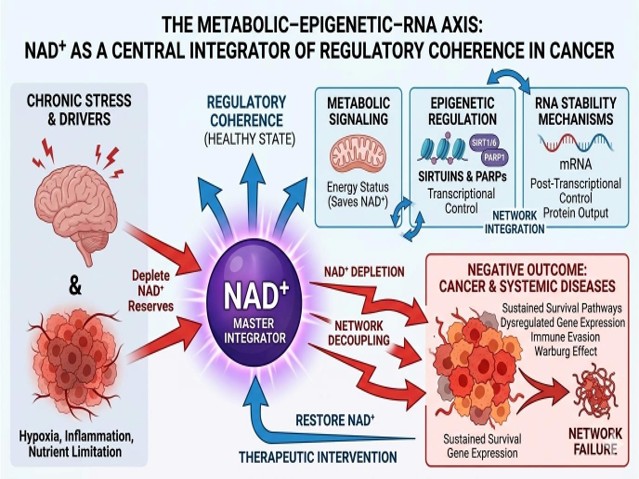
Figure 1. Systems-Level Framework of Regulatory Coherence in Cancer. (Left) Cellular and tumor-microenvironmental pressures, including hypoxia, acidosis, nutrient stress, genotoxic stress, and inflammation, alter NAD+ homeostasis. (Center) NAD+ functions as a metabolic interface connecting redox state and metabolic demand with PARP- and sirtuin-dependent regulatory processes. (Right) Context-dependent NAD+ perturbation may modify DNA repair, chromatin regulation, RNA control, and cellular phenotypes. The framework is intended as a hypothesis-generating model rather than a universal linear pathway.
Introduction
Cancer is a systems-level disease in which genetic alterations interact with metabolic, epigenetic, transcriptional, and post-transcriptional mechanisms to shape tumor-cell behavior. Metabolic reprogramming is a central component of this process, enabling cancer cells to adapt to nutrient limitation, hypoxia, inflammation, and therapeutic stress [1,2]. Nicotinamide adenine dinucleotide (NAD+) is a key metabolic cofactor that also serves as a substrate for enzymes involved in DNA repair and chromatin regulation, particularly poly (ADP-ribose) polymerases (PARPs) and sirtuins. Consequently, changes in NAD+ availability can influence genome maintenance, chromatin regulation, and cellular stress responses. These effects depend on cellular context, NAD+ compartmentalization, and the balance between NAD+ synthesis and consumption [3].
PARP-mediated NAD+ consumption provides a direct metabolic link between DNA damage and NAD+ homeostasis, whereas NAD+-dependent sirtuins connect metabolic state with chromatin regulation and DNA repair. Thus, NAD+ availability may influence several regulatory processes simultaneously rather than functioning solely as a redox metabolite [3]. The effects of metabolic state also extend to post-transcriptional gene regulation. RNA stability, processing, modification, and translation strongly influence cellular phenotype, and increasing evidence indicates extensive interactions between metabolism and RNA regulation. NAD+-capped RNA provides a potential direct connection between NAD+ metabolism and RNA biology, although robust functional evidence in mammalian tumor systems remains limited; however, its distribution and functional significance in mammalian cells remain incompletely defined [4]. Therefore, NAD+-RNA coupling should currently be regarded as an emerging mechanism rather than an established general regulator of RNA stability. Cellular senescence represents an additional context in which metabolic, genomic, epigenetic, and inflammatory pathways converge. Senescence is characterized by stable cell-cycle arrest, persistent stress signaling, metabolic alterations, chromatin remodeling, and, in many settings, acquisition of the senescence-associated secretory phenotype (SASP). Importantly, senescence is heterogeneous and depends on the initiating stress and cellular context [5]. The relationship between NAD+ metabolism and senescence is therefore unlikely to be linear; altered NAD+ availability may instead modify DNA-damage responses, chromatin regulation, and mitochondrial stress pathways according to cellular conditions [3]. Here, we examine the potential coupling among NAD+ metabolism, epigenetic regulation, and post-transcriptional RNA control in cancer. We propose that NAD+ availability may act as a metabolic variable connecting these regulatory layers, while emphasizing that the strength and direction of these interactions remain context-dependent. Rather than proposing NAD+ depletion as a universal cause of cancer or senescence, we develop a testable framework linking NAD+ homeostasis with chromatin state, RNA regulation, and cellular phenotype. This framework highlights experimentally testable questions concerning whether alterations in NAD+ metabolism are accompanied by coordinated changes in epigenetic and RNA regulatory states, and whether manipulating NAD+ metabolism can modify these states in cancer cells.
Theoretical Background
Cellular phenotype is determined by the interaction of multiple regulatory layers rather than by genomic information alone. Genetic alterations interact with metabolic state, chromatin organization, transcriptional regulation, RNA processing, and extracellular signaling to determine cellular behavior [1,2,6]. Systems biology has therefore increasingly emphasized the organization of cellular processes as interconnected regulatory networks in which perturbation of one layer can propagate to others. Metabolic changes, for example, can modify the availability of cofactors and substrates required for chromatin-modifying enzymes, while signaling pathways can simultaneously influence transcription and post-transcriptional RNA regulation [3,7–9]. This network perspective is particularly relevant to cancer because malignant cells must continuously adapt to fluctuations in nutrient availability, oxygen tension, inflammatory signaling, and therapeutic pressure. Such adaptation involves coordinated changes in metabolism, gene regulation, and cellular stress responses rather than isolated alterations in individual pathways [1,2].
This context dependence is particularly important in cancer, where NAD+ metabolism can be simultaneously affected by increased metabolic demand, DNA damage, oxidative stress, and altered expression of NAD+ biosynthetic or consuming enzymes. Gene-expression regulation does not terminate at transcription. RNA processing, RNA modification, RNA stability, localization, and translation constitute additional regulatory layers that determine the amount, timing, and localization of proteins produced by individual transcripts [10]. RNA-binding proteins and RNA-modifying enzymes can respond to cellular stress and metabolic conditions, thereby altering the stability or translational efficiency of specific transcript populations. These mechanisms allow cells to modify protein production more rapidly than would be possible through transcriptional remodeling alone. The existence of metabolically responsive RNA modifications provides an additional conceptual connection between metabolism and post-transcriptional regulation. Among these modifications, NAD+-capped RNA represents a particularly intriguing example because NAD+ can be incorporated as a non-canonical RNA cap during transcription [4,11]. However, the functional significance of NAD+-capped RNA in mammalian cells remains incompletely characterized. Current evidence therefore supports its consideration as a potential metabolic–RNA interface rather than as an established universal mechanism controlling RNA stability in cancer [4]. Based on these observations, we propose that NAD+ metabolism may provide a point of convergence between metabolic state, epigenetic regulation, and post-transcriptional RNA control. In this proposed model, cellular stress can alter NAD+ availability through changes in metabolic demand, DNA-damage signaling, and NAD+ consumption. Changes in NAD+ availability may subsequently influence NAD+-dependent enzymes involved in genome maintenance and chromatin regulation, while metabolic changes occurring in parallel may influence RNA-processing and RNA-stability pathways [3]. The resulting changes at the chromatin and RNA levels could reinforce one another by altering the expression and persistence of regulatory proteins, metabolic enzymes, and stress-response mediators. Such interactions could contribute to the persistence of altered cellular states under chronic metabolic or inflammatory stress. The proposed model is therefore not based on a single linear pathway:
NAD+ depletion → epigenetic change → cancer.
Instead, we propose a bidirectional regulatory network in which NAD+ metabolism, chromatin regulation, RNA control, and cellular signaling influence one another dynamically. Cellular senescence provides a useful biological context in which metabolic, genomic, epigenetic, and inflammatory mechanisms converge. Senescent cells generally exhibit stable cell-cycle arrest accompanied by changes in chromatin organization, metabolism, mitochondrial function, and inflammatory signaling [5,12].
The senescence-associated secretory phenotype further illustrates how a persistent cellular state can influence the surrounding tissue through the release of cytokines, chemokines, growth factors, and other extracellular mediators [12]. NAD+ metabolism may intersect with senescence through its established roles in DNA repair, chromatin regulation, mitochondrial function, and cellular stress responses. Nevertheless, NAD+ depletion should not be regarded as a universal initiating mechanism of senescence because senescence can arise through multiple molecular routes and exhibits substantial context dependence [3,5]. We therefore propose that NAD+ availability may act as a metabolic constraint or modulator of senescence-associated responses rather than as a single upstream trigger. Cancer cells frequently display simultaneous alterations in metabolism, chromatin organization, transcription, RNA regulation, and stress-response signaling. These alterations can generate stable cellular phenotypes that persist even when individual environmental stimuli fluctuate [1,2]. From this perspective, malignant progression can be viewed as the emergence and stabilization of alternative regulatory states within a highly interconnected cellular network. Genetic alterations remain central to this process, but their phenotypic consequences are shaped by metabolic and regulatory context [1]. The present framework therefore does not replace the genetic model of cancer. Instead, it proposes that genetic alterations and metabolic–epigenetic–RNA regulation should be considered interacting components of the same biological system.
The proposed framework generates several experimentally testable predictions. First, experiments should distinguish total NAD+ abundance from the NAD+/NADH redox state and from compartment-specific NAD+ pools, because these variables may change independently. Second, perturbation of NAD+ synthesis or consumption should be accompanied by measurement of PARP and sirtuin activity, DNA-damage responses, and defined chromatin features rather than inferred from total NAD+ measurements alone. Third, the same perturbations should be assessed for effects on RNA processing, RNA stability, and, where technically feasible, NAD+-capped RNA abundance or turnover. Fourth, experiments should compare proliferating, metabolically stressed, and senescent cancer cells to determine whether the direction and magnitude of the response are context dependent. Finally, rescue experiments that restore NAD+ availability, alter NAD+-consuming enzyme activity, or selectively modify the relevant metabolic compartment could help distinguish causal relationships from correlated responses.
These predictions provide a framework for experimentally evaluating whether NAD+ functions primarily as a metabolic substrate within these pathways or whether its regulation contributes more broadly to the coordination of metabolic, epigenetic, and post-transcriptional cellular responses.
Cellular Regulatory Integration: An Integrated Regulatory Network
The regulation of cellular phenotype can be conceptualized as an integrated process in which multiple molecular inputs converge on interconnected regulatory networks before generating a measurable biological output. These inputs include metabolic substrates, intracellular energy status, DNA-damage signals, cytokines, hormones, redox changes, and extracellular environmental cues [1,7]. In engineering and systems biology, a black-box model describes a system whose internal operations may be complex, while its inputs and outputs can be experimentally measured. Applied to cellular regulation, this concept does not imply cognition or consciousness. Rather, it provides a functional representation of how heterogeneous molecular signals can converge through regulatory networks to produce context-dependent cellular states. Within this framework, NAD+ occupies a potentially important position because its availability is simultaneously influenced by metabolic activity and NAD+-consuming enzymes, while also affecting the activity of NAD+-dependent regulatory proteins [3]. Consequently, changes in NAD+ availability may alter several downstream processes without requiring a single linear signaling pathway. The proposed black-box model therefore consists of three functional layers. The first layer represents inputs, including metabolic stress, DNA damage, inflammatory signals, hypoxia, and neuroendocrine signaling. The second layer represents regulatory integration, involving NAD+ metabolism, PARP activity, sirtuin-dependent regulation, chromatin remodeling, transcriptional responses, and RNA-processing mechanisms. The third layer represents cellular outputs, including proliferation, metabolic adaptation, inflammatory signaling, senescence-associated phenotypes, and survival or cell-death responses [1,3]. This organization provides a mechanistic interpretation of regulatory coherence. Under physiological conditions, multiple regulatory pathways remain dynamically coordinated, allowing cells to adapt to changes in their environment while maintaining functional stability. Under persistent metabolic or genotoxic stress, however, simultaneous perturbation of several regulatory layers may stabilize an altered cellular state. Importantly, the proposed model does not assume that NAD+ is the sole determinant of this state. Instead, NAD+ is proposed as one metabolic variable capable of connecting several regulatory processes that are otherwise frequently studied independently. The model also predicts that disruption at one regulatory layer may propagate to other layers. For example, DNA damage can increase PARP-dependent NAD+ consumption, altered NAD+ availability can influence NAD+-dependent chromatin regulation, and metabolic or stress-associated changes can subsequently modify RNA-processing and translational programs [3,4]. The resulting phenotype would therefore emerge from network interactions rather than from a single molecular event.
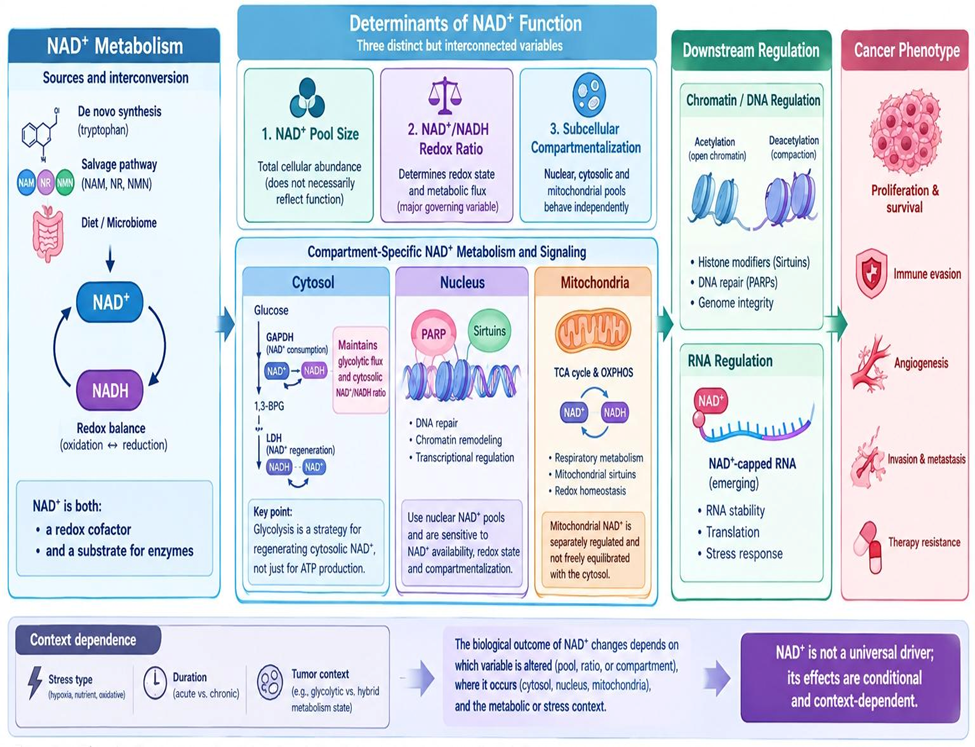
Figure 2. NAD+ pool, redox state, and compartmentalization as determinants of cancer-cell regulation. NAD+ functions both as a redox cofactor and as a substrate for NAD+-dependent enzymes. Importantly, total NAD+ abundance, the NAD+/NADH redox ratio, and subcellular NAD+ pools represent distinct but interconnected variables. In the cytosol, NAD+ regeneration through glycolytic and lactate-producing reactions supports continued glycolytic flux, whereas nuclear and mitochondrial NAD+ pools contribute to PARP- and sirtuin-dependent regulation and mitochondrial metabolism. These compartment-specific metabolic signals can influence DNA repair, chromatin regulation, and emerging RNA regulatory pathways, ultimately shaping cancer-cell phenotypes. The framework proposes that the biological consequences of NAD+ perturbation depend on which NAD+ variable changes, where the change occurs, and the metabolic or stress context, rather than on total NAD+ abundance alone.
Proposed Regulatory Architecture
We propose the following conceptual sequence
Environmental and cellular stress → metabolic perturbation → altered NAD+ availability → modulation of NAD+-dependent regulatory enzymes → chromatin and transcriptional changes → RNA-level regulation → altered cellular phenotype. This sequence should not be interpreted as a strictly unidirectional pathway. Feedback mechanisms are expected to operate between the different layers, particularly because transcriptional and post-transcriptional changes can themselves alter metabolic demand and the expression of enzymes involved in NAD+ synthesis and consumption. The resulting network can therefore be represented as a dynamic system:
Stress inputs ↔ NAD+ metabolism ↔ epigenetic regulation ↔ RNA regulation ↔ cellular phenotype.
This formulation generates a testable hypothesis: persistent alterations in NAD+ homeostasis may be associated with coordinated changes across epigenetic and RNA regulatory layers, and the magnitude of these changes should depend on cellular context. Such a hypothesis can be experimentally evaluated by simultaneously measuring intracellular NAD+ concentrations, NAD+-consuming enzyme activity, chromatin-associated modifications, transcriptomic changes, RNA stability, and cellular phenotypes under defined stress conditions.
Why this model matters for cancer
Cancer cells frequently experience simultaneous metabolic, genotoxic, oxidative, and inflammatory stress. Rather than responding to each stimulus independently, malignant cells integrate these signals through interconnected regulatory networks that determine whether the cell proliferates, adapts, enters senescence, or undergoes cell death [1,7]. The proposed framework therefore places NAD+ metabolism within a broader regulatory architecture rather than treating it as an isolated metabolic pathway. If experimentally validated, this framework could provide a mechanistic explanation for how metabolic disturbances become coupled to persistent changes in chromatin and RNA regulation during tumor evolution. It may also provide a rationale for therapeutic strategies that target regulatory states rather than individual molecular lesions. However, whether manipulation of NAD+ metabolism can restore such regulatory coordination remains an empirical question and requires experimental validation.
Preclinical and Translational Implications of NAD+ Targeting in Cancer
NAD+ metabolism is already being investigated as a therapeutic vulnerability in cancer, particularly through inhibition of the NAD+ salvage enzyme nicotinamide phosphoribosyltransferase (NAMPT). NAMPT inhibitors have produced substantial antitumor effects in multiple preclinical models, but early clinical development has been limited by toxicity and modest efficacy. One explanation is that tumor cells can engage alternative NAD+-biosynthetic routes, including the Preiss–Handler pathway, allowing partial restoration of NAD+ despite NAMPT inhibition. These observations support the central premise of the present framework: the biological response to NAD+ perturbation depends on metabolic context, pathway redundancy, and the ability of tumor cells to redistribute or regenerate NAD+ rather than on total NAD+ abundance alone [13,14].
The translational implications therefore extend beyond a simple strategy of either increasing or decreasing NAD+. Potential approaches include selective inhibition of NAD+ biosynthesis, combination strategies designed to overcome compensatory pathways, and biomarker-guided identification of tumors that are particularly dependent on specific NAD+-producing or NAD+-consuming enzymes. Preclinical studies also support investigating NAMPT-targeted approaches in genetically or metabolically defined tumor contexts. At present, however, these strategies remain investigational in oncology, and the clinical experience with NAD+-targeting agents does not establish a broadly effective therapeutic approach. The proposed metabolic–epigenetic–RNA framework may therefore be useful as a basis for selecting measurable biomarkers—such as NAD+/NADH state, compartment-specific NAD+ availability, PARP/sirtuin activity, chromatin changes, and RNA-regulatory phenotypes—for future translational studies [13,14].
NAD+–Epigenetic–RNA Regulatory Coupling
NAD+ metabolism occupies a distinctive position at the intersection of cellular metabolism, genome maintenance, and gene regulation. Unlike metabolites that primarily participate in energy production, NAD+ also serves as a substrate for regulatory enzymes whose activities directly influence DNA repair, chromatin organization, and cellular stress responses [3]. The intracellular NAD+ pool is continuously maintained through coordinated biosynthetic and salvage pathways while being consumed by NAD+-dependent enzymes. Consequently, the cellular effects of NAD+ availability depend not only on its absolute concentration but also on the balance between synthesis, recycling, compartmentalization, and enzymatic consumption [3]. One of the most direct connections between NAD+ metabolism and genome regulation is mediated by PARP enzymes. DNA damage activates PARP-dependent signaling and can substantially increase NAD+ consumption. This creates a direct biochemical connection between the cellular response to genomic damage and metabolic state [3]. The same metabolite also regulates sirtuin activity. Sirtuins are NAD+-dependent enzymes involved in chromatin regulation, DNA repair, transcriptional control, mitochondrial function, and metabolic adaptation. Changes in NAD+ availability can therefore modify the activity of several regulatory processes simultaneously rather than affecting a single downstream pathway [3]. This relationship provides a mechanistic basis for coupling metabolic state to epigenetic regulation. When NAD+ availability changes, the activity of NAD+-dependent chromatin regulators may change accordingly, potentially modifying histone acetylation, chromatin accessibility, and transcriptional responses. However, these effects remain highly context dependent and should not be interpreted as a universal consequence of NAD+ depletion [3]. The connection between NAD+ metabolism and genome maintenance is further supported by experimental evidence demonstrating that NAD+ availability participates in nucleotide metabolism and genomic DNA replication. These findings indicate that NAD+ homeostasis can influence genome stability through mechanisms extending beyond its classical role in cellular redox reactions [15].
From Epigenetic Regulation to RNA Control
The consequences of metabolic and epigenetic alterations ultimately extend to the transcriptome. Cellular phenotype is determined not only by which genes are transcribed but also by how transcripts are processed, modified, stabilized, transported, and translated [10]. RNA-binding proteins, RNA-modifying enzymes, and RNA-decay pathways allow cells to rapidly alter protein production in response to environmental and intracellular stress. These mechanisms provide an additional regulatory layer between transcription and cellular phenotype. This raises an important question for NAD+ biology: can changes in NAD+ metabolism influence RNA regulation directly, in addition to their effects on chromatin and transcription?
The discovery of NAD+-capped RNA provides a potentially important molecular connection. NAD+ can function as a non-canonical RNA cap, demonstrating that a metabolite traditionally associated with cellular metabolism can also become physically incorporated into RNA molecules [11]. Subsequent studies have expanded the characterization of NAD+-capped RNA, including evidence for its occurrence in human cells [16], but robust functional evidence establishing a causal role for NAD+-capped RNA in mammalian tumor systems remains very limited. Recent reviews therefore identify NAD+-capped RNA as an emerging and relatively unexplored area of RNA biology rather than an established general mechanism of post-transcriptional regulation [4]. This distinction is critical for the present model. We do not propose that NAD+-capped RNA has already been demonstrated to control cancer-cell phenotype. Instead, we propose that it represents one plausible molecular interface through which metabolic state could potentially influence RNA regulation.
A Three-Layer Regulatory Model
The available evidence supports a conceptual model consisting of three interconnected regulatory layers:
Layer 1 — Metabolic state: NAD+ availability reflects the balance between biosynthesis, salvage, metabolic demand, and enzymatic consumption [3].
Layer 2 — Epigenetic and genomic regulation: NAD+ availability influences NAD+-dependent enzymes involved in DNA repair and chromatin regulation, including PARPs and sirtuins [3].
Layer 3 — RNA regulation: Metabolic and transcriptional changes are translated into changes in RNA processing, stability, modification, and translation, while NAD+-capped RNA provides a potential direct connection between NAD+ metabolism and RNA biology, although robust functional evidence in mammalian tumor systems remains limited [4,11]. The central proposition of this Perspective is that these layers should not be considered independent. Instead, they may form a coupled regulatory network in which perturbation of NAD+ metabolism propagates across chromatin and RNA regulatory processes.
The Proposed Coupling Mechanism
We therefore propose the following model:
Metabolic or genotoxic stress → altered NAD+ homeostasis → altered PARP/sirtuin activity → changes in genome maintenance and chromatin regulation → altered transcriptional output → changes in RNA processing/stability/translation → persistent cellular phenotype. A parallel pathway may involve direct effects of NAD+ metabolism on RNA through NAD+-capped transcripts:
NAD+ availability → NAD+-RNA capping → altered RNA fate → altered protein expression. The second pathway remains considerably less established than the first and should therefore be regarded as a hypothesis-generating component of the model rather than a demonstrated mechanism. Importantly, the proposed network is bidirectional rather than linear. Changes in gene expression can alter the abundance of NAD+-biosynthetic and NAD+-consuming enzymes, while changes in RNA stability can modify the expression of metabolic regulators. Thus, cellular metabolism and gene regulation may participate in reciprocal feedback loops that stabilize particular cellular states.
Relevance to Cancer
Cancer cells are exposed to persistent metabolic and genotoxic pressures that can simultaneously affect NAD+ metabolism, DNA repair, chromatin organization, and RNA regulation. These pressures occur within a tumor microenvironment characterized by altered nutrient availability, hypoxia, oxidative stress, inflammation, and competition between tumor and immune cells [1,7]. Under these conditions, the consequences of altered NAD+ homeostasis may extend beyond energy metabolism. Changes in NAD+ availability could influence DNA-repair capacity, chromatin regulation, and stress-responsive transcription while interacting with downstream RNA regulatory mechanisms. We therefore propose that NAD+-centered metabolic–epigenetic–RNA coupling may represent one component of the regulatory architecture that enables cancer cells to maintain adaptive phenotypes under chronic stress. This proposition does not imply that NAD+ dysregulation is sufficient to produce malignant transformation. Rather, NAD+ metabolism is proposed as a regulatory node that may modify the phenotypic consequences of genetic and environmental alterations already present within cancer cells.
Limitations
Several limitations should be considered when interpreting this framework. First, NAD+ metabolism is highly heterogeneous across tumor types, cellular states, and subcellular compartments, so findings obtained in one model may not generalize to other cancers. Second, total cellular NAD+ measurements do not necessarily resolve compartment-specific pools or the NAD+/NADH redox state, which may obscure biologically important changes. Third, most links among NAD+ metabolism, chromatin regulation, and RNA control remain associative when considered across different experimental systems; the present framework therefore does not establish a single causal pathway. Fourth, functional evidence for NAD+-capped RNA in mammalian tumor systems remains limited, and this component should be regarded as hypothesis generating. Finally, preclinical responses to NAD+-targeting interventions cannot be assumed to translate directly into clinical benefit because toxicity, metabolic compensation, tumor heterogeneity, and pharmacological context may alter therapeutic responses. These limitations define the principal experimental requirements for testing the proposed model.
Discussion
The evidence reviewed here supports a functional relationship between NAD+ metabolism, epigenetic regulation, and post-transcriptional RNA control in cancer, but the strength and direction of these interactions are highly context dependent. NAD+ should therefore not be considered a universal upstream regulator of cancer biology. Rather, its cellular availability represents a metabolic variable that can influence multiple NAD+-dependent processes according to tissue context, subcellular compartment, metabolic demand, and rates of NAD+ synthesis and consumption [3,17]. The most firmly established connections involve NAD+ consumption by PARPs and the activity of NAD+-dependent sirtuins. PARP activation following DNA damage can substantially increase NAD+ consumption, linking DNA-repair activity to cellular metabolic state. Conversely, NAD+ availability is required for sirtuin-mediated deacylation reactions involved in chromatin regulation, DNA repair, and metabolic adaptation [3,14]. These mechanisms provide a plausible biochemical basis for coupling metabolic status with genome maintenance and epigenetic regulation. However, the biological consequences of altered NAD+ availability are not necessarily uniform, because NAD+ metabolism and the expression of its consuming enzymes differ among cancer types and cellular states [3]. The relationship between NAD+ metabolism and RNA regulation is potentially important but remains less well established. Cellular metabolism can influence RNA modification, processing, stability, and translation, establishing a broader connection between metabolic state and post-transcriptional gene regulation. The identification of NAD+-capped RNA provides a direct biochemical link between NAD+ and RNA biology; however, the distribution, regulation, and functional significance of NAD+-capped transcripts in mammalian cells remain incompletely defined [4]. Accordingly, the present framework does not assume that NAD+ availability directly determines global RNA stability or translation. Instead, it identifies NAD+-RNA coupling as an emerging regulatory interface that requires mechanistic validation. Cellular senescence further illustrates the context dependence of NAD+ biology. Senescence involves coordinated changes in cell-cycle control, metabolism, chromatin organization, DNA-damage signaling, and inflammatory secretion, but these features can vary substantially according to the initiating stress and cellular context [18,19]. NAD+ metabolism intersects with several of these processes. Reduced NAD+ availability can increase DNA damage and mitochondrial dysfunction and may promote senescence under some conditions. Conversely, NAD+ depletion may also restrict the metabolically demanding development of the senescence-associated secretory phenotype (SASP). Thus, the relationship between NAD+ and senescence cannot be adequately described as a simple NAD+ depletion → senescence pathway [20]. This context dependence is particularly relevant to cancer. Tumor cells can alter NAD+ biosynthesis and consumption to meet increased requirements for proliferation, DNA repair, redox balance, and stress adaptation. Consequently, both NAD+ depletion and NAD+ dependence may occur in different tumor settings, and manipulation of NAD+ metabolism can produce different biological effects depending on the metabolic phenotype of the tumor [14]. This complexity argues against interpreting NAD+ restoration or depletion as inherently tumor-promoting or tumor-suppressive.
The central proposition of this Perspective is therefore narrower: NAD+ metabolism may provide a metabolic interface through which changes in cellular energy and stress state influence several established regulatory layers, including DNA-damage responses, chromatin regulation, and RNA metabolism. The model does not propose that these processes are controlled exclusively by NAD+, nor that their coupling has already been demonstrated as a single integrated pathway. Instead, it proposes that changes in NAD+ availability may alter the degree of coordination among these pathways. This model generates experimentally testable predictions. Manipulation of NAD+ synthesis or consumption should be accompanied by measurable changes in PARP and sirtuin activity, chromatin state, DNA-damage responses, and selected RNA-regulatory processes if these pathways are functionally coupled. Such effects should be examined across distinct cellular states, including proliferating, metabolically stressed, and senescent cells, because the direction and magnitude of the response may differ among them. Importantly, measurements of total cellular NAD+ alone may be insufficient, given the compartmentalization of NAD+ metabolism and the distinct functions of nuclear, cytoplasmic, and mitochondrial NAD+ pools [17]. Overall, the available evidence provides strong support for interactions between NAD+ metabolism, PARP activity, sirtuin function, DNA repair, and chromatin regulation, whereas the proposed connection between NAD+ metabolism and post-transcriptional RNA control remains comparatively underexplored. The principal value of the proposed framework is therefore hypothesis generation: it identifies a set of mechanistic relationships that can be experimentally tested without assuming that NAD+ is a universal determinant of cancer progression or cellular senescence. Establishing whether these regulatory layers are causally coupled, rather than merely associated, will require integrated measurements of NAD+ metabolism, chromatin state, RNA regulation, and cellular phenotype in defined cancer models.
Funding
This research received no external funding.
Author Contributions
Ahmed Elhosary conceived the hypothesis, developed the theoretical framework, and wrote the manuscript.
Conflicts of Interest
The author declares no conflict of interest.
Ethics and Consent to Participate
Not applicable.
References
2. De Martino M, Rathmell JC, Galluzzi L, Vanpouille-Box C. Cancer cell metabolism and antitumour immunity. Nat Rev Immunol. 2024 Sep;24(9):654–69.
3. Migaud ME, Ziegler M, Baur JA. Regulation of and challenges in targeting NAD+ metabolism. Nat Rev Mol Cell Biol. 2024 Oct;25(10):822–40.
4. Ma Q, Liu J, Hu H, Luo Z. The uncharted territory of NAD+-capped RNA. Trends Cell Biol. 2024 May;34(5):355–59.
5. McHugh D, Durán I, Gil J. Senescence as a therapeutic target in cancer and age-related diseases. Nat Rev Drug Discov. 2025 Jan;24(1):57–71.
6. Allis CD, Jenuwein T. The molecular hallmarks of epigenetic control. Nat Rev Genet. 2016 Aug;17(8):487–500.
7. Pavlova NN, Zhu J, Thompson CB. The hallmarks of cancer metabolism: Still emerging. Cell Metab. 2022 Mar 1;34(3):355–77.
8. Cavalli G, Heard E. Advances in epigenetics link genetics to the environment and disease. Nature. 2019 Jul;571(7766):489–99.
9. Etchegaray JP, Mostoslavsky R. Interplay between Metabolism and Epigenetics: A Nuclear Adaptation to Environmental Changes. Mol Cell. 2016 Jun 2;62(5):695–711.
10. Hentze MW, Castello A, Schwarzl T, Preiss T. A brave new world of RNA-binding proteins. Nat Rev Mol Cell Biol. 2018 May;19(5):327–41.
11. Cahová H, Winz ML, Höfer K, Nübel G, Jäschke A. NAD captureSeq indicates NAD as a bacterial cap for a subset of regulatory RNAs. Nature. 2015 Mar 19;519(7543):374–7.
12. Gorgoulis V, Adams PD, Alimonti A, Bennett DC, Bischof O, Bishop C, et al. Cellular Senescence: Defining a Path Forward. Cell. 2019 Oct 31;179(4):813–27.
13. Ghanem MS, Caffa I, Monacelli F, Nencioni A. Inhibitors of NAD+ Production in Cancer Treatment: State of the Art and Perspectives. Int J Mol Sci. 2024 Feb 8;25(4):2092.
14. Mogol AN, Kaminsky AZ, Dutton DJ, Madak Erdogan Z. Targeting NAD+ Metabolism: Preclinical Insights into Potential Cancer Therapy Strategies. Endocrinology. 2024 Mar 29;165(5):bqae043.
15. Munk SHN, Merchut-Maya JM, Adelantado Rubio A, Hall A, Pappas G, Milletti G, et al. NAD+ regulates nucleotide metabolism and genomic DNA replication. Nat Cell Biol. 2023 Dec;25(12):1774–86.
16. Jiao X, Doamekpor SK, Bird JG, Nickels BE, Tong L, Hart RP, et al. 5' End Nicotinamide Adenine Dinucleotide Cap in Human Cells Promotes RNA Decay through DXO-Mediated deNADding. Cell. 2017 Mar 9;168(6):1015–27.
17. Zhu Y, Liu J, Park J, Rai P, Zhai RG. Subcellular compartmentalization of NAD+ and its role in cancer: A sereNADe of metabolic melodies. Pharmacol Ther. 2019 Aug;200:27–41.
18. Zhang F, Guo J, Yu S, Zheng Y, Duan M, Zhao L, et al. Cellular senescence and metabolic reprogramming: Unraveling the intricate crosstalk in the immunosuppressive tumor microenvironment. Cancer Commun (Lond). 2024 Sep;44(9):929–66.
19. Reimann M, Lee S, Schmitt CA. Cellular senescence: Neither irreversible nor reversible. J Exp Med. 2024 Apr 1;221(4):e20232136.
20. Chini CCS, Cordeiro HS, Tran NLK, Chini EN. NAD metabolism: Role in senescence regulation and aging. Aging Cell. 2024 Jan;23(1):e13920.