Loading


Addiction and Substance Abuse
ISSN: 2833-1036

2026
Volume 4, Issue 1, p1-24
Articles published in this issue are Open Access and licensed under Creative Commons Attribution License (CC BY NC) where the readers can reuse, download, distribute the article in whole or part by mentioning proper credits to the authors.
Decisional incentive sensitivity is linked to contingency management outcome and striatal dopamine signaling in individuals with cocaine use disorder: a preliminary study
Nehal P. Vadhan, Kenneth M. Carpenter, Elysia Benedict, Catherine E. Myers, Mark A. Gluck, Diana Martinez, Edward V. Nunes
Nontreatment-seeking individuals with cocaine use disorder (CUD) have been found to exhibit decision-making on laboratory tasks that is risky but also sensitive to monetary incentive, relative to controls. Objective: The purpose of this study was to replicate these findings in treatment-seeking individuals and explore their relationships with voucher-based treatment outcome and striatal dopamine (DA) release.
Addict Subst Abuse, 2026, Volume 4, Issue 1, p1-10 | DOI: 10.46439/addiction.4.011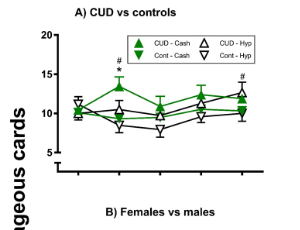
- Abstract |
- Full Text |
- Cite |
- Supplementary File
The biphasic model of addiction: integration, application, and limitations
Derick H. Lindquist
The conceptualization of substance addiction is linked to diverse theories, with competing models emphasizing distinct psychological, behavioral, and neurobiological mechanisms [1,2]. As illustrated in Table 1, the Biphasic model of addiction proposed by Aggarwal, Naik, and Lindquist [3] offers an integrative framework that systematically organizes addiction processes across five domains: reinforcement, motivation, associative learning, tolerance, and inhibitory control.
Addict Subst Abuse, 2026, Volume 4, Issue 1, p11-13 | DOI: 10.46439/addiction.4.012
Introduction of methadone maintenance treatment at the Abidjan Centre for Addiction and Care: Profile of service users, treatment outcomes and challenges after 4 years of operation
Aline Hien, Aïssata Diakite, Abou Dramane Sangaré, David Meless
Access to treatment for disorders related to the abuse of psychoactive substances is a global public health priority. In 2021, the Centre for Addiction Support and Care in Abidjan (CASA) was created to address the issue of care provision through an integrated approach combining opioid substitution therapy. The aim of the study was to determine the epidemiological profile and describe the treatment outcomes of drug users seeking care at CASA.
Addict Subst Abuse, 2026, Volume 4, Issue 1, p17-24 | DOI: 10.46439/addiction.4.014
Recommended Articles
Association between resilience promotion factors during childhood and risk of drug use disorder during adulthood
Few studies have been conducted on the relationship between “outside-residing” resilience characteristics and the risk of developing drug use disorder later in life. These characteristics include responsive and caring parenting, household routines involving regular family meals and bedtime routines, social support from peers, participation in organized activities, and religious service attendance.
Portrayal of substance use in media and its effects on substance use disorders among youth
A variety of behavioral, environmental, developmental, and genetic factors have been documented as contributing to the development of Substance use disorders (SUDs) in youth. For example, it has been suggested that things such as the perceived availability of substances, familial history of anti-social behavior, personal attitudes favorable towards drug use all have strong correlations to the development of substance use in youth.
Predictors of relapse in alcohol use disorder: identifying individuals most vulnerable to relapse
Alcohol Use Disorder (AUD) is described as a chronic relapsing condition with definitive behavioral markers and is characterized by repeated drug intake despite severe negative consequences [1]. With 12-month prevalence rates at 14% and lifetime estimates of 29% [2], it is clear that AUD adversely and substantially affects individual and societal health [3]. Recognized clinically as affecting decision making, relationships, and neurological function [4]
Detection of some synthetic cannabinoids (FUB-AMB and AB-FUBINACA) in blood and urine using Gas Chromatography-mass spectrometry liquid–liquid extraction
In recent years, various types of synthetic cannabinoids have become widely distributed and are causing social and health problems in most parts of the world. Synthetic cannabinoids are currently the largest group of new psychoactive substances. Those that have been subjected to legal control are replaced by newer controlled and uncontrolled substances.
Suicide, opioids, chronic pain, and mental health disorders: a narrative
Suicide rates are on the rise in the United States as is mortality associated with opioid toxicity. According to the Centers for Disease Control and Prevention, about 7% of opioid overdose deaths are suicide, but this number may be under-reported. Many people who use opioids or have opioid use disorder, (OUD), may have “passive” intentions to commit suicide that are difficult to quantify.
Filter ventilation and the risk associated with cigarette smoking
It has long been clear that cigarette smoking is causally linked to many diseases, particularly lung cancer, chronic obstructive pulmonary disease and various forms of cardiovascular disease. For lung cancer, for example, a meta-analysis my colleagues and I conducted, based on epidemiological evidence published in the 1900s [1], estimated that current smoker/never smoker relative risks, were around 10 in North America
Clay eating in pregnancy in French Guiana: How does one understand the practices and act for prevention?
Geophagy is described in most countries of the world as a practice observed in pregnant women. In industrialized countries, it results from migrant populations who carry with them their cultural habits and practices. This is the case in France and more particularly in Guiana, an overseas territory. Originally used to treat the ills of pregnancy, it is today considered to be dangerous for the woman and her unborn child.
AI in addiction: Harnessing technology for diagnosis, prevention, and recovery: A narrative review
Addiction, both substance use and behavioral disorders, remains a significant global public health issue, affecting individuals, families, and societies. Traditional methods of addiction management struggle to meet the increasing demand for effective solutions. Artificial intelligence (AI) has emerged as a promising tool to address this challenge, offering innovative solutions across diagnosis, prevention, and recovery.
Prevalence of screening positive for attention-deficit/hyperactivity disorder in adults seeking methadone for opioid use disorder
This study aimed to characterize the prevalence of screening positive for attention-deficit/hyperactivity disorder (ADHD) among patients seeking methadone treatment for opioid use disorder (OUD) at an opioid treatment program (OTP) to study the association between screening positivity and patient retention.
Impulsive responding increases during a laboratory model of a cocaine binge in individuals who use cocaine: A preliminary study
Individuals with a binge pattern of cocaine use have been found to exhibit cognitive decrements relative to controls, but also experience increases in cognitive performance during binge cocaine administration in the laboratory.
Decisional incentive sensitivity is linked to contingency management outcome and striatal dopamine signaling in individuals with cocaine use disorder: a preliminary study
Nontreatment-seeking individuals with cocaine use disorder (CUD) have been found to exhibit decision-making on laboratory tasks that is risky but also sensitive to monetary incentive, relative to controls. Objective: The purpose of this study was to replicate these findings in treatment-seeking individuals and explore their relationships with voucher-based treatment outcome and striatal dopamine (DA) release.
The biphasic model of addiction: integration, application, and limitations
The conceptualization of substance addiction is linked to diverse theories, with competing models emphasizing distinct psychological, behavioral, and neurobiological mechanisms [1,2]. As illustrated in Table 1, the Biphasic model of addiction proposed by Aggarwal, Naik, and Lindquist [3] offers an integrative framework that systematically organizes addiction processes across five domains: reinforcement, motivation, associative learning, tolerance, and inhibitory control.
Introduction of methadone maintenance treatment at the Abidjan Centre for Addiction and Care: Profile of service users, treatment outcomes and challenges after 4 years of operation
Access to treatment for disorders related to the abuse of psychoactive substances is a global public health priority. In 2021, the Centre for Addiction Support and Care in Abidjan (CASA) was created to address the issue of care provision through an integrated approach combining opioid substitution therapy. The aim of the study was to determine the epidemiological profile and describe the treatment outcomes of drug users seeking care at CASA.