
Abstract
A systematic analysis of Global Burden of Diseases (GBD) documented by the World Health Organization (WHO) now includes alarming prevalence of neurological diseases (NDs) as the foremost leading cause of death and disability worldwide. Given limited effectiveness of current symptomatic management of NDs, clinical implementation of alternative therapies is gaining increasing recognition as the viable option(s) for treating NDs. Neurofeedback, musical neurofeedback in particular, that utilizes music as a form of feedback, constitutes one of such alternatives. Musical stimulus with specific pitch, timbre, rhythm, and tempo is capable of entraining brainwaves in desired direction. These musical brain-entraining characteristics can be further magnified with the use of Indian Classical music (ICM) as the unique music stimulus. This brief review discusses added benefits of ICM/Raga neurofeedback in orchestrating comprehensive restoration of lost brain functions attributed to Raga’s ability of activating Raga- specific emotions, neurotransmitters, and pertinent brain regions/pathways/networks.
Keywords
Indian classical music, Brain entrainment, Music genre, EEG, Raga, Dopamine, Emotional response
Abbreviations
AD: Alzheimer’s Disease; ANS: Autonomic Nervous System; BCI: Brain-Computer Interface; Bpm: Beats Per Minute; EEG: Electroencephalogram; fMRI: Functional Magnetic Resonance Imaging; GBD: Global Burden of Diseases; ICM: Indian Classical Music; NDs: Neurological Diseases; NF: Neurofeedback; NIRS: Near-Infrared Spectroscopy; RF: Random Feedback; UWS: Unresponsive Wakeful Syndrome; WHO: World Health Organization.
Graphical Abstract
Introduction
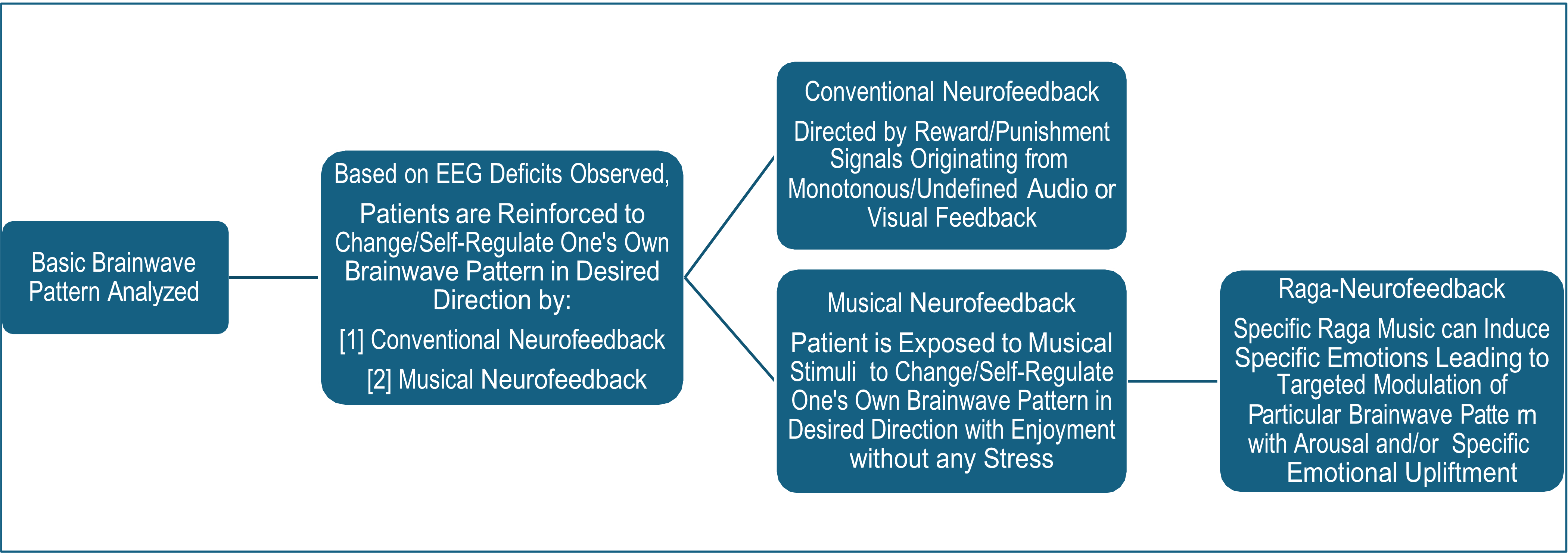
The increasing burden of neurological disorders afflicting ~3 billion people worldwide [1–4] and limited effectiveness of symptomatic therapy [5,6], prompted the emergence of alternative treatments in finding effective cure for neurological disorders (NDs) [7–9]. Neurofeedback (NF) constitutes one of such alternatives increasingly considered for treating NDs [10–13]. Neurofeedback is a type of biofeedback which refers to modifying bodily physiological functions [14]. A typical NF involves (a) An acquisition of patient’s real-time brainwave map in the form of electroencephalogram (EEG), followed by (b) A feedback-EEG showing the existing abnormal brainwaves, followed by (c) A reward/punishment feedback showing the achievement level of NF training after “self-regulating” the brain activity in a desired direction [15,16].
Conventional Neurofeedback
Conventional neurofeedback is provided to patients by various brain-computer interface (BCI) modalities such as functional magnetic resonance imaging (fMRI), near-infrared spectroscopy (NIRS) or EEG [15,17] which can be achieved through visual, tactile or auditory stimulation [17,18]. Visual stimuli involve presentation of images, symbols or graphics with variations in color, shapes or movements which change in brightness or movement; tactile stimuli involve vibrations or touch; while auditory stimuli include presentations of sounds with variable pitch, volume; all visual, tactile or auditory stimuli increase/decrease indicating reward/punishment, in response to the success level of NF training [19]. Most NF systems use visual feedback system which is perceived to be more user-friendly, however, its implementation with “closed eye” medical conditions becomes limited [20]. On the other hand, auditory feedback, although not as user-friendly as visual NF, offers additional advantage of changing various parameters of sound [17,21]. Music constitutes one of the most powerful auditory NF due to its versatility [22,23].
Neurofeedback per se has been shown to impact clinical treatment of NDs due to its non-invasiveness [24] and its potential in modifying brain functions in a targeted manner [25,26]. Neurofeedback training was observed to rebalance theta brainwaves and sensomotor rhythm frequencies leading to improved memory and cognition with no effect on attention [27]. Neurofeedback treatment was effective in dementia subjects regardless of the type of dementia such as primary degenerative dementia, Alzheimer’s disease (AD) related dementia, vascular dementia, depression or mild cognitive impairment [15,28]. Additional studies showed that neurofeedback training of alpha activity exerted a positive effect on working and episodic memory in healthy subjects [29] and improved cognitive functions and speech perception in elderly people with age-related hearing loss [30]. Thus, neurofeedback presents a potential non-invasive intervention for treating neurological disorders [31]. Despite all, the adversities associated with neurofeedback techniques make its clinical implementation somewhat questionable [20]. The most commonly practiced neurofeedback using visual cues such as computer games, cartoons and movies, are associated with fatigue and boredom due to prolonged therapy sessions [32], and auditory neurofeedback with monotonous sound stimulation is not perceived relaxing [17]. Moreover, it is expensive, time-consuming and benefits are not long-lasting [20].
Musical Neurofeedback
In contrast to such conventional NF [15], musical NF is perceived to be stress-free, enjoyable and more effective due to its likable versatility in genres, pitch, tempo, and emotional valence [17,21,33,34]. Moreover, brain’s natural tendency of synchronizing brainwave frequencies to the external rhythmic stimuli of music, known as “Entrainment”, makes musical NF a better choice [19,35–37]. In addition, music induces cognitive and sensory processes and emotions [38–41], via activation of autonomic nervous system [42–45] and brain networks [19,38,39], promising musical NF to be more effective than conventional NF [21,31,36].
Several reports have shown beneficial effects of musical NF intervention in health and disease(s) [31]. A double-blind placebo-controlled study indicated that eyes open alpha power music training in healthy gymnasts using their own favorite music improved sleep quality and mental abilities such as attention when compared to placebo controls exposed to random beta power training [46]. Ramirez et al. have shown that patients suffering from depression when subjected to listening to their own favorite music showed significantly lowered left alpha along with improved depression condition indicating that the integration of NF and receptive music therapy was beneficial [21]. A crossover study that examined whether music based NF would increase the power of alpha in healthy subjects compared to random feedback (RF) controls, showed that normalized alpha power was significantly higher in music-based NF than in control RF, revealing greater improvements in short-term memory and cognitive functions after musical NF [17]. Fedotchev et al. conducted a pilot study showed that compared to conventional NF, musical NF reduced stress sensations and induced positive shifts in mental and emotional status [33]. Keller et al. showed that in a small number of brain injured patients with unresponsive wakeful syndrome (UWS) with higher theta/beta ratio, when subjected to listen to their favorite music, dropped their elevated theta/beta ratio below the threshold, providing evidence that musical NF can be used in a state of UWS [47]. A preliminary musical NF study showed that relaxing music induced alpha waves and produced both short- and long-term soothing effects psychologically and physiologically [48]. Thus, compared to conventional NF, musical NF may be more promising [19].
Potential of Raga Music in Advancing Musical Neurofeedback
Indian Classical Music (Raga) is postulated to further enhance the effects of musical NF by virtue of its structural uniqueness, defined rhythmicity, circadian specificity [49–52], and activation of autonomic nervous system (ANS) that regulate sympathetic/parasympathetic functions [53–56].
Structural uniqueness of Raga includes defined arrangement of notes (Swara) in a particular ascending/descending order with a combination of “Shuddha” (Pure/Consonant/Major) or Komal (Flat/Minor) or Tivra (Sharp) Swaras (Notes) specified for a given Raga [49,57–61]. Predominance of Shuddha (Consonant/Major) Swaras makes the Raga “Happy/Cheerful” [49,58,62], that are known to modulate reward-driven music-memory consolidation [63,64] by activating dopaminergic system in music-evoked pleasure [65–67]. Whereas the predominance of Komal (Dissonant/Flat/Minor) Swaras makes the Raga progressively sentimental, promoting relaxation, peace and tranquility [68,69]. Pleasurable music has been shown to induce alpha waves [70] and balance frontal alpha asymmetry in depression [71]. Relaxing music on the other hand, induces long-term psychological and physiological soothing effects, observed from the increase in alpha and theta brain waves [48].
Besides Swara composition, the defined rhythmicity of Raga adds to brain-entraining effects [50,60,72]. Brainwaves are the rhythmic patterns of brain activity which possess natural ability to synchronize with the rhythms of external origin-such as music [19,35–37]. Rhythm refers to the organized pattern of sounds/silence in music including tempo, beats per minute (bpm), meter [73,74]. The defined rhythmicity of Raga is conventionally presented in two to three different rhythmic modes consisting of an arhythmic mode called “Aalap”, followed by a second mode called “Gat” with a faster tempo along with Raga-specific rhythmic cycles, followed by a third mode called “Tarana” with the fastest tempo of all and a specific rhythmic cycle, which may produce differential rhythmic stimulation [49,51,52,57,58,75]. The change in musical rhythmic patterns can alter the emotional content of music and the way it is perceived [76]. The perception of musical rhythm stimulates the release and circulation of dopamine throughout the brain leading to different types of cognitive and motor responses and experience of pleasure [72,77,78]. Music stimuli with different tempo can entrain differential EEGs [79] and produce varying emotional responses [80]. Yang and co-workers have documented that the slow (56 bpm), medium (106 bpm) and fast (156 bpm) tempi activated theta, alpha and beta/gamma brainwaves respectively, parallelly correlating with relaxation/soothing, pleasant and active/attentional emotional states respectively [80].
The Ragas influences the ANS-plexuses comprising of sympathetic/parasympathetic energy hubs called “Chakras” that regulate different physiological functions [54–56, 81]. There is one more aspect of Ragas, i.e. circadian (and also seasonal) specificity, that influences human health [82]. Human physiology exhibits ubiquitous circadian rhythmicity [83]. According to the Indian Ayurvedic medicine, bodily circadian rhythmic activity encompass three basic bio-natural elements with diurnal peak-times known as “Prakritis”, i.e. “Kapha”(Water/Body- Fluids/Secretions/Inflammation-Edema) (6am/pm–10am/pm), “Pitta” (Fire/Metabolism) (10am/pm–2am/pm), and “Vata” (Air/Movement/Conduction/Transport) (2am/pm–6am/pm), governing body physiology [83,84], and gene expression, recognized as “Ayurgenomics” as one of the important components of P4 medicine [85,86]. Imbalance of any of these “Prakriti” doshas (dysfunction) can lead to the development of disease(s) [83,84], The Vata Prakriti dosha/imbalance is strongly implicated in the development of neurological diseases [85,87,88]. Circadian specificity of Raga is closely related to the bodily circadian “Prakritis” [89,90]. The Ragas designated to be performed/listened aligning with these “Prakriti” time slots (Kapha, Pitta, Vata) are postulated to regulate respective “Prakriti”-doshas [82,91,92]. Thus, such Raga- multiplicity can exert comprehensive benefits on brain/body physiology.
Conclusions
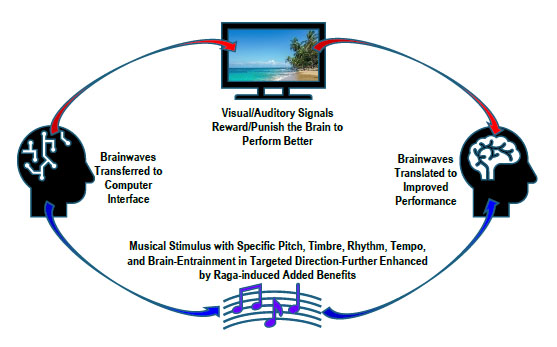
Indian Classical Music (Raga) can be exploited as an effective musical neurofeedback alternative attributed to its versatility of pitch, timbre, rhythm, and tempo entraining brainwaves in desired direction, and its extra-entraining comprehensive physiological effects exerted via induction of neurohormones, activation of pertinent emotive, cognitive and motor brain networks/pathways targeted at restoring normal brain functions in a circadian-specific manner [93] (Figure 1).
Author Contributions
All authors contributed equally.
Conflict of Interests
All authors declare no conflict of interests.
Funding Statement
Neelima Chauhan (Fulbright-Nehru Academic and Professional Excellence Awardee; Grant #APE 2023-24 USIEF) gratefully acknowledges the support provided by the Fulbright U.S. Scholar Program, U.S. Department of State and United States-India Educational Foundation (USIEF) Fulbright Commission.
Acknowledgements
Authors gratefully acknowledges the support provided by the U.S. Department of State and United States-India Educational Foundation (USIEF) Fulbright Commission, India. Its contents are solely the responsibility of the author and do not represent official views of Fulbright Program, USIEF. Authors also acknowledge the support provided by the Department of Pediatrics, University of Illinois at Chicago, Chicago, IL, USA.
References
2. Feng S, Wang T, Su Y, Yan J, Wang Y, Zhang Z, et al. Global burden, risk factors, and projections of early-onset dementia: Insights from the Global Burden of Disease Study 2021. Ageing Res Rev. 2025 Feb;104:102644.
3. Geck MS, Lecca D, Marchese G, Casu L, Leonti M. Ethnomedicine and neuropsychopharmacology in Mesoamerica. J Ethnopharmacol. 2021 Oct 5;278:114243.
4. Correction to Lancet Neurol 2024; 23: 344-81. Lancet Neurol. 2024 May;23(5):e9.
5. Ningrum DNA, Kung WM. Challenges and Perspectives of Neurological Disorders. Brain Sci. 2023 Apr 18;13(4):676.
6. Passeri E, Elkhoury K, Morsink M, Broersen K, Linder M, Tamayol A, et al. Alzheimer's Disease: Treatment Strategies and Their Limitations. Int J Mol Sci. 2022 Nov 12;23(22):13954.
7. Bleibel M, El Cheikh A, Sadier NS, Abou-Abbas L. The effect of music therapy on cognitive functions in patients with Alzheimer's disease: a systematic review of randomized controlled trials. Alzheimers Res Ther. 2023 Mar 27;15(1):65.
8. Sahu M, Ambasta RK, Das SR, Mishra MK, Shanker A, Kumar P. Harnessing Brainwave Entrainment: A Non-invasive Strategy To Alleviate Neurological Disorder Symptoms. Ageing Res Rev. 2024;101:102547.
9. Moser N, Gargoum S, Popovic MR, Kalsi-Ryan S. Effectiveness of Non-Pharmacological Therapy on Physical Symptoms in Patients With Persistent Concussion Symptoms: A Systematic Review. J Neurotrauma. 2024 Jul;41(13-14):1473–93.
10. Cioffi E, Hutber A, Molloy R, Murden S, Yurkewich A, Kirton A, et al. EEG-based sensorimotor neurofeedback for motor neurorehabilitation in children and adults: A scoping review. Clin Neurophysiol. 2024 Nov;167:143–66.
11. Ubeda Matzilevich E, Daniel PL, Little S. Towards therapeutic electrophysiological neurofeedback in Parkinson's disease. Parkinsonism Relat Disord. 2024 Apr;121:106010.
12. Feigin VL, Vos T, Nichols E, Owolabi MO, Carroll WM, Dichgans M, et l. The global burden of neurological disorders: translating evidence into policy. Lancet Neurol. 2020 Mar;19(3):255–65.
13. Cidral-Filho FJ, Porter P, Donatello NN. An Integrative Review of Brainwave Entrainment Benefits for Human Health. Appl Psychophysiol Biofeedback. 2025 Mar;50(1):3–9.
14. Tosti B, Corrado S, Mancone S, Di Libero T, Rodio A, Andrade A, et al. Integrated use of biofeedback and neurofeedback techniques in treating pathological conditions and improving performance: a narrative review. Front Neurosci. 2024 Mar 19;18:1358481.
15. Trambaiolli LR, Cassani R, Mehler DMA, Falk TH. Neurofeedback and the Aging Brain: A Systematic Review of Training Protocols for Dementia and Mild Cognitive Impairment. Front Aging Neurosci. 2021 Jun 9;13:682683.
16. Papo D. Neurofeedback: Principles, appraisal, and outstanding issues. Eur J Neurosci. 2019 Jun;49(11):1454–69.
17. Takabatake K, Kunii N, Nakatomi H, Shimada S, Yanai K, Takasago M, et al. Musical Auditory Alpha Wave Neurofeedback: Validation and Cognitive Perspectives. Appl Psychophysiol Biofeedback. 2021 Dec;46(4):323–34.
18. Sitaram R, Ros T, Stoeckel L, Haller S, Scharnowski F, Lewis-Peacock J,et al. Closed-loop brain training: the science of neurofeedback. Nat Rev Neurosci. 2017 Feb;18(2):86–100.
19. Bhavsar P, Shah P, Sinha S, Kumar D. Musical Neurofeedback Advancements, Feedback Modalities, and Applications: A Systematic Review. Appl Psychophysiol Biofeedback. 2024 Sep;49(3):347–63.
20. Marzbani H, Marateb HR, Mansourian M. Neurofeedback: A Comprehensive Review on System Design, Methodology and Clinical Applications. Basic Clin Neurosci. 2016 Apr;7(2):143–58.
21. Ramirez R, Palencia-Lefler M, Giraldo S, Vamvakousis Z. Musical neurofeedback for treating depression in elderly people. Front Neurosci. 2015 Oct 2;9:354.
22. Thoma MV, La Marca R, Brönnimann R, Finkel L, Ehlert U, Nater UM. The effect of music on the human stress response. PLoS One. 2013 Aug 5;8(8):e70156.
23. Thoma MV, Ryf S, Mohiyeddini C, Ehlert U, Nater UM. Emotion regulation through listening to music in everyday situations. Cogn Emot. 2012;26(3):550–60.
24. Hampson M, Ruiz S, Ushiba J. Neurofeedback. Neuroimage. 2020 Sep;218:116473.
25. Mirifar A, Keil A, Ehrlenspiel F. Neurofeedback and neural self-regulation: a new perspective based on allostasis. Rev Neurosci. 2022 Feb 7;33(6):607–29.
26. Marchi A, Guex R, Denis M, El Youssef N, Pizzo F, Bénar CG, et al. Neurofeedback and epilepsy: Renaissance of an old self-regulation method? Rev Neurol (Paris). 2024 Apr;180(4):314–25.
27. Laborda-Sánchez F, Cansino S. The Effects of Neurofeedback on Aging-Associated Cognitive Decline: A Systematic Review. Appl Psychophysiol Biofeedback. 2021 Mar;46(1):1–10.
28. Surmeli T, Eralp E, Mustafazade I, Kos H, Özer GE, Surmeli OH. Quantitative EEG Neurometric Analysis-Guided Neurofeedback Treatment in Dementia: 20 Cases. How Neurometric Analysis Is Important for the Treatment of Dementia and as a Biomarker? Clin EEG Neurosci. 2016 Apr;47(2):118–33.
29. Yeh WH, Hsueh JJ, Shaw FZ. Neurofeedback of Alpha Activity on Memory in Healthy Participants: A Systematic Review and Meta-Analysis. Front Hum Neurosci. 2021 Jan 5;14:562360.
30. Kim HJ, Weon HW, Son HK. Effects of neurofeedback training on the alpha activity in quantitative electroencephalography, cognitive function, and speech perception in elderly with presbycusis: a quasi-experimental study. BMC Geriatr. 2024 Jul 31;24(1):639.
31. Bhavsar P, Shah P, Sinha S, Kumar D. Correction: Musical Neurofeedback Advancements, Feedback Modalities, and Applications: A Systematic Review. Appl Psychophysiol Biofeedback. 2024 Dec;49(4):697.
32. Shabani F, Nisar S, Philamore H, Matsuno F. Haptic vs. Visual Neurofeedback for Brain Training: A Proof-of-Concept Study. IEEE Trans Haptics. 2021 Apr-Jun;14(2):297–302.
33. Alexander F. Stress Coping Via Musical Neurofeedback. Adv Mind Body Med. 2018 Spring;32(2):17–20.
34. Hofbauer LM, Rodriguez FS. Emotional valence perception in music and subjective arousal: Experimental validation of stimuli. Int J Psychol. 2023 Oct;58(5):465–75.
35. Trost W, Trevor C, Fernandez N, Steiner F, Frühholz S. Live music stimulates the affective brain and emotionally entrains listeners in real time. Proc Natl Acad Sci U S A. 2024 Mar 5;121(10):e2316306121.
36. Fedotchev A, Radchenko G, Zemlianaia A. On one approach to health protection: Music of the brain. J Integr Neurosci. 2018;17(3–4):309–15.
37. Bergstrom I, Seinfeld S, Arroyo-Palacios J, Slater M, Sanchez-Vives MV. Using music as a signal for biofeedback. Int J Psychophysiol. 2014 Jul;93(1):140–9.
38. Koelsch S. Brain correlates of music-evoked emotions. Nat Rev Neurosci. 2014 Mar;15(3):170–8.
39. Koelsch S. Investigating the Neural Encoding of Emotion with Music. Neuron. 2018 Jun 27;98(6):1075–9
40. Koelsch S. Music-evoked emotions: principles, brain correlates, and implications for therapy. Ann N Y Acad Sci. 2015 Mar;1337:193–201.
41. Taruffi L, Koelsch S. The paradox of music-evoked sadness: an online survey. PLoS One. 2014 Oct 20;9(10):e110490.
42. Xiao X, Chen W, Zhang X. The effect and mechanisms of music therapy on the autonomic nervous system and brain networks of patients of minimal conscious states: a randomized controlled trial. Front Neurosci. 2023 May 12;17:1182181.
43. Chee ZJ, Chang CYM, Cheong JY, Malek FHBA, Hussain S, de Vries M, et al. The effects of music and auditory stimulation on autonomic arousal, cognition and attention: A systematic review. Int J Psychophysiol. 2024 May;199:112328.
44. Li X, Min S. Researching how music affects the autonomic nervous system and influences wound healing processes in trauma patients. Int Wound J. 2024 Mar;21(3):e14790.
45. Pant U, Frishkopf M, Park T, Norris CM, Papathanassoglou E. A Neurobiological Framework for the Therapeutic Potential of Music and Sound Interventions for Post-Traumatic Stress Symptoms in Critical Illness Survivors. Int J Environ Res Public Health. 2022 Mar 6;19(5):3113.
46. Dekker MK, van den Berg BR, Denissen AJ, Sitskoorn MM, van Boxtel GJ. Feasibility of eyes open alpha power training for mental enhancement in elite gymnasts. J Sports Sci. 2014;32(16):1550–60.
47. Keller I, Garbacenkaite R. Neurofeedback in three patients in the state of unresponsive wakefulness. Appl Psychophysiol Biofeedback. 2015 Dec;40(4):349–56.
48. Phneah SW, Nisar H. EEG-based alpha neurofeedback training for mood enhancement. Australas Phys Eng Sci Med. 2017 Jun;40(2):325–36.
49. Valla JM, Alappatt JA, Mathur A, Singh NC. Music and Emotion-A Case for North Indian Classical Music. Front Psychol. 2017 Dec 19;8:2115.
50. Sharma S, Sasidharan A, Marigowda V, Vijay M, Sharma S, Mukundan CS, et al. Indian classical music with incremental variation in tempo and octave promotes better anxiety reduction and controlled mind wandering-A randomised controlled EEG study. Explore (NY). 2021 Mar-Apr;17(2):115–21.
51. Ganguli KK, Rao P. On the perception of raga motifs by trained musicians. J Acoust Soc Am. 2019 Apr;145(4):2418.
52. Babel S, Baral S, Srivastava A. Impact of Listening to Indian Classical Music, or Rāgas, on the Electroencephalogram: A Meta-Analysis. Cureus. 2023 Nov 28;15(11):e49592.
53. Sweta KM, Awasthi HH, Godbole A, Prajapati S. Physio-anatomical resemblance of inferior hypogastric plexus with Muladhara Chakra: A cadaveric study. Ayu. 2017 Jan-Jun;38(1–2):7–9.
54. Veerabrahmachar R, Bista S, Bokde R, Jasti N, Bhargav H, Bista S. Immediate Effect of Nada Yoga Meditation on Energy Levels and Alignment of Seven Chakras as Assessed by Electro-photonic Imaging: A Randomized Controlled Crossover Pilot Study. Adv Mind Body Med. 2023 Winter;37(1):11–6.
55. Loizzo JJ. The subtle body: an interoceptive map of central nervous system function and meditative mind-brain-body integration. Ann N Y Acad Sci. 2016 Jun;1373(1):78–95.
56. Loizzo J. Meditation research, past, present, and future: perspectives from the Nalanda contemplative science tradition. Ann N Y Acad Sci. 2014 Jan;1307(1):43–54.
57. Midya V, Valla J, Balasubramanian H, Mathur A, Singh NC. Cultural differences in the use of acoustic cues for musical emotion experience. PLoS One. 2019 Sep 13;14(9):e0222380.
58. Mathur A, Vijayakumar SH, Chakrabarti B, Singh NC. Emotional responses to Hindustani raga music: the role of musical structure. Front Psychol. 2015 Apr 30;6:513.
59. Sanivarapu S. Music and mind. Indian J Psychiatry. 2013 Oct;55(4):400.
60. Ranjani HG, Srinivasamurthy A, Paramashivan D, Sreenivas TV. A compact pitch and time representation for melodic contours in Indian art music. J Acoust Soc Am. 2019 Jan;145(1):597.
61. Schofield KB. Emotions in Indian music history: anxiety in late Mughal Hindustan. South Asian Hist Cult. 2021 Mar 14;12(2–3):182-205.
62. Bowling DL, Sundararajan J, Han S, Purves D. Expression of emotion in Eastern and Western music mirrors vocalization. PLoS One. 2012;7(3):e31942.
63. Ferreri L, Mas-Herrero E, Cardona G, Zatorre RJ, Antonijoan RM, Valle M, et al. Dopamine modulations of reward-driven music memory consolidation. Ann N Y Acad Sci. 2021 Oct;1502(1):85–98.
64. Ferreri L, Rodriguez-Fornells A. Memory modulations through musical pleasure. Ann N Y Acad Sci. 2022 Oct;1516(1):5–10.
65. Hawari L, Singer N, Rabinowitz A, Zatorre R. What is the Best Music for Neurofeedback Training?. McGill Science Undergraduate Research Journal. 2021 Apr 15;16(1):43–9.
66. Ferreri L, Mas-Herrero E, Zatorre RJ, Ripollés P, Gomez-Andres A, Alicart H, et al. Dopamine modulates the reward experiences elicited by music. Proc Natl Acad Sci U S A. 2019 Feb 26;116(9):3793–8.
67. Salimpoor VN, Benovoy M, Larcher K, Dagher A, Zatorre RJ. Anatomically distinct dopamine release during anticipation and experience of peak emotion to music. Nat Neurosci. 2011 Feb;14(2):257–62.
68. Fritz TH, Liebau G, Löhle M, Hartjen B, Czech P, Schneider L, et al. Dissonance in Music Impairs Spatial Gait Parameters in Patients with Parkinson's Disease. J Parkinsons Dis. 2021;11(1):363–72.
69. Balasubramanian SV, Balasubramanian G, Ramanathan G. Integrative Medicine System Based on Music. Altern Ther Health Med. 2016 Apr;22 Suppl 1:14–23.
70. Plourde-Kelly AD, Saroka KS, Dotta BT. The impact of emotionally valenced music on emotional state and EEG profile: Convergence of self-report and quantitative data. Neurosci Lett. 2021 Jul 27;758:136009.
71. Arjmand HA, Hohagen J, Paton B, Rickard NS. Emotional Responses to Music: Shifts in Frontal Brain Asymmetry Mark Periods of Musical Change. Front Psychol. 2017 Dec 4;8:2044.
72. Bowling DL. Biological principles for music and mental health. Transl Psychiatry. 2023 Dec 4;13(1):374.
73. Vuust P, Heggli OA, Friston KJ, Kringelbach ML. Music in the brain. Nat Rev Neurosci. 2022 May;23(5):287–305.
74. Levitin DJ, Grahn JA, London J. The Psychology of Music: Rhythm and Movement. Annu Rev Psychol. 2018 Jan 4;69:51–75.
75. Rohrmeier M, Widdess R. Incidental Learning of Melodic Structure of North Indian Music. Cogn Sci. 2017 Jul;41(5):1299–27.
76. Mohammad Alipour Z, Mohammadkhani S, Khosrowabadi R. Alteration of perceived emotion and brain functional connectivity by changing the musical rhythmic pattern. Exp Brain Res. 2019 Oct;237(10):2607–19.
77. Pando-Naude V, Matthews TE, Højlund A, Jakobsen S, Østergaard K, Johnsen E, et al. Dopamine dysregulation in Parkinson's disease flattens the pleasurable urge to move to musical rhythms. Eur J Neurosci. 2024 Jan;59(1):101–18.
78. Cameron DJ, Pickett KA, Earhart GM, Grahn JA. The Effect of Dopaminergic Medication on Beat-Based Auditory Timing in Parkinson's Disease. Front Neurol. 2016 Feb 22;7:19.
79. Nicolaou N, Malik A, Daly I, Weaver J, Hwang F, Kirke A, et al. Directed Motor-Auditory EEG Connectivity Is Modulated by Music Tempo. Front Hum Neurosci. 2017 Oct 18;11:502.
80. Yang Z, Su Q, Xie J, Su H, Huang T, Han C, et al. Music tempo modulates emotional states as revealed through EEG insights. Sci Rep. 2025 Mar 10;15(1):8276.
81. Sharma M, Dhankar M, Kumar D. Awakening of Kundalini Chakras Presenting as Psychosis-A Case Report. Indian J Psychol Med. 2022 Sep;44(5):526–8.
82. Agrawal T, Shanahan D, Huron D, Keller H. Time-of-day practices echo circadian physiological arousal: An enculturated embodied practice in Hindustani classical music. Musicae Scientiae. 2023 Mar;27(1):70–93.
83. Arora D, Kumar M. Concept of chronopharmacology in ayurveda. Anc Sci Life. 2000;19(3- 4):155–63.
84. Dey S, Pahwa P. Prakriti and its associations with metabolism, chronic diseases, and genotypes: Possibilities of new born screening and a lifetime of personalized prevention. J Ayurveda Integr Med. 2014 Jan;5(1):15–24.
85. Wallace RK. Ayurgenomics and Modern Medicine. Medicina (Kaunas). 2020 Nov 30;56(12):661.
86. Huang Z, Chavda VP, Bezbaruah R, Uversky VN, P S, Patel AB, et al. An Ayurgenomics Approach: Prakriti-Based Drug Discovery and Development for Personalized Care. Front Pharmacol. 2022;13:866827.
87. Manyam BV, Kumar A. Ayurvedic constitution (prakruti) identifies risk factor of developing Parkinson's disease. J Altern Complement Med. 2013 Jul;19(7):644–9.
88. Mills PJ, Peterson CT, Wilson KL, Pung MA, Patel S, Weiss L, et al. Relationships among classifications of ayurvedic medicine diagnostics for imbalances and western measures of psychological states: An exploratory study. J Ayurveda Integr Med. 2019 Jul-Sep;10(3):198–202.
89. Pathak JS, Saxena AK. Therapeutic Effects of Hindustani Classical Music with Reference to Raga Drabari Kanada, Raga Bageshree and Raga Malkauns. GAP BODHI TARU-A Global Journal of Humanities-Special Issue on Indian Knowledge System. 2023;VI:104–9.
90. Sarkar J, Biswas U. An effect of Raga Therapy on our human body. Int J Humanit Soc Sci Res. 2015 Nov;1(1):40–3.
91. Sharma A, Moon E, Kim G, Kang SU. Perspectives of Circadian-Based Music Therapy for the Pathogenesis and Symptomatic Treatment of Neurodegenerative Disorders. Front Integr Neurosci. 2022 Jan 26;15:769142.
92. Konsam M, Praharaj SK, Panda S, Shetty J, Ravishankar N, D'Souza SRB. Effectiveness of health literacy and relaxing music on quality of sleep and risk for antenatal depression. Indian J Psychiatry. 2023 Oct;65(10):1035–43.
93. Qiao H, Fang D, Chen J, Sun Y, Kang C, Di L, et al. Orally delivered polycurcumin responsive to bacterial reduction for targeted therapy of inflammatory bowel disease. Drug Deliv. 2017 Nov;24(1):233–42.