
Editorial
The origin of Raga-the nucleus of Indian classical music (ICM)-dates back to the Vedic era with its identifiable roots in the Sama Veda [1,2]. The prototype monotonic Rig Veda recitation was originally developed to include only three notes i.e. a principal note, a higher note (Udatta), and a lower note (Anudatta) which was modified in the Yajur Veda to include a tetra chord with two principal notes and two accents. This tetra chord was further refined in the Sama Veda with the addition of three more notes, making the first scale of seven notes used to recite the Vedic hymns [3,4]. This scale of seven notes (Saptak) formulated to chant the Sama Veda, became the first Raga, closely resembling to Raga Kharaharapriya or Kafi of ICM [3,4].
As defined by the World Music Maestro-Pt. Ravi Shankar, “The Raga is a scientific, precise, subtle, and aesthetic melodic structure with its own peculiar creation, consisting either of a full seven note octave, or a series of six or five note octave(s), or a combination of any of these, composed in an ascending (Aroha) and descending (Avaroha) order, along with a subtle difference in the expression/omission/emphasis of particular note(s), or the use of microtones, that makes the Raga” [5]. Thus, Raga is a defined melodic structure that constitutes the “nucleus” of ICM system-regardless of its bifurcation as North Indian Hindustani Music or South Indian Carnatic Classical Music [1,2].
While todays Indian Classical Music is very commonly heard as Ragas, its existence and evolution is rooted in the ancient Yogic system known as “Nada Yoga” [6-8]. Yoga in general is defined as the body-mind-spirit regulatory system that integrates gross body or “Soma” (Sthula Sharira) with subtle body or “Psyche” (Sukshma Sharira), via functional energy center(s) (Chakras) that are postulated to govern the gross body [9-11]. Nada Yoga is the Yogic practice of body-mind-spirit integration through internal/Anahata (e.g. mediation) or external/Ahata (e.g. mantras/chanting/music) sound(s), that resonate in the body through defined sound frequencies, vibrating specific energy centers (Chakras) [6-8]. Humans have mechanoreceptors (Pacinian Corpuscles) located all over the body including skin, tendons, bones, most abdominal and sexual organs, which are sensitive to vibrations and therefore are able to resonate with sounds, making it plausible to believe that their stimulation by musical sounds will produce an effect [12]. Integrative therapeutic use of Raga (Raga Chikitsa/Therapy) is a part of Nada Yoga, in which defined melodic structure of a given Raga is aimed at synchronizing, vibrating and activating designated Chakra(s) [6,8,13-16].
Chakras are the vital energy hubs of the subtle body system [9-11]. This subtle body or “Psyche” model (Sukshma Sharira) shows close correlation with the nerve-plexuses formed by the autonomic nervous system (ANS) of the gross body or “Soma” (Sthula Sharira), with its sympathetic and parasympathetic control of lateral/peripheral dominance, relaying back to the central nervous system (CNS) (Figure 1) [9,10,17]. The scientific observations show near-perfect alignment of major ANS-nerve plexuses with each of the Chakras, as confirmed by cadaveric [18] electro-photonic [8] and contemplative cross-referencing (Figure 2) [9,10].
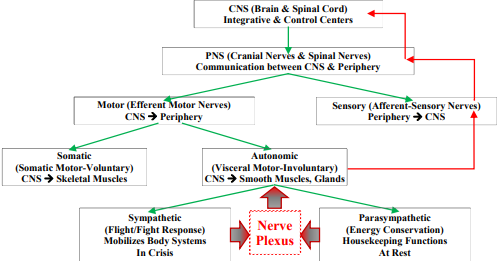
Figure 1: Origin of Nerve Plexuses.
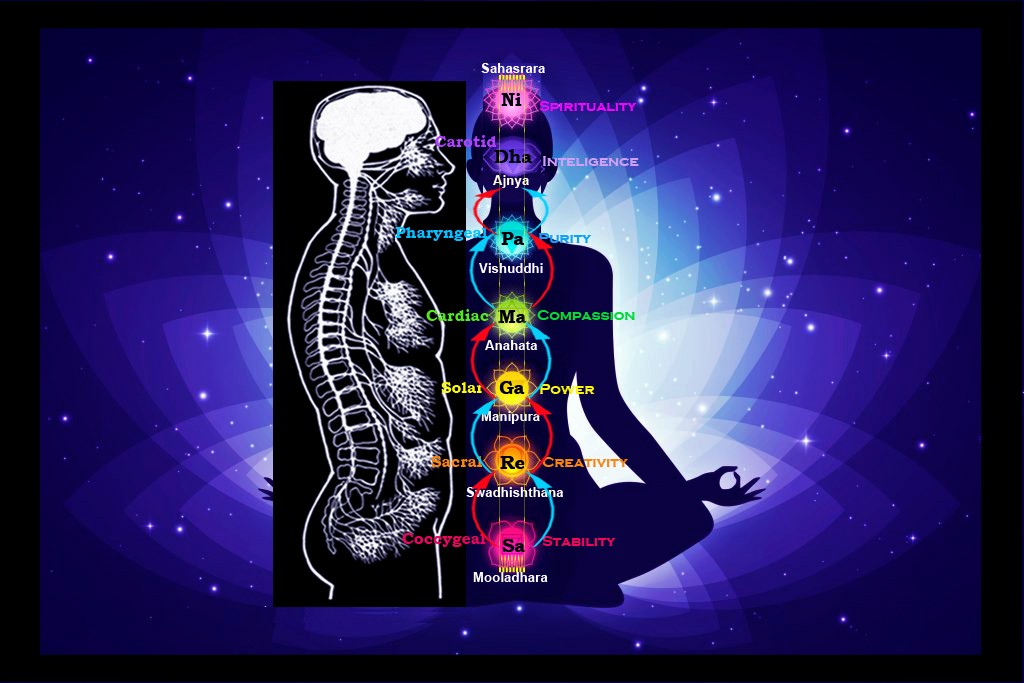
Figure 2: Near-Perfect Correlation of Autonomic Nerve Plexuses with Chakras.
The Chakra subtle body system consists of seven prime Chakras i.e. Mooladhar (Root), Swadhishthan (Sacral), Manipura (Solar), Anahata (Cardiac/Heart), Vishuddhi (Throat/Pharyngeal), Ajnya (Carotid), Sahasrara (Carotid) Chakras, interconnected with the energy channels called “Reeds” or “Meridians” known in Vedas as “Nadis” [10,14] (Figure 2). There are three principal Meridians including right “Masculine” Nadi (Pingala) (Figure 2, Red), left “Feminine” Nadi (Ida) (Figure 2, Blue), and central “Neutral” Nadi (Sushumna) (Figure 2, Yellow Dotted Lines). The Masculine and Feminine Meridians intersect and pass through successive “Chakra”-points, finally converging into right and left nostrils respectively, after passing through the Vishuddhi Chakra (Pharyngeal Plexus) [8,10] (Figure 2). Congregation of all Chakras (Mooladhar, Swadhishthan, Manipura, Anahata, Vishuddhi, Ajnya, Sahasrara), through peripheral and central Meridians (Figure 2, Red-Pingala-Masculine, Blue-Ida-Feminine, Yellow Dotted-Central Sushumna), is aimed at attaining total mind-body integration and tranquility [10,13,15,16].
Every Chakra is correlated with specific physiological, psychological, and spiritual characteristics [8]. Each Chakra governs specified physiological function(s) including respiration, excretion, reproduction, metabolism, circulation, sensation, motor, and proprioception [8,10]. Mooladhara Chakra is responsible for security, stability, survival, and regulates excretion and reproduction; Swadhishthana Chakra is responsible for creativity, emotions, and governs reproduction, regeneration; Manipura Chakra is responsible for power, vigor, ego, and governs digestion, assimilation, metabolism; Anahata Chakra is responsible for love, passion, affection, and governs respiration and circulation; Vishuddhi Chakra is responsible for purity, discriminative thinking, and regulates effective speech and communication; Ajnya Chakra is known as the “Sixth Sense” that is responsible for analytical reasoning, intelligence, and governs rational thinking, intellectual ability; lastly, Sahasrara Chakra governs knowledge, wisdom, spiritual enlightenment, and makes one aware of self-consciousness, oneness with the Supreme [8-10] (Table 1). Furthermore, it is considered that each Chakra is also associated with bodily endocrine glands i.e. Mooladhara with adrenals, Swadhishthana with gonads, Manipura with pancreas, Anahata with thymus, Vishuddhi with thyroid, Ajnya and Sahasrara with Cerebrum, pineal, Hypothalamo-Pituitary-Adrenal (HPA) axis [8-10].
|
Chakras (Nerve Plexuses) |
Associated Qualities |
Imbalanced Attributes |
Associated Ragas |
Vadi Swara-Ragas |
|
|
|
Sahasrar (Carotid Plexus) Element: All Elements Swara: Ni |
Eternal Knowledge, Spiritual Enlightenment, Self-Realization, Higher Consciousness, Liberation |
Frustration, Melancholy, Delusions, Destructive Feelings, Pessimism, Cynicism, Disconnect with Supreme |
Darbari Kanada, Bhairavi, Sindhubhairavi |
(Ni) Hemshree |
|
|
Ajnya/Agnya (Carotid Plexus) Element: “Tej” (Illumination) Swara: Dha |
The “Sixth Sense”, Intellect, Intuition, Clairvoyance, Analysis/Reasoning, Spiritual and Emotional Vibrance |
Headache, Lack of Direction/Clarity, Anxiety, Confusion, Anger/Rage, Indecisiveness/Irrationality |
Bhup/Bhupali, Bageshree |
(Dha) Gunakali, Bhairav, Gujari Todi, Bhupal Todi, Vibhas, Todi |
|
|
Vishuddhi (Pharyngeal Plexus) Element: Space (Akash) Swara: Pa |
Effective Expression, Diplomacy, Constructive Communication, Purity of Thoughts, Discriminative Ability |
Inability to Express/Communicate Timidity, Lying, Arrogance, Fear, Manipulative Tendencies, Anxiety |
Puriya, Jaijaivanti, Desh, Jogkauns |
(Pa) Madhuvanti, Kafi, Shyam Kalyan, Kalavati |
|
|
Anahata (Cardiac Plexus) Element: Air Swara: Ma |
Harmony, Selfless love, Empathy, Compassion, Caring, Optimistic, Motivation, Acceptance, Kindness |
Anger, Lack of Trust, Self-Hate, Anxiety, Jealousy, Depression, Difficulty in Relationships |
Ahir Bhairav, Bhairav, Durga |
(Ma) Bageshree, Jog, Bhairavi, Malkauns |
|
|
Manipura/Nabhi (Solar Plexus) Element: Fire (Agni) Swara: Ga |
Dynamism, Achievement, Power, Strength, Content, Self-Esteem, Ego, Productivity, Focus, Determination |
Uncontrolled Anger/Aggression, Mistrust, Rigid/Manipulative, Low Self-Esteem, Misuse of Power |
Bhatiyar, Gunakali, Malkauns, Abhogi, Lalit, Bhimpalas |
(Ga) Bhup, Bihag, Pilu, Rageshree, Yaman |
|
|
Swadhishthana (Sacral Plexus) Element: Water Swara: Re |
Continuation of Life, Creativity, Pre/Post-Natal Development, Mood/Emotions, Vibrance, Joy |
Irritability, Emotional Instability, Anxiety, Depression, Infertility, Lack of Creativity, Developmental Defects |
Yaman, Todi Gurjari Todi |
(Re) Shuddha Sarang, Desh, Darbari |
|
|
Mooladhara (Coccygeal Plexus) Element: Earth Swara: Sa |
Survival, Stability, Security, Confidence, Identity, Comfort, Ambition, Independence |
Instability, Lack of Ambition, Self-Hate, Insecurity, Fear for Survival, Frustration, Anger, Self-Pity |
Shyam Kalyan, Hansdhwani, Bilawal, Malkauns |
(Sa) Puriya Kalyan, Mand Mishra |


Ragas are postulated to activate Chakras via two principal mechanisms: Association of Swaras with Chakras, and Association of Ragas with Chakras.
Association of Swaras with Chakras
The seven basic notes of Raga (Swaras) are associated with each of the seven prime Chakras and their corresponding Plexuses (Figure 1). i.e. Mooladhar (Coccygeal) (Sa), Swadhishthan (Sacral) (Re), Manipura (Solar) (Ga), Anahata (Cardiac) (Ma), Vishuddhi (Pharyngeal) (Pa), Ajnya or Agnya (Carotid) (Dha), Sahasrara (Carotid) (Ni) [5,6,13]. Each Raga contains a predominant Swara called the “Vadi” Swara which is frequently used in the rendition [3-5]. The Raga with a specific Vadi Swara will activate a Vadi-Swara-specific Chakra [2,5]. For example, Raga Jog with “Ma” Vadi Swara is capable of vibrating Anahata Chakra (Table 1). In addition, each Raga is composed of Shuddha (Major) or Komal (Minor/Flat) or Tivra (Sharp) Swaras. The Raga that contains all Shuddha (Major) seven Swaras is called the “Sampurna” Raga, and by virtue of containing all seven Shuddha (Major) Swaras in its composition, a “Sampurna” Raga can activate all Chakras [2-5]. For example, Raga Mand Mishra is a “Sampurna” Raga which can activate all seven Chakras. On the other hand, Raga Mohanam/Bhupali, containing all Shuddha (Major) Swaras except Ma and Ni, can activate all Chakras except Anahata and Sahasrara Chakras [13].
Association of Ragas with Chakras
Besides Swara-specificities, defined designation of Ragas with specific Chakras also can activate specific Chakras [5,6,13] (Table 1). Each Chakra can be activated with a particular Raga designated to be associated with that particular Chakra [19] (Table 1). As detailed in Table 1, Raga Shyam Kalyan can activate the Mooladhara Chakra, Raga Yaman helps activate the Swadhishthana Chakra. Raga Abhogi can activate the Manipura Chakra while Ragas Bhairav and Raga Durga can activate Anahata Chakra. Raga Jayawanti is able to activate the Vishuddhi Chakra, and Raga Bhup can activate Ajnya Chakra, allowing the Kundalini pass through the Ajnya Chakra entering the Sahasrara Chakra, causing a person to reach a state of selfless awareness and tranquility [16]. Chakras are known to be activated by Swaras, Chakra-associated Ragas, and also by chanting of Chakra-specific “Beej Mantras” (Vedic Seed Mantra with defined Hz that activates specific Chakra) [8,13,16]. Ragas can activate specific Chakras maintaining optimum spin, which allows the Kundalini energy to rise, energize and nourish the Chakra(s). Ragas influence Chakras to maintain their optimum spin, ensuring a physiological balance [16].
Empirical evidence linking sound/music vibrations to Chakra activation
Chakra activation/balancing and music therapy are part of the traditional Indian healing system, however, very little is known about the effect of music on Chakra activation [9,10,13]. Some of those few empirical evidences linking music vibrations to Chakra activation include an exploratory study that evaluated effects on individual Chakra activation through a maneuver of six cycles of ascending/descending Swaras – each cycle included singing of ascending notes “S”, “R”, “G”, “M”, “P”, “D”, “N”, “S” (higher) followed by descending notes “N”, “D”, “P”, “M”, “G”, “R”, “S”, followed by 3 cycles of chanting “Om”, with the whole intervention lasting for 12 min, conducted in the controlled environmental conditions. Increase in the body temperature was considered as one of the physiological changes as a result of Chakra activation [20]. This study with a single 12 min session of singing ascending and descending notes followed by “Om” chanting, elevated whole body temperatures from feat to head in all subjects, confirming the activation of all Chakras [20]. Another randomized crossover pilot study investigated immediate effects of Nada Yoga meditation using Chakra-specific “Beej Mantra” on the energy levels and activation of aligned Chakras in healthy volunteers, assessed by electro-photonic imaging measurements of Chakra-specific Hz energy [8]. The results showed enhanced activation of Mooladhar, Manipura, Anahata, and Vishuddhi Chakras, and moderate activation of Swadhishthana, Ajnya and Sahasrara Chakras [8]. Unfortunately, there is insufficient documentation regarding individual variability of Chakra-activation experiences.
Therapeutic directives and clinical applications of Ragas
The documentation of curing Mussolini’s insomnia by Pt. Omkarnath Thakur’s Raga Puriya rendition is the oldest evidence presenting clinical application of Raga [21]. Regarding current clinical Raga applications, the “ClinicalTrial.gov” search rendered only five studies that used Indian Raga intervention(s) either in vocal or instrumental form for treating different health disparities (Table 2). A randomized controlled trial (NCT03790462) evaluated the effects of Raga Puriya, Hindol, and Todi on psychological and social stress, as assessed by salivary stress biomarkers (Cortisol, Amylase), electroencephalogram (EEG), heart rate variability (HRV), blood pressure (BP) and anxiety assessed by State Trait Anxiety Inventory (STAI) scores. Other randomized controlled trials tested the effects of Ragas Ahir Bhairav, Kausi Kanada, Bhimpalas (NCT02691585), and Raga Bhimpalas only (NCT02147366) on hypertension, EEG and HRV. Another randomized study (NCT04351217) evaluated the effects of Raga Ahir Bhairav and Bhairavi on craving reduction in alcohol dependency/syndrome. A randomized study on the effects of Indian classical music-Melodic Intonation Therapy (MIT, Raga not specified) was compared with standard speech rehabilitation therapy in post-stroke and non-fluent aphasia (NCT06323330). None of these clinical trials have posted the results yet.
|
|
Study Title |
ClinicalTrials.gov ID Type/Status Location |
Conditions |
Intervention |
|
1. |
Select Indian Ragas on Electrophysiological Parameters (RAGA-2) |
NCT03790462 RCT/Completed Bangalore, Karnataka, India |
Psychological and Social Stress |
Vocal/Instrumental-(Patient’s choice) Raga A (Puriya)-10 min Raga B (Hindol)-10 min Raga C (Todi)-10 mi Daily 30 min intervention/3 months |
|
2. |
Indian Instrumental Music in Hypertension |
NCT02147366 Completed Bangalore, Karnataka, India |
Hypertension |
Raga Bhimpalas (Flute) (15 min/Daily) For 3 Months |
|
3 |
Indian Ragas on Health - an Electrophysiological Study (RAGA-1) |
NCT02691585 Completed Bangalore, Karnataka, India |
Hypertension |
Raga Bhimpalas (Vocal) (25 min/Session) Daily, for 4 Weeks |
|
4 |
Music vs Relaxation Training in Craving Reduction in Alcohol Dependence Syndrome |
NCT04351217 Completed Mangalore, Karnataka, India |
Alcohol Dependent Syndrome |
Raga Ahir Bhairav and Bhairavi (22 min/session) Daily, for 4 Weeks |
|
5 |
Music Therapy for Rehabilitation in Post-Stroke Non-fluent Aphasia: the Indian Adaptation |
NCT06323330 New-Not Yet Recruiting AIIMS, New Delhi, India |
Aphasia, Broca, Post-Stroke Rehabilitation |
Indian Music Melodic Intonation Therapy (Raga not Specified), Daily, For 6 & 12 Weeks |
Multidisciplinary integrative approach in healing
Multidisciplinary integrative medicine approaches including music therapy have gained credence in recent years due to limited efficacy of pharmaco-mono therapies [22,23]. The exploration of non-pharmacological alternative and complementary medicine has set the stage for the evolution of integrative approach in health and healing which supports the mind-body connection [24,25]. The rationale behind integrative health hails from ancient healing practices such as Yoga [26]. Nada Yoga constitutes a type of Yoga that deals with body-mind-spirit integration through internal/Anahata (such as mediation) or external/Ahata (such as mantras/chanting/music) sound(s) that vibrate specific energy centers (Chakras), resonating in the body-organs with specific sound frequencies [6,8]. Integrative therapeutic use of Raga (Raga Chikitsa/Therapy) is a part of Nada Yoga, in which defined melodic structure of a given Raga synchronizes, vibrates and activates associated Chakras [6,8,13]. In summary, Raga offers an integrative healing practice that links physiological, emotional, sociological, psychological, and spiritual dimensions of the human body, thus connecting “Psyche” (Sukshma Sharira) with “Soma” (Sthula Sharira).
References
2. Singh MT, Devi KR. HINDUSTANI CLASSICAL MUSIC AND ITS PRINCIPLES. Journal of Visual and Performing Arts. 2023;4(2):247-58.
3. Ruckert G, Widdess R. Hindustani raga. In: The Garland Encyclopedia of World Music. Routledge; 2017 Sep 25. pp. 64-88.
4. Beck GL. Sacred music and Hindu religious experience: From ancient roots to the modern classical tradition. Religions. 2019 Jan 29;10(2):85.
5. Mittal S, Kumar S. Fostering Mental Wellbeing by Healing Chakras through Music Therapy. Indian Journal of Social Sciences and Literature Studies. 2021;7(2):12-9.
6. Sanivarapu SL. India's rich musical heritage has a lot to offer to modern psychiatry. Indian J Psychiatry. 2015 Apr-Jun;57(2):210-3.
7. Mikes S. Nada Yoga. [https://stephanmikescom]. 2022.
8. Veerabrahmachar R, Bista S, Bokde R, Jasti N, Bhargav H, Bista S. Immediate Effect of Nada Yoga Meditation on Energy Levels and Alignment of Seven Chakras as Assessed by Electro-photonic Imaging: A Randomized Controlled Crossover Pilot Study. Adv Mind Body Med. 2023 Winter;37(1):11-16.
9. Loizzo JJ. The subtle body: an interoceptive map of central nervous system function and meditative mind-brain-body integration. Ann N Y Acad Sci. 2016 Jun;1373(1):78-95.
10. Loizzo J. Meditation research, past, present, and future: perspectives from the Nalanda contemplative science tradition. Ann N Y Acad Sci. 2014 Jan;1307(1):43-54.
11. Patra S. Sukshma sareera (Astral Body) beyond our comprehension. International Journal of Yoga-Philosophy, Psychology and Parapsychology. 2017 Jul 1;5(2):29-34.
12. Koelsch S. Music-evoked emotions: principles, brain correlates, and implications for therapy. Ann N Y Acad Sci. 2015 Mar;1337:193-201.
13. Balasubramanian SV, Balasubramanian G, Ramanathan G. Integrative Medicine System Based on Music. Altern Ther Health Med. 2016 Apr;22 Suppl 1:14-23.
14. Van Kanegan G, Worley J. Complementary Alternative and Integrative Treatment for Substance Use Disorders. J Psychosoc Nurs Ment Health Serv. 2018 May 1;56(6):16-21.
15. Maxwell RW, Katyal S. Characteristics of Kundalini-Related Sensory, Motor, and Affective Experiences During Tantric Yoga Meditation. Front Psychol. 2022 Jun 30;13:863091.
16. Sharma M, Dhankar M, Kumar D. Awakening of Kundalini Chakras Presenting as Psychosis-A Case Report. Indian J Psychol Med. 2022 Sep;44(5):526-28.
17. Shannahoff-Khalsa D. Lateralized rhythms of the central and autonomic nervous systems. Int J Psychophysiol. 1991 Dec;11(3):225-51.
18. Sweta KM, Awasthi HH, Godbole A, Prajapati S. Physio-anatomical resemblance of inferior hypogastric plexus with Muladhara Chakra: A cadaveric study. Ayu. 2017 Jan-Jun;38(1-2):7-9.
19. Ramani S. Music and Chakras-The Kundalini Energy System. [https://shankarramanicom]. 2019.
20. Sumathy S, Parmar PN. Effect of a Single Musical Cakra Activation Manoeuvre on Body Temperature: An Exploratory Study. Anc Sci Life. 2016 Jul-Sep;36(1):3-5.
21. Sarkar J BU. An effect of Raga Therapy on our human body. Journal of Humanities and Social Science Research. 2015;1(1):40-3.
22. Loewy J. Underlying Music Mechanisms Influencing the Neurology of Pain: An Integrative Model. Brain Sci. 2022 Sep 29;12(10):1317.
23. Pérez-Eizaguirre M, Vergara-Moragues E. Music Therapy Interventions in Palliative Care: A Systematic Review. J Palliat Care. 2021 Jul;36(3):194-205.
24. Liu L, Tang Y, Baxter GD, Yin H, Tumilty S. Complementary and alternative medicine - practice, attitudes, and knowledge among healthcare professionals in New Zealand: an integrative review. BMC Complement Med Ther. 2021 Feb 13;21(1):63.
25. Mi M, Wu L, Zhang Y, Wu W. Integration of arts and humanities in medicine to develop well-rounded physicians: the roles of health sciences librarians. J Med Libr Assoc. 2022 Apr 1;110(2):247-52.
26. Pearson N, Prosko S, Sullivan M, Taylor MJ. White Paper: Yoga Therapy and Pain-How Yoga Therapy Serves in Comprehensive Integrative Pain Management, and How It Can Do More. Int J Yoga Therap. 2020 Jan 1;30(1):117-33.