
Abstract
Here we report a novel method of performing a Neodyminium:YAG (Nd:YAG) laser posterior capsulotomy in an adult patient, unable to tolerate the procedure awake with topical anaesthesia in the outpatient clinic setting. The procedure was performed by altering the chin rest and arms of the Nd:YAG laser machine so that the procedure could be undertaken in an anaesthetized patient in the operating theatre, in the lateral decubitus position, with the laser machine upright in its normal position.
Keywords
Posterior capsular opacification, Cataract, Naodymium, Corneal injury
Introduction
Posterior capsular opacification (PCO) is a common consequence of uncomplicated cataract surgery. PCO is due to the abnormal proliferation of lens epithelial cells, which migrate to the posterior capsular surface. When PCO affects the central 3 mm zone visual acuity, high contrast sensitivity and low contrast acuity are decreased [1]. The reported incidence of PCO varies widely, with 25% to 50% of patients developing visually significant PCO within 2 to 5 years after surgery [2,3].
Neodymium:YAG (Nd:YAG) laser posterior capsulotomy has become the mainstay of treatment. Nd:YAG capsulotomy offers a fast, noninvasive way to improve visual acuity. It does however have inherent risks such as a rise in intraocular pressure, corneal injury, hyphaema, IOL pitting or dislocation, vitreous prolapse, cystoid macular oedema, retinal detachment and, rarely, endophthalmitis [4]. It is important to focus the aiming beam precisely when undertaking this procedure to minimize the risk of such complications.
The typical set-up of an Nd:YAG laser is where the patient rests their chin on the chin rest and the focusing beam is aimed through a contact lens on to the posterior capsule. Laser energy is then delivered to disrupt the posterior capsule. This procedure requires a high level of patient compliance, with a need to sit upright and keep still. This may present a challenge in certain patients and thus render them unsuitable for the traditional format of the procedure. The main patient groups that may experience difficulty during this procedure are children and adults with severe physical or learning disabilities.
We report the case of a 55 year-old patient who required an Nd:YAG capsulotomy for visually significant posterior capsular opacification. Due to his co-morbidities of trisomy 9 mosaicism, learning difficulties and epilepsy, he was an unsuitable candidate for routine YAG capsulotomy in the outpatient setting due to positioning and adherence to instructions during the procedure.
Surgical Technique
In our case, we used the OptoYag&SLT laser machine (OPTOTEK Medical, Llubljana, Slovenia). The laser machine was disassembled, removing the chin rest (Figure 1). The patient was given a general anesthetic and taken into the operating theatre. He was placed in the lateral decubitus position on an Eschmann T20-m+ operating table (Eschmann Holdings, West Sussex, U.K.). The height of the table was adjusted with additional foam headrests as required to ensure the patient’s eye was in line with the aiming beam of the laser. The patient was stabilized with the help of ancillary theatre staff (Figures 2 and 3). This position allowed both good access to the patient and safe use of the laser. We used a contact lens to deliver 81.00 mJ of energy to the patient’s right eye. Once complete, we then turned the patient over, readjusted the position and delivered 120.0 mJ of energy via the contact lens to the patients left eye. The procedure was successfully completed with no immediate complications.
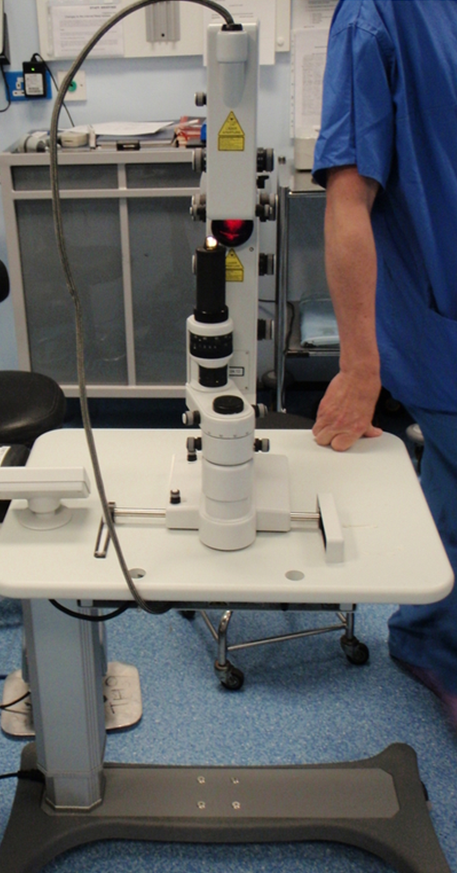
Figure 1: Laser machine has been modified to remove areas that could hinder patient positioning and effective laser delivery.
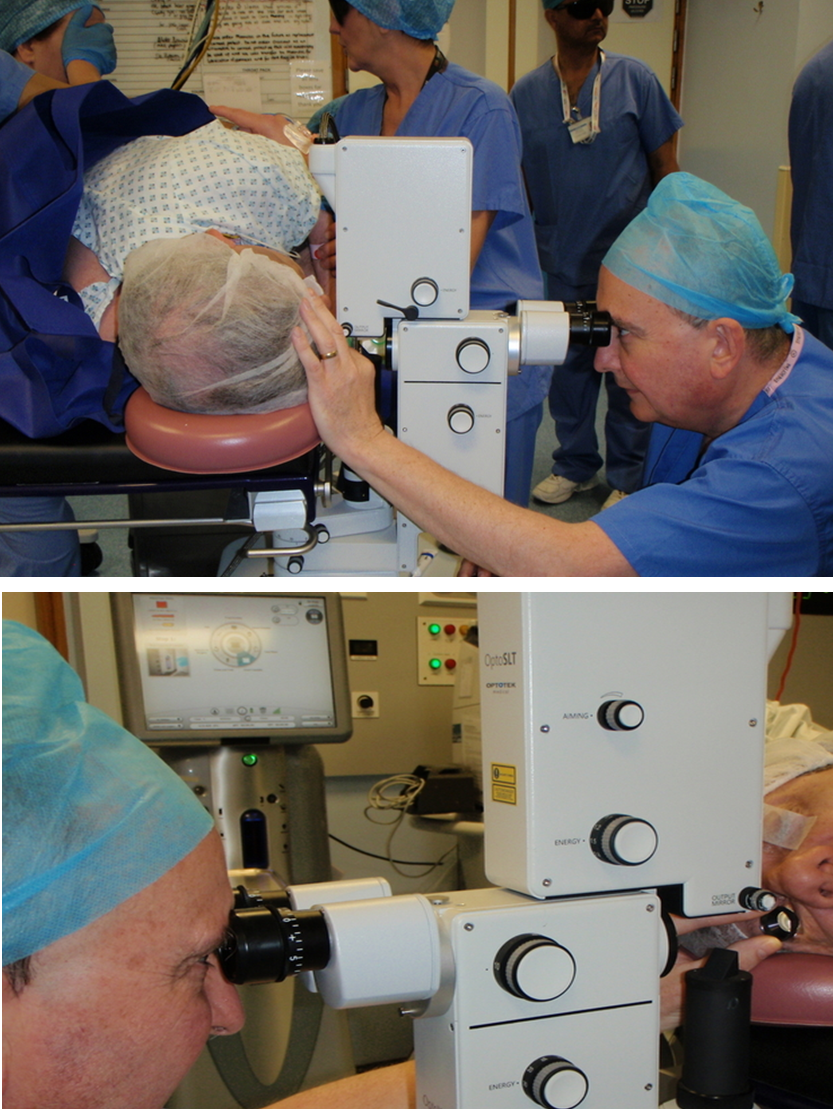
Figures 2 and 3: Performing the procedure.
Results
Post-procedural IOP was 15 mmHg in the right and 16 mmHg in the left eye with the iCare (iCare Findland Oy, Vantaa, Finland). Post operatively, the patient was sent to recovery from his general anaesthesia and was discharged the same day. Post operatively, he was reviewed in the outpatient clinic. There was no intraocular inflammation and the visual axes were clear in both eyes, with no post operative complications.
Pre-op visual acuity (LogMAR at 2m) - OD: 0.875 OS: 0.6. Post-op visual acuity:
OD: 0.85 (has macular scarring in this eye prior), OS: 0.375. There has been a significant subjective and objective improvement in vision.
His mother, who is also the main carer, noticed a significant improvement when performing visual tasks.
Discussion
This is the first reported case pertaining to the management of adult patients unable to tolerate standard Nd:YAG capsulotomies. The patient was added to a normal ophthalmology operating list and the laser machine can be easily transported into theatre.
Positioning of the patient is important, and we advocate the use of pillows, and support of the neck and an assistant to hold the head in place during the procedure to ensure stability.
Chen et al. reported a novel technique for undertaking a capsulotomy in a 7 year-old girl. The patient developed PCO 2 years following cataract extraction. She was given a general anaesthetic and the capsulotomy was successfully performed with the patient in the lateral decubitus position using a standard upright Nd:YAG laser [5]. Subash et al. also reported performing the procedure in the prone position under general anaesthesia [6].
Other methods have been described, such as using a mounted Nd:YAG laser which allows the procedure to be performed on supine children, awake or anaesthetized [7]. This is a relatively rare set up and would not be available in most centres.
In conclusion, we report a safe, efficient way to offer and perform Nd:YAG capsulotomies to patients unable to tolerate the procedure in the outpatient setting and sit upright and still during the procedure, using a common laser machine with minor adjustments and no additional equipment modifications.
What was Known
YAG capsuolotomy for PCO is a common procedure, performed in the outpatient clinic. Patients need to be awake and sit upright, with their chin on the chin rest and not move during the procedure.
There is a mounted device available in some children’s centres so the procedure can be performed with the child supine.
What this Paper Adds
This technique can be performed on patients under general anaesthesia in the lateral decubitus position.
This is the first case of an adult undergoing the procedure in this fashion of which the authors are aware.
A standard YAG laser machine can be adapted to perform this procedure easily.
Disclosures
None of the authors have any commercial interest in the devices used, nor any financial or proprietary interest in any material or method mentioned.
Conflicts of Interest
The authors declare no conflicts of interest.
References
2. Schaumberg DA, Dana MR, Christen WG, Glynn RJ. A systematic overview of the incidence of posterior capsule opacification. Ophthalmology. 1998;105(7):1213-21.
3. Apple DJ, Solomon KD, Tetz MR, Assia EI, Holland EY, Legler UF, et al. Posterior capsule opacification. Survey of ophthalmology. 1992;37(2):73-116.
4. Chambless WS. Neodymium:YAG laser posterior capsulotomy results and complications. Journal - American Intra-Ocular Implant Society. 1985;11(1):31-2.
5. Chen JA, Fredrick DR. Novel technique for Nd:YAG posterior capsulotomy in pediatric patients. Journal of pediatric ophthalmology and strabismus. 2010;47(1):41-2.
6. Subash M, Horgan SE. Nd: YAG laser capsulotomy in the prone position under general anesthesia. Ophthalmic Surgery, Lasers and Imaging Retina. 2008 May 1;39(3):257-9.
7. Atkinson CS, Hiles DA. Treatment of secondary posterior capsular membranes with the Nd: YAG laser in a pediatric population. American journal of ophthalmology. 1994 Oct 1;118(4):496-501.