

Abstract
Understanding the total structure of noble metal nanoclusters has been a major dream of colloid chemists, however, relatively low synthesis efficiency is still the main issue of cluster research. In a recent publication in Chemistry - A European Journal, Shuxin Wang and co-workers reported the development of a machine learning (ML) guided automated high-throughput synthesis platform, which has been crucial for accelerating the synthesis of clusters. The authors ingeniously implemented a cyclical feedback mechanism involving high-throughput synthesis and machine learning. A series of nanoclusters with atomically accurate structures were successfully synthesized, namely, [Au41Cu66(SC6H11)44](SbF6)3, Au40Cu34(4-S-PhF)40, Au40Cu34(4-S-PhF)40, Au18Cu32(3,5-C8H9S)36, [Au6Cu6(SPh)12]n, Cu-NC respectively, are abbreviated as Au41Cu66,
Au40Cu34, Au18Cu32, Au18, Au6Cu6, Cu-NC. This approach not only significantly optimized the synthesis pathway, but also offered profound insights into the influence of various reaction variables, thereby illuminating fresh perspectives for advancing research in the realm of metal nanoclusters.
Keywords
Metal nanocluster, Machine learning, High-throughput synthesis, Precise structures
Commentary
Metal nanoclusters, consisting of a few to a few hundreds of metal atoms, have been of great scientific interest due to their potential applications in areas like bio-labeling and catalysis [1-9]. To obtain such nanoclusters with precise structures, it is a prerequisite to synthesize 'truly' mono-disperse metal nanoclusters, in which not only the number of atoms is precise, but each nanoparticle also shares the same structure [10-12]. Among the different types of nanoclusters, gold or its alloyed nanoclusters protected by thiolate ligands (-SR) serve as a model system and constitute an important template for nanotechnology [13-20]. Traditional synthetic methods date back 40 years, with the synthesis of poly-disperse gold nanoparticles and the first monodisperse thiolated gold nanoclusters [21]. However, the yield was very low [22-24]. Since then, techniques such as, size focusing [25-28] photoinduced synthesis [29-32], kinetic control [33-35], two-phase ligand exchange method [36-39], and ligand-exchange-induced size/structure transformation [40-45] have been employed to synthesize metal nanoclusters with precise structures. However, these traditional methods still have limitations. The efficiency of cluster synthesis remains low due to the complexity of the process and the vast number of variables involved. Moreover, the strict controls required on stirring and environment further complicate the process. This has made it difficult to establish clear relationships between the data obtained over decades of research, hindering the development of more efficient synthesis methods. Therefore, the development of rapid cluster synthesis methods to obtain more thiolated metal nanoclusters with precise structures is a problem facing cluster synthesis.
High-throughput platforms, assisted by machine learning, offer significant advantages in metal nanocluster synthesis. The current high-throughput methods have been widely used in organic synthesis and crystallography research [46-50]. High-throughput methods allow for the simultaneous testing of numerous conditions, significantly accelerating the process. However, the vast amount of data generated can be overwhelming. This is where machine learning comes in. Machine learning algorithms can analyze this data, identify patterns, and even predict optimal synthesis conditions, further enhancing efficiency. This combination of high-throughput experimentation and machine learning has the potential to revolutionize the field of nanomaterials, enabling the rapid development and optimization of new nanoclusters. Therefore, the development of a high-throughput synthesis platform for clusters, and data learning on this basis to obtain synthesis rules, will greatly improve the efficiency of cluster synthesis and push the boundaries of nanocluster research.
In a new paper published in Chemistry - A European Journal, Shuxin Wang, and their team from Qingdao University of Science and Technology designed a high-throughput reaction device assisted by machine learning. This device is suitable for cluster synthesis, improves synthesis efficiency, and has been used to successfully form a series of nanoclusters (That is, Au41Cu66, Au40Cu34, Au18Cu32, Au18, Au6Cu6, Cu-NC) (Figure 1) [51].
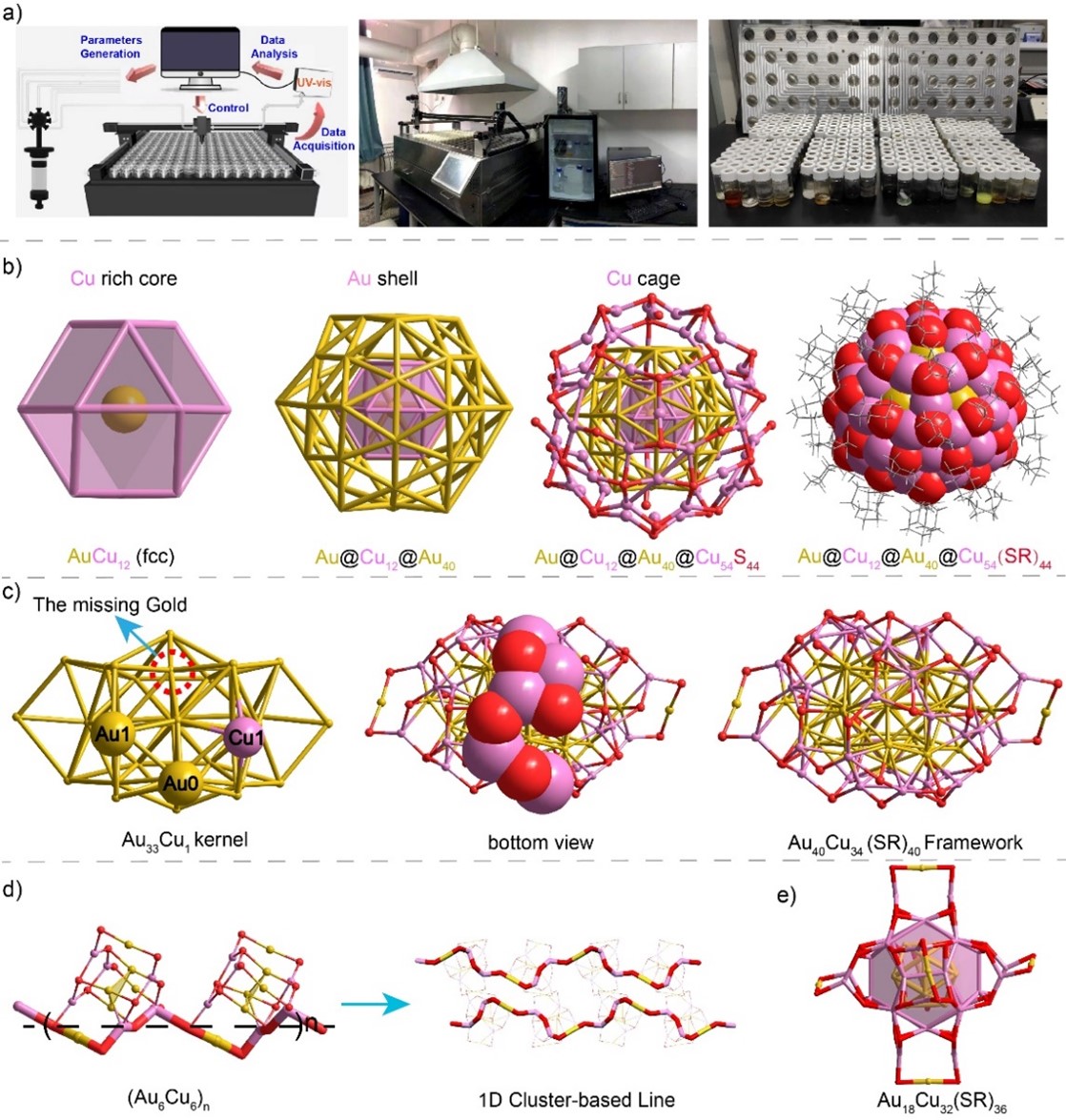
Figure 1: (a) Schematic illustration of the high-throughput synthesis process for nanoclusters. (b) Structure anatomy of Au41Cu66. (c) Structure anatomy of Au40Cu34. (d) Structure of Au6Cu6. (e) Structure of Au18Cu32.
In detail, they engineered a high-throughput synthesis platform capable of conducting up to 260 reactions simultaneously, successfully synthesizing three nanoclusters (namely, Au41Cu66, Au18, Cu-NC nanoclusters) in one go. Subsequently, machine learning was introduced to analyze the experimental data to guide the synthesis of nanoclusters. The innovative approach of utilizing decision tree analysis and random forest models to predict reaction yields not only provided insights into the relationship between reaction factors and products but also optimized the synthesis pathway for the products (Figure 1a). The results indicated three advantages of employing machine learning for this data analysis: it accelerated the process of discovering new products by reducing the number of required reactions; it facilitated the simultaneous regulation of multiple variables; and it effectively improved the yield of the products. Based on the optimal synthesis routes obtained, the authors, by altering ligands and metal types, leveraged the high-throughput platform to synthesize another three nanoclusters (namely, Au40Cu34, Au18Cu32, Au6Cu6, nanoclusters). It's worth noting that, structurally, Au41Cu66 emerges as the inaugural alloy nanocluster to integrate a cuboctahedral Au1Cu12 metal kernel, exhibiting superior thermal stability and oxidation resistance, as evidenced by its characterization results (Figure 1b); concurrently, the chiral nature of Au40Cu34 due to symmetry breaking (Figure 1c), and the one-dimensional linear chain structure of Au6Cu6, present particularly intriguing aspects (Figure 1d). These findings are expected to open up new avenues for future research on Au-Cu alloys and their applications. Furthermore, each iteration of experimental data, when harnessed for subsequent machine learning exercises, not only derives further optimized synthesis plans for the next experimental synthesis but also forms a cyclical feedback loop, significantly enhancing the efficiency of the synthesis process.
In summary, in the study of metal clusters, chemical synthesis should not restrict the use of any structural molecules designed to answer chemical questions. To this end, Shuxin Wang and co-workers have implemented a machine learning-assisted high-throughput platform to accelerate the discovery of metal nanoclusters. A series of Au41Cu66, Au40Cu34, Au18Cu32, Au18, Au6Cu6, Cu-NC nanoclusters were successfully synthesized through the high-throughput platform. Among them, the discovery of a Au41Cu66 nanocluster with an unprecedented AuCu face-centered cubic (FCC) core, a Au40Cu34 cluster exhibiting chirality due to symmetry breaking, and a unique Au6Cu6 cluster featuring a one-dimensional linear chain composed of distinct building blocks, were reported meticulously for the first time. This innovative approach not only heightened the synthetic efficiency of the nanoclusters but also provided robust guidance for the synthesis of a broader range of nanoclusters.
Acknowledgments
S.W. acknowledges the financial support provided by the National Natural Science Foundation of China (22171156 and 21803001), the Taishan Scholar Foundation of Shandong Province, and Startup Foundation of Qingdao University of Science and Technology.
Conflict of Interest
The authors declare that they have no conflict of interest.
References
2. Liu X, Cai X, Zhu Y. Catalysis Synergism by Atomically Precise Bimetallic Nanoclusters Doped with Heteroatoms. Acc Chem Res. 2023 Jun 20;56(12):1528-38.
3. Yuan YX, Zhang JN, Wang JR, Li K, Zang SQ. Chiral silver cluster-based light-harvesting systems: Enantioselective chirality transfer and amplified circularly polarized luminescence. Chem. 2024 Feb 21;10(6):1766-82.
4. Caschera D, Brugnoli B, Primitivo L, De Angelis M, Righi G, Pilloni L, et al. Synthesis of Photoluminescent 2D Self-Assembled Silver Thiolate Nanoclusters for Sensors and Biomolecule Support. Inorg Chem. 2024 Feb 26;63(8):3724-34.
5. Dong JP, Xu Y, Zhang XG, Zhang H, Yao L, Wang R, et al. Copper-Sulfur-Nitrogen Cluster Providing a Local Proton for Efficient Carbon Dioxide Photoreduction. Angew Chem Int Ed Engl. 2023 Nov 27;62(48):e202313648.
6. Lei Z, Zhao P, Guan ZJ, Nan ZA, Ehara M, Wang QM. 'Passivated Precursor' Approach to All-Alkynyl-Protected Gold Nanoclusters and Total Structure Determination of Au130. Chemistry. 2024 May 26:e202401094.
7. Tang L, Luo Y, Ma X, Wang B, Ding M, Wang R, et al. Poly‐Hydride [AuI7 (PPh3) 7H5](SbF6) 2 cluster complex: Structure, Transformation, and Electrocatalytic CO2 Reduction Properties. Angewandte Chemie. 2023 Mar 6;135(11):e202300553.
8. Arima D, Hidaka S, Yokomori S, Niihori Y, Negishi Y, Oyaizu R, et al. Triplet-Mediator Ligand-Protected Metal Nanocluster Sensitizers for Photon Upconversion. J Am Chem Soc. 2024 May 13.
9. Das AK, Biswas S, Pal A, Manna SS, Sardar A, Mondal PK, et al. A thiolated copper-hydride nanocluster with chloride bridging as a catalyst for carbonylative C-N coupling of aryl amines under mild conditions: a combined experimental and theoretical study. Nanoscale. 2024 Feb 15;16(7):3583-90.
10. Dong C, Huang RW, Sagadevan A, Yuan P, Gutiérrez-Arzaluz L, Ghosh A, et al. Isostructural Nanocluster Manipulation Reveals Pivotal Role of One Surface Atom in Click Chemistry. Angew Chem Int Ed Engl. 2023 Sep 11;62(37):e202307140.
11. Tang L, Deng S, Wang S, Pei Y, Zhu M. Total structural determination of alloyed Au15.37Cu16.63(S-Adm)20 nanoclusters with double superatomic chains. Chem Commun (Camb). 2021 Feb 25;57(16):2017-20.
12. Wu H, Anumula R, Andrew GN, Luo Z. A stable superatomic Cu6(SMPP)6 nanocluster with dual emission. Nanoscale. 2023 Feb 23;15(8):4137-42.
13. Wang S, Meng X, Das A, Li T, Song Y, Cao T, et al. A 200-fold quantum yield boost in the photoluminescence of silver-doped Ag(x)Au(25-x) nanoclusters: the 13th silver atom matters. Angew Chem Int Ed Engl. 2014 Feb 24;53(9):2376-80.
14. Qu M, Zhang FQ, Zhang GL, Qiao MM, Zhao LX, Li SL, et al. Cocrystallization-driven Formation of fcc-based Ag110 Nanocluster with Chinese Triple Luban Lock Shape. Angew Chem Int Ed Engl. 2024 Feb 12;63(7):e202318390.
15. Xu Z, Dong H, Gu W, He Z, Jin F, Wang C, et al. Lattice Compression Revealed at the ≈1 nm Scale. Angew Chem Int Ed Engl. 2023 Sep 25;62(39):e202308441.
16. Tang L, Ma A, Zhang C, Liu X, Jin R, Wang S. Total Structure of Bimetallic Core–Shell [Au42Cd40 (SR) 52] 2− Nanocluster and Its Implications. Angewandte Chemie International Edition. 2021 Aug 9;60(33):17969-73.
17. Sakthivel NA, Dass A. Aromatic thiolate-protected series of gold nanomolecules and a contrary structural trend in size evolution. Accounts of Chemical Research. 2018 Jul 20;51(8):1774-83.
18. Nasaruddin RR, Chen T, Yan N, Xie J. Roles of thiolate ligands in the synthesis, properties and catalytic application of gold nanoclusters. Coordination Chemistry Reviews. 2018 Aug 1;368:60-79.
19. Wang S, Jin S, Yang S, Chen S, Song Y, Zhang J, et al. Total structure determination of surface doping [Ag46Au24 (SR) 32](BPh4) 2 nanocluster and its structure-related catalytic property. Science Advances. 2015 Aug 14;1(7):e1500441.
20. Tang L, Kang X, Wang X, Zhang X, Yuan X, Wang S. Dynamic metal exchange between a metalloid silver cluster and silver (I) thiolate. Inorganic Chemistry. 2021 Feb 12;60(5):3037-45.
21. Brust M, Walker M, Bethell D, Schiffrin DJ, Whyman R. Synthesis of thiol-derivatised gold nanoparticles in a two-phase liquid–liquid system. Journal of the Chemical Society, Chemical Communications. 1994(7):801-2.
22. Fang L, Fan W, Bian G, Wang R, You Q, Gu W, et al. Sandwich-Kernelled AgCu Nanoclusters with Golden Ratio Geometry and Promising Photothermal Efficiency. Angew Chem Int Ed Engl. 2023 Sep 4;62(36):e202305604.
23. Hostetler MJ, Green SJ, Stokes JJ, Murray RW. Monolayers in three dimensions: synthesis and electrochemistry of ω-functionalized alkanethiolate-stabilized gold cluster compounds. Journal of the American Chemical Society. 1996 May 1;118(17):4212-3.
24. Whetten RL, Khoury JT, Alvarez MM, Murthy S, Vezmar I, Wang ZL, et al. Nanocrystal gold molecules. Advanced Materials. 1996 May;8(5):428-33.
25. Liao L, Yao C, Wang C, Tian S, Chen J, Li MB, et al. Quantitatively monitoring the size-focusing of Au nanoclusters and revealing what promotes the size transformation from Au44 (TBBT) 28 to Au36 (TBBT) 24. Analytical Chemistry. 2016 Dec 6;88(23):11297-301.
26. Jin R, Qian H, Wu Z, Zhu Y, Zhu M, Mohanty A, et al. Size focusing: a methodology for synthesizing atomically precise gold nanoclusters. The Journal of Physical Chemistry Letters. 2010 Oct 7;1(19):2903-10.
27. Muhammed MA, Aldeek F, Palui G, Trapiella-Alfonso L, Mattoussi H. Growth of in situ functionalized luminescent silver nanoclusters by direct reduction and size focusing. ACS Nano. 2012 Oct 23;6(10):8950-61.
28. Dharmaratne AC, Krick T, Dass A. Nanocluster size evolution studied by mass spectrometry in room temperature Au25(SR)18 synthesis. J Am Chem Soc. 2009 Sep 30;131(38):13604-5.
29. Tang L, Kang X, Wang S, Zhu M. Light-Induced Size-Growth of Atomically Precise Nanoclusters. Langmuir. 2019 Sep 24;35(38):12350-5.
30. Jana A, Unnikrishnan PM, Poonia AK, Roy J, Jash M, Paramasivam G, et al. Carboranethiol-Protected Propeller-Shaped Photoresponsive Silver Nanomolecule. Inorg Chem. 2022 Jun 13;61(23):8593-03.
31. Wang YX, Zhang J, Su HF, Cui X, Wei CY, Li H, et al. Photochemical Synthesis of Atomically Precise Ag Nanoclusters. ACS Nano. 2023 Jun 27;17(12):11607-15.
32. Zhu ZM, Zhao Y, Zhao H, Liu C, Zhang Y, Fei W, et al. Photochemical Route for Synthesizing Atomically Precise Metal Nanoclusters from Disulfide. Nano Lett. 2023 Aug 23;23(16):7508-15.
33. Zhu M, Lanni E, Garg N, Bier ME, Jin R. Kinetically controlled, high-yield synthesis of Au25 clusters. J Am Chem Soc. 2008 Jan 30;130(4):1138-9.
34. Liu XH, Wang FH, Shao CY, Du GF, Yao BQ. Kinetically controlled synthesis of atomically precise Ag nanoclusters for the catalytic reduction of 4-nitrophenol. International Journal of Minerals, Metallurgy and Materials. 2021 Oct;28:1716-25.
35. Chen Y, Wang J, Liu C, Li Z, Li G. Kinetically controlled synthesis of Au 102 (SPh) 44 nanoclusters and catalytic application. Nanoscale. 2016;8(19):10059-65.
36. Chen S, Wang S, Zhong J, Song Y, Zhang J, Sheng H, et al. The structure and optical properties of the [Au18 (SR) 14] nanocluster. Angewandte Chemie. 2015 Mar 2;127(10):3188-92.
37. Yang S, Chai J, Song Y, Fan J, Chen T, Wang S, et al. In situ two-phase ligand exchange: a new method for the synthesis of alloy nanoclusters with precise atomic structures. Journal of the American Chemical Society. 2017 Apr 26;139(16):5668-71.
38. Dou X, Wang X, Qian S, Liu N, Yuan X. From understanding the roles of tetraoctylammonium bromide in the two-phase Brust–Schiffrin method to tuning the size of gold nanoclusters. Nanoscale. 2020;12(38):19855-60.
39. Qian H, Zhu M, Andersen UN, Jin R. Facile, large-scale synthesis of dodecanethiol-stabilized Au38 clusters. The Journal of Physical Chemistry A. 2009 Apr 23;113(16):4281-4.
40. Zhao J, Ziarati A, Rosspeintner A, Wang Y, Bürgi T. Engineering ligand chemistry on Au 25 nanoclusters: from unique ligand addition to precisely controllable ligand exchange. Chemical Science. 2023;14(28):7665-74.
41. Gratious S, Mahal E, Thomas J, Saha S, Nair AS, Adarsh KV, et al. “Visualizing” the partially reversible conversion of gold nanoclusters via the Au 23 (S-c-C 6 H 11) 17 intermediate. Chemical Science. 2024.
42. Tang L, Wang B, Wang R, Wang S. Alloying and dealloying of Au 18 Cu 32 nanoclusters at precise locations via controlling the electronegativity of substituent groups on thiol ligands. Nanoscale. 2023;15(4):1602-8.
43. Hosier CA, Ackerson CJ. Regiochemistry of Thiolate for Selenolate Ligand Exchange on Gold Clusters. J Am Chem Soc. 2019 Jan 9;141(1):309-14.
44. Tang L, Duan T, Pei Y, Wang S. Synchronous Metal Rearrangement on Two-Dimensional Equatorial Surfaces of Au-Cu Alloy Nanoclusters. ACS Nano. 2023 Mar 14;17(5):4279-86.
45. Truttmann V, Herzig C, Illes I, Limbeck A, Pittenauer E, Stöger-Pollach M, et al. Ligand engineering of immobilized nanoclusters on surfaces: ligand exchange reactions with supported Au11(PPh3)7Br3. Nanoscale. 2020 Jun 25;12(24):12809-16.
46. Buitrago Santanilla A, Regalado EL, Pereira T, Shevlin M, Bateman K, Campeau LC, et al. Organic chemistry. Nanomole-scale high-throughput chemistry for the synthesis of complex molecules. Science. 2015 Jan 2;347(6217):49-53.
47. Perera D, Tucker JW, Brahmbhatt S, Helal CJ, Chong A, Farrell W, et al. A platform for automated nanomole-scale reaction screening and micromole-scale synthesis in flow. Science. 2018 Jan 26;359(6374):429-434.
48. Chen P, Tang Z, Zeng Z, Hu X, Xiao L, Liu Y, et al. Machine-learning-guided morphology engineering of nanoscale metal-organic frameworks. Matter. 2020 Jun 3;2(6):1651-66.
49. Chen T, Li J, Cai P, Yao Q, Ren Z, Zhu Y, et al. Identification of chemical compositions from “featureless” optical absorption spectra: Machine learning predictions and experimental validations. Nano Research. 2023 Mar;16(3):4188-96.
50. Mastracco P, Gonzàlez-Rosell A, Evans J, Bogdanov P, Copp SM. Chemistry-Informed Machine Learning Enables Discovery of DNA-Stabilized Silver Nanoclusters with Near-Infrared Fluorescence. ACS Nano. 2022 Oct 25;16(10):16322-31.
51. Tang L, Wang L, Wang B, Pei Y, Wang S. Discovering Syntheses of Atomically Precise Metal Nanoclusters by Applying Machine Learning to a High-Throughput Platform. Chemistry. 2024 May 23:e202302602.