

Abstract
The methodology employed in this study demonstrates coherence through its integrative approach. Numerous reviews have thoroughly documented the impacts of various environmental stresses on plant physiology and morphology. In this context, the present review focuses on the effects of major abiotic stressors, drought, salinity, temperature extremes, light stress, heavy metals, and air pollution, on plant physiology and morphology, while also addressing selected biotic stresses. Our main goal is to compile current molecular and physiological insights that enhance plant resilience under these abiotic challenges, particularly with regard to genetic regulation, signaling pathways, and adaptive metabolic processes. By integrating transcriptomic, metabolomic, and genetic data, we explore how plants perceive and respond to stress, with particular emphasis on genetic tolerance factors. Beyond summarizing existing knowledge, this review critically synthesizes inconsistent findings across model and non-model species, evaluates the reliability of molecular markers under field conditions, and highlights emerging regulatory mechanisms, such as non-coding RNAs and epigenetic regulation, that offer untapped potential for crop improvement.
Keywords
ROS signaling, Gene networks, Abiotic stress, Biotic stress
Introduction
Agricultural systems are increasingly challenged by the intensification of abiotic and biotic stresses associated with climate variability and environmental change. As sessile organisms, plants cannot escape unfavorable environments and therefore rely on sophisticated genetic, molecular, and physiological mechanisms to perceive stress signals and mount adaptive responses [1]. Central to these responses is the accumulation of osmoprotective and antioxidant molecules, together with the activation of coordinated antioxidant systems that maintain cellular redox homeostasis and limit damage caused by reactive oxygen species (ROS) (Figure 1). Over evolutionary time, plants have developed complex regulatory networks that integrate environmental perception with metabolic reprogramming and developmental plasticity. Among these regulatory layers, epigenetic mechanisms, particularly DNA methylation, have emerged as key modulators of stress-responsive gene expression and may contribute to the inheritance of adaptive traits across generations [2,3]. Although the functional stability and agronomic relevance of stress-induced epigenetic modifications still require further experimental validation, the targeted manipulation of epigenetic pathways represents a promising avenue for enhancing crop resilience. At the same time, advances in bioinformatics and integrated multi-omics approaches are transforming our understanding of plant resilience by revealing dynamic interactions among genes, proteins, metabolites, and regulatory networks [4]. In parallel, systems biology approaches combined with machine learning methods are improving the prediction of genotype x environment interactions and facilitating the identification of key molecular targets for precision breeding and genome-editing strategies such as CRISPR-based technologies [5,6]. High-throughput sequencing platforms have further accelerated the discovery of transcription factors and regulatory genes associated with tolerance to multiple environmental stresses. In this review, we propose an integrative framework that highlights multi-omics approaches and the central role of redox regulation in coordinating stress responses and promoting resilient agricultural systems. By integrating advances in molecular biology, systems biology, and crop science, this perspective provides a conceptual foundation for future research and supports the development of climate-resilient crops that can sustain productivity under increasingly variable environmental conditions.
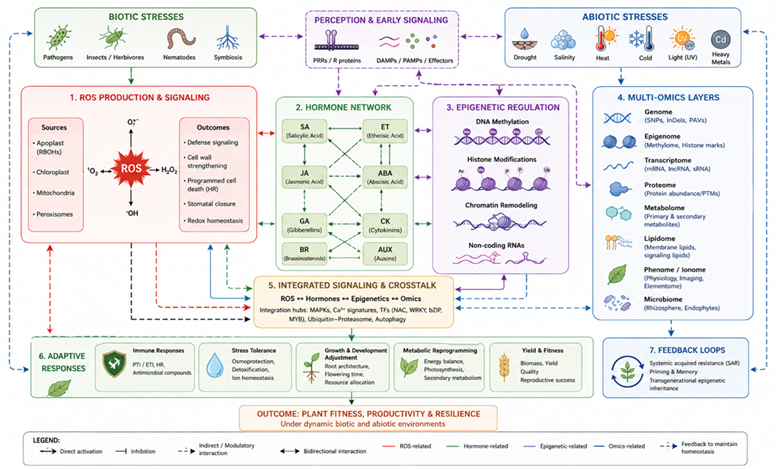
Figure 1. Integrated network of plant responses to biotic and abiotic stress involving ROS signaling, hormonal crosstalk, epigenetic regulation, and multi-omics layers.
Summary
The methodology employed in this study demonstrates coherence through its integrative approach. Numerous reviews have thoroughly documented the impacts of various environmental stresses on plant physiology and morphology. In this context, the present review focuses on the effects of major abiotic stressors, drought, salinity, temperature extremes, light stress, heavy metals, and air pollution, on plant physiology and morphology, while also addressing selected biotic stresses. Our main goal is to compile current molecular and physiological insights that enhance plant resilience under these abiotic challenges, particularly with regard to genetic regulation, signaling pathways, and adaptive metabolic processes. By integrating transcriptomic, metabolomic, and genetic data, we explore how plants perceive and respond to stress, with particular emphasis on genetic factors that confer tolerance. Beyond summarizing existing knowledge, this review critically synthesizes inconsistent findings across model and non-model species, evaluates the reliability of molecular markers under field conditions, and highlights emerging regulatory mechanisms, such as non-coding RNAs and epigenetic regulation, that offer untapped potential for crop improvement.
Effects of Abiotic Stresses on Plant
Abiotic stresses such as drought, salinity, extreme temperatures, heavy metal contamination, and high light or ultraviolet radiation significantly affect plant growth and productivity by disrupting key physiological and biochemical processes. Drought stress reduces cellular turgor pressure, promotes stomatal closure, and limits plant growth and photosynthetic activity (Table 1). In response, plants activate adaptive mechanisms, including osmotic adjustment, root system elongation, and abscisic acid (ABA)-mediated signaling pathways, often involving genes such as DREB2A, late embryogenesis abundant (LEA) proteins, and aquaporins [7]. Salinity stress causes ion toxicity, osmotic imbalance, and oxidative stress. Plants counteract these effects through ion homeostasis, antioxidant defense systems, and the accumulation of compatible solutes, with important molecular regulators including HKT1, SOS1, NHX1, and several microRNAs [8]. High-temperature stress leads to protein denaturation, membrane instability, and reduced fertility, triggering heat-shock responses and membrane stabilization mediated by heat shock proteins such as HSP101 and OsBHT, as well as heat shock transcription factors (HSFs) [7]. Conversely, cold and freezing stress cause membrane rigidification, ice crystal formation, and photoinhibition, prompting the accumulation of cryoprotectants, cold acclimation processes, and pathways regulated by genes such as CBF/DREB1, cold-responsive (COR) genes, and VaERF057 (Table 1) [9,10]. Heavy metal accumulation in soil poses a major constraint on crop productivity by disrupting plant physiology and metabolism through tightly interconnected processes. Metals such as Fe, Zn, Pb, and As perturb redox homeostasis, impairing enzymatic activity, photosynthesis, and energy metabolism, whereas Mo, Mn, Cu, Hg, Cr, Co, Ni, and Cd adversely affect growth, root architecture, and nutrient acquisition [11]. These effects are synergistic rather than isolated; metal interactions amplify oxidative stress, accelerate senescence, and disrupt beneficial symbioses such as nodulation, collectively reducing plant resilience. Consequently, biomass accumulation declines, yield quality deteriorates, and the sustainability of agricultural systems is compromised. At the mechanistic level, plant responses involve the coordinated regulation of metal uptake, transport, and detoxification pathways, as well as extensive crosstalk among stress-signaling networks. Tolerance strategies include metal chelation, activation of antioxidant systems, and intracellular sequestration mediated by metallothioneins, phytochelatins, and ZIP transporters. Importantly, heavy metal stress often co-occurs with other abiotic constraints. For instance, excessive light and ultraviolet radiation exacerbate photooxidative damage, inducing DNA lesions and pigment degradation. Plants counteract these combined stresses through integrated signaling pathways involving photoreceptors, flavonoid biosynthesis, and circadian regulation, with key regulators such as UVR8, HY5, and APX2. Understanding these multilayered interactions is essential for designing effective remediation strategies, improving genetic tolerance, and developing management practices that sustain crop productivity in contaminated environments.
|
Abiotic stress |
Physiological effects |
Perception and signaling mechanisms |
Molecular and biochemical responses |
Physiological and anatomical adjustments |
Key genes/regulatory factors |
|
Drought |
Water deficit, loss of cell turgor, stomatal closure, and reduced photosynthesis |
ABA accumulation, Ca²+, and ROS signaling |
Synthesis of osmolytes (proline and sugars), LEA proteins, aquaporins, and antioxidant enzymes |
Stomatal closure, deeper root systems, and reduced leaf area |
DREB, AREB/ABF, NCED, SnRK2 |
|
Salinity |
Ionic toxicity (Na+/Cl-), osmotic imbalance, and oxidative stress |
Osmotic and ionic sensing, SOS, and ABA pathways |
Vacuolar Na+ compartmentalization, osmoprotectant synthesis, and antioxidant activation |
Na+ exclusion from roots, maintenance of K+/Na+ homeostasis, and leaf succulence |
SOS1, NHX1, HKT1, DREB2A |
|
Heat |
Protein denaturation, membrane instability, and ROS overproduction |
HSF-mediated signaling and Ca²+/ROS pathways |
Accumulation of heat shock proteins (HSPs) and molecular chaperones |
Membrane fluidity adjustment, evaporative cooling, and metabolic acclimation |
HSFA1, HSP70, HSP101, MBF1c |
|
Cold/freezing |
Membrane rigidification, metabolic slowdown, and cellular injury |
Ca²+, ABA, and CBF mediated signaling pathways |
Accumulation of soluble sugars, antifreeze proteins, and antioxidants |
Osmotic adjustment and increased membrane lipid unsaturation |
CBF/DREB1, COR, ICE1 |
|
Flooding/hypoxia |
Oxygen deficiency, impaired respiration, and ethylene accumulation |
Ethylene, ROS, and NO-mediated signaling |
Activation of anaerobic fermentation and metabolic reprogramming |
Aerenchyma formation, stem elongation, and adventitious root development |
SUB1A, ADH1, ERF-VII |
|
Nutrient deficiency |
Growth inhibition, chlorosis, and reduced metabolic activity |
Nutrient sensing and hormonal signaling |
Nutrient remobilization and induction of nutrient transporters |
Root architecture remodeling and enhanced mycorrhizal associations |
PHR1, NRT, IRT1, SPX |
|
Heavy metal |
Cellular toxicity, oxidative damage, and enzyme inhibition |
ROS, MAPK, and phytohormone-mediated signaling |
Chelation by phytochelatins and metallothioneins, coupled with antioxidant defense |
Vacuolar sequestration and root exclusion mechanisms |
PCS1, MTs, ZIP, HMA |
|
UV radiation/high light |
Photoinhibition, DNA damage, and chloroplast impairment |
UVR8 photoreceptor-mediated and ROS signaling |
Flavonoid and carotenoid biosynthesis, along with DNA repair mechanisms |
Leaf thickening and photosynthetic reorganization |
UVR8, HY5, CHS |
Effects of Biotic Stresses on Plants
Biotic stresses imposed by herbivores, pathogens, and competing plants constitute dynamic constraints on agricultural productivity, the intensity and distribution of which are being profoundly reshaped by climate change. Global warming, rising CO2 concentrations, and the increasing frequency of extreme events not only expand the geographic ranges of insects and pathogens but also directly modulate plant molecular defense circuits, thereby altering both the efficiency and the costs of these responses. Herbivory by insects such as caterpillars (e.g., Manduca sexta) and aphids rapidly triggers inducible defense programs characterized by trichome formation, the accumulation of secondary metabolites, and the activation of hormonal networks dominated by jasmonic acid (JA) and ethylene (ET) [12]. These responses are coordinated by mitogen-activated protein kinase (MAPK) cascades, transcriptional regulators such as MYC2, and enzymes involved in jasmonate conjugation. A central feature linking these diverse biotic interactions is hormonal crosstalk: JA-, ET-, and salicylic acid (SA)-mediated pathways are highly context dependent and are often antagonized by abscisic acid (ABA), a key regulator of abiotic stress responses such as drought and heat. Under field conditions, where multiple stresses occur simultaneously, these interactions can attenuate immune responses and compromise the effectiveness of resistance mechanisms observed under controlled conditions. However, prolonged activation of these pathways entails substantial reallocation of carbon and energy, imposing physiological trade-offs between growth and defense, a cost that intensifies under adverse environmental conditions and combined-stress scenarios.
Plant–pathogen interactions further illustrate the complexity of these responses. Fungal pathogens such as Fusarium, Alternaria, Botrytis, and Puccinia compromise cellular integrity and plant metabolism, inducing defense mechanisms including cell wall reinforcement and the accumulation of pathogenesis-related proteins. These processes are largely regulated by chitin perception systems, WRKY transcription factors, and SA-dependent pathways. Similarly, bacterial pathogens, including Pseudomonas, Xanthomonas, and Ralstonia, elicit multilayered immune responses, including pattern-triggered immunity (PTI) and effector-triggered immunity (ETI) [13]. These pathways converge on callose deposition and transcriptional reprogramming coordinated by central regulators such as NPR1. Despite this sophistication, the high adaptive potential of bacterial and fungal populations, often facilitated by mobile genetic elements and rapid effector evolution, undermines the durability of resistance under field conditions.
Viral pathogens add an additional layer of complexity. Viruses such as tobacco mosaic virus (TMV), tomato yellow leaf curl virus (TYLCV), and cucumber mosaic virus (CMV) hijack host cellular machinery to establish systemic infections and are primarily countered by RNA silencing mechanisms and systemic acquired resistance. Although emerging biotechnological approaches, such as genome editing and RNA interference (RNAi), expand control strategies, high rates of viral mutation and recombination continue to constrain the development of durable, broad-spectrum resistance. Beyond herbivores and pathogens, weeds represent a persistent and often underestimated form of biotic stress. Species such as Amaranthus, Cyperus, and Echinochloa compete intensely for light, water, nutrients, and space, significantly reducing crop yields. Some crops respond by releasing allelopathic compounds, such as phenolic compounds and root exudates, that suppress competitors. However, the widespread evolution of herbicide resistance, combined with the limited genomic characterization of many weed species, constitutes a critical barrier to sustainable management. Notably, the evolutionary dynamics of herbicide resistance mirror those observed in pathogens, indicating that its durability is inherently limited under strong selective pressures in homogeneous agroecosystems.
Plant Responses to Biotic and Abiotic Stressors
Biotic and abiotic stresses are intensifying under ongoing climate change, thereby aggravating plant-pathogen interactions and further constraining crop productivity. These environmental pressures impair photosynthetic efficiency, shorten plant lifespan, and contribute significantly to yield losses occurring both before and after harvest. Plant responses to such stress conditions are partly mediated by phytohormones, which act as central signaling molecules coordinating complex regulatory networks that control physiological adjustments and molecular defense pathways [13]. Advances in molecular biotechnology have substantially expanded the range of tools available for managing plant diseases. Genome editing approaches, particularly CRISPR/Cas9 systems, along with RNA interference (RNAi), enable precise modification or silencing of plant susceptibility genes and disruption of viral genomes. These strategies have enabled the development of targeted and potentially durable resistance mechanisms against diverse pathogens. Complementary transgenic strategies that introduce resistance determinants, including genes encoding antimicrobial peptides, have also demonstrated considerable promise for producing crop varieties with stable, broad-spectrum pathogen resistance. At the same time, the application of multi-omics technologies has greatly improved our understanding of plant–pathogen interactions across variable environmental contexts. In particular, transcriptomic and metabolomic approaches have revealed key molecular and biochemical pathways involved in stress perception and defense responses, thereby supporting the development of more precise and sustainable strategies for plant disease management. In addition to molecular defense mechanisms, plants exhibit remarkable phenotypic plasticity, enabling them to modify their growth and development in response to environmental variability. This plasticity constitutes a fundamental adaptive strategy for coping with both biotic and abiotic stresses [14]. Such responses involve coordinated morphophysiological and biochemical adjustments, including changes in root system architecture, photosynthetic activity, hormonal homeostasis, and secondary metabolite production. These processes are regulated by intricate hormonal cross-talk involving auxins, cytokinins, abscisic acid (ABA), and ethylene, whose effects depend on tissue type, developmental stage, and environmental conditions.
Antioxidant Defense Mechanisms in Plants under Stress
Environmental stresses such as drought, salinity, and high temperature disrupt cellular metabolism and frequently result in the excessive production of reactive oxygen species (ROS). Although ROS function as key signaling molecules involved in stress perception and downstream gene regulation, their uncontrolled accumulation can damage lipids, proteins, and nucleic acids (Figure 1). To maintain redox homeostasis while preserving ROS-mediated signaling, plants rely on a sophisticated antioxidant defense network composed of both enzymatic and non-enzymatic components [7]. The enzymatic antioxidant system includes superoxide dismutase (SOD), catalase (CAT), ascorbate peroxidase (APX), glutathione peroxidase (GPX), glutathione reductase (GR), monodehydroascorbate reductase (MDHAR), and dehydroascorbate reductase (DHAR), as well as additional peroxidases and peroxiredoxins. These enzymes operate across multiple cellular compartments, including chloroplasts, mitochondria, and peroxisomes, where they detoxify ROS generated during stress conditions (Figure 1). Complementing these enzymatic defenses, non-enzymatic antioxidants such as ascorbic acid, glutathione, tocopherols, carotenoids, flavonoids, alkaloids, and several non-protein amino acids contribute to redox buffering by scavenging free radicals and stabilizing cellular redox balance. A central hub of this antioxidant network is the ascorbate–glutathione cycle, which coordinates multiple redox reactions to ensure efficient detoxification of hydrogen peroxide. In this pathway, superoxide radicals are first converted into hydrogen peroxide by SOD, after which enzymes such as CAT, APX, and GPX catalyze its reduction. The regeneration of reduced antioxidants is sustained by MDHAR, DHAR, and GR, which recycle oxidized forms of ascorbate and glutathione, thereby maintaining cellular redox buffering capacity. Importantly, antioxidant systems are tightly integrated with broader stress signaling networks. ROS accumulation can activate mitogen-activated protein kinase (MAPK) cascades, calcium-dependent signaling pathways, and phytohormone-mediated responses involving abscisic acid (ABA), salicylic acid (SA), and jasmonic acid (JA) [15,16]. These signaling pathways regulate the transcription of genes encoding antioxidant enzymes, osmoprotectant biosynthesis pathways, and molecular chaperones. For example, ABA-dependent signaling under drought and salinity stress promotes stomatal regulation and enhances antioxidant capacity, whereas heat stress induces ROS-mediated signaling pathways that coordinate the expression of heat shock proteins and other protective mechanisms.
Multi-omics Approach
Omics-based technologies are now widely regarded as foundational for dissecting plant responses to abiotic stress; however, their translational value is often overstated relative to their actual explanatory power [4–6]. At the genomic level, although the identification of stress-associated genes and quantitative trait loci (QTLs) has been accelerated by single-nucleotide polymorphism (SNP) genotyping, genome-wide association studies (GWAS), and CRISPR-enabled target discovery, these approaches frequently yield associations with limited mechanistic resolution. Their utility in breeding pipelines (marker-assisted selection, genomic selection, and genome editing) is therefore constrained by the highly polygenic architecture of stress tolerance and the pervasive influence of genotype × environment interactions, which routinely undermine predictive transferability across conditions [17,18]. Transcriptomics has similarly expanded descriptive resolution without necessarily improving functional inference. RNA sequencing consistently identifies large sets of differentially expressed genes and highlights canonical stress-responsive transcription factor families (e.g., DREB, NAC, WRKY), yet these signatures often lack reproducibility across tissues, developmental stages, and experimental conditions. Moreover, bulk RNA-seq masks cellular heterogeneity, while more informative single-cell and high-temporal-resolution approaches remain technically and financially limiting in most plant systems. Most critically, transcript abundance is a poor proxy for functional output, restricting interpretation of transcriptional networks as causal regulatory architectures rather than correlative expression patterns.
Proteomics was expected to bridge this gap, yet in practice, it has revealed additional layers of discordance rather than integration. Although mass spectrometry–based platforms have identified stress-responsive proteins such as heat shock proteins and antioxidant enzymes, proteome coverage remains biased toward abundant, soluble fractions, with persistent underrepresentation of regulatory, membrane-associated, and low-abundance proteins. Methodological variability in extraction, quantification, and normalization further limits cross-study comparability. Importantly, the generally weak correlation between transcript and protein abundance is not merely a technical artifact but reflects pervasive post-transcriptional, translational, and protein turnover controls that remain insufficiently resolved in plant stress biology. Metabolomics provides the most immediate readout of stress physiology, yet it is arguably the most context-dependent and least stable of the omics layers. Although GC–MS, LC–MS, and NMR-based approaches capture key osmoprotectants, antioxidants, and secondary metabolites, metabolite profiles are highly sensitive to sampling time, microenvironmental variation, and developmental stage. Incomplete chemical coverage and platform-specific biases further constrain quantitative comparability and pathway-level interpretation. As a result, metabolomics often yields fragmented, condition-specific snapshots rather than robust system-level representations of stress adaptation.
Epigenomics has been proposed as a mechanism underpinning stress memory and heritable adaptation, but the field remains both methodologically and conceptually unsettled. While bisulfite sequencing and ChIP-seq have identified stress-associated DNA methylation and chromatin modifications, the functional interpretation of these marks is frequently ambiguous. Many reported epigenetic changes are transient, reversible, or secondary consequences of transcriptional reprogramming rather than stable regulatory determinants. Disentangling causal epigenetic regulation from downstream stress effects remains a major unresolved challenge, compounded by tissue heterogeneity and limited cell-type resolution in most studies. Taken together, oxidative stress research starkly illustrates the limited integrative power of current omics frameworks. Although genomics, transcriptomics, proteomics, and metabolomics each capture distinct components of redox regulation, ranging from QTLs and gene expression changes to antioxidant enzymes and metabolites such as ascorbate, glutathione, and flavonoids, cross-layer concordance remains consistently weak. This fragmentation reflects not only biological complexity but also fundamental mismatches in temporal resolution, spatial specificity, and analytical sensitivity across platforms. Consequently, most multi-omics studies remain largely descriptive rather than predictive, underscoring the persistent gap between data accumulation and mechanistic understanding in plant stress biology.
Conclusions and Future Perspectives
The increasing frequency and intensity of environmental stresses represent one of the most critical challenges for global agriculture in the twenty-first century. Plants are frequently exposed to complex combinations of abiotic and biotic constraints that interact across multiple biological scales, influencing growth, productivity, and survival. As highlighted in this review, plant resilience emerges from highly coordinated regulatory networks that integrate environmental sensing, hormonal signaling, redox homeostasis, and transcriptional reprogramming. These interconnected systems enable dynamic adjustment of metabolism, development, and defense responses to maintain cellular stability under fluctuating conditions. A central theme emerging from recent research is the pivotal role of oxidative signaling and antioxidant defense mechanisms in mediating stress adaptation. Reactive oxygen species (ROS) act not only as damaging by-products of stress but also as critical signaling molecules coordinating responses across cellular compartments. The balance between ROS production and detoxification maintained through enzymatic and non-enzymatic antioxidant systems represents a fundamental determinant of stress tolerance. These redox processes are tightly integrated with hormonal signaling and calcium-dependent pathways, collectively regulating downstream gene expression and metabolic adjustments.
Although multi-omics approaches have substantially expanded our understanding of plant stress biology and enabled the identification of candidate genes, regulatory networks, and metabolic pathways associated with stress tolerance, their translation into consistent field-level improvements remains limited. Several studies have successfully employed integrated transcriptomic, metabolomic, and genomic analyses to identify targets subsequently validated through breeding strategies or genome editing. However, many discoveries obtained under controlled conditions fail to perform consistently in agricultural environments due to the complexity of genotype × environment (G×E) interactions, the temporal variability of molecular responses, and the limited capacity for large-scale field phenotyping. Under controlled experimental conditions, omics signatures frequently represent transient molecular states that do not necessarily predict emergent agronomic traits such as yield stability, phenotypic plasticity, and long-term resilience. In addition, the high dimensionality of multi-omics datasets, combined with limited validation across multiple environments, often results in models with low predictive power and reduced transferability. Future advances will therefore depend on integrative frameworks that combine multi-omics, high-throughput phenotyping, environmental metadata, and artificial intelligence to model genotype × environment × management (G×E×M) interactions across diverse agricultural systems. Such approaches may enable the development of more mechanistic, robust, and field-applicable predictive models, thereby accelerating the breeding and engineering of crops with enhanced resilience to climate change.
Author Contributions: CRediT
Raymond Joseph: Conceptualization, Methodology, Investigation, Writing – original draft, Writing – review and editing. Luciano Carlos Da Maia: Conceptualization, Methodology, Investigation, Writing – original draft, Writing – review and editing. Allisson Ferreira Ramires: Conceptualization, Methodology, Investigation, Writing – original draft, Writing – review and editing. Judson Cheristin: Conceptualization, Methodology, Investigation, Writing – original draft, Writing – review and editing. Antonio Costa De Oliveira: Project administration, Resources, Validation, Supervision, Writing – review and editing.
References
2. Galviz YC, Ribeiro RV, Souza GM. Yes, plants do have memory. Theor Exp Plant Physiol. 2020 Sep;32(3):195–202.
3. Lloyd JPB, Lister R. Epigenome plasticity in plants. Nat Rev Genet. 2022 Jan;23(1):55–68.
4. Joseph R, Apollon W, Jean-Baptiste MC, Costa de Oliveira A. Plant resilience under abiotic stress: all for one or one for all?. Plant and Soil. 2026 Apr 24:1–38.
5. Neto JBS, Brito LF, Mota LFM, Rodrigues GRD, Baldi F. Modeling genotype-by-environment interactions across climatic conditions reveals environment-specific genomic regions and candidate genes underlying feed efficiency traits in tropical beef cattle. Sci Rep. 2026 Jan 5;16(1):643.
6. Wang P, Lehti-Shiu MD, Lotreck S, Segura Abá K, Krysan PJ, Shiu SH. Prediction of plant complex traits via integration of multi-omics data. Nat Commun. 2024 Aug 10;15(1):6856.
7. Zhang H, Zhu J, Gong Z, Zhu JK. Abiotic stress responses in plants. Nat Rev Genet. 2022 Feb;23(2):104–19.
8. Waadt R, Seller CA, Hsu PK, Takahashi Y, Munemasa S, Schroeder JI. Plant hormone regulation of abiotic stress responses. Nat Rev Mol Cell Biol. 2022 Oct;23(10):680–94.
9. Baumann K. Stress Responses: Membrane-to-nucleus signals modulate plant cold tolerance. Nat Rev Mol Cell Biol. 2017 May;18(5):276–7.
10. Chinnusamy V, Zhu JK, Sunkar R. Gene regulation during cold stress acclimation in plants. Methods Mol Biol. 2010;639:39–55.
11. Xu D, Shen Z, Dou C, Dou Z, Li Y, Gao Y, et al. Effects of soil properties on heavy metal bioavailability and accumulation in crop grains under different farmland use patterns. Sci Rep. 2022 Jun 2;12(1):9211.
12. Gatehouse JA. Plant resistance towards insect herbivores: a dynamic interaction. New Phytol. 2002 Nov;156(2):145–69.
13. Jones JD, Dangl JL. The plant immune system. Nature. 2006 Nov 16;444(7117):323–9.
14. Stotz GC, Salgado-Luarte C, Escobedo VM, Valladares F, Gianoli E. Global trends in phenotypic plasticity of plants. Ecol Lett. 2021 Oct;24(10):2267–81.
15. Dong Q, Wallrad L, Almutairi BO, Kudla J. Ca2+ signaling in plant responses to abiotic stresses. J Integr Plant Biol. 2022 Feb;64(2):287–300.
16. Baxter A, Mittler R, Suzuki N. ROS as key players in plant stress signalling. J Exp Bot. 2014 Mar;65(5):1229–40.
17. Burgess DJ. Gene regulation: multiple mechanisms of small RNAs. Nat Rev Genet. 2015 Feb;16(2):70.
18. Joseph R, Apollon W, De Oliveira AC. The stressing point: how plants respond to environmental stimuli. Biotechnol Adv. 2025 Nov;84:108691.