

Abstract
Majority of tongue lacerations in children can be treated conservatively. Although there is controversy in management of tongue trauma, accepted indications for suture repair include complex injury, large flaps, and active bleeding. The purpose of this commentary is to highlight a unique severe injury pattern in a child.
A 3-year-old boy fell on a cemented floor causing a complex full-thickness midline longitudinal injury resulting in a bifid tongue. The patient underwent a successful surgical repair with good functional and aesthetic outcome.
Given the paucity of reports of such a description in the literature, this unique case of acquired traumatic pediatric bifid tongue will make clinicians aware of this presentation and its management.
Keywords
Tongue trauma, Tongue laceration, Bifid tongue, Tongue lesion
Introduction
The tongue is a complex muscular organ essential for speech, taste, chewing and swallowing [1]. Tongue injuries range in severity from minor lacerations to complete amputation. The most common location is anterior dorsum as a result of falls, seizures, self-mutilation, electroconvulsive therapy or child abuse [1,2]. Young children (age 3-4 years) are particularly prone to such injuries after falls [3,4].
The majority of these lacerations are horizontal in orientation [1]. In general, small lacerations of the tongue can be allowed to self-heal when wound margins are in good approximation [5]. Because suturing may predispose the tongue to invasive, closed-space infection and requires general anesthesia for children, surgical closure is recommended only in cases of larger wounds, profuse bleeding, muscle involvement, or full thickness injury [3-5]. This case describes the presentation and repair of a rare full-thickness longitudinal tongue laceration in a 3-year-old male.
Case Report
A 3-year-old healthy male presented to the Emergency Department with a laceration of the tongue after a fall, just prior to arrival. His mother reported that the child was playing in their cemented basement when she heard a loud sound. She did not believe that he landed on any object but found a large amount of blood at the scene. She denied any loss of consciousness, seizures, or neck stiffness. Child was unable to speak but without any respiratory distress or hemodynamic compromise. Of note, social services were consulted and excluded child abuse. Due to the severity of his injury, plastic surgery was consulted. The physical examination, with tongue at rest inside the mouth, revealed a 3.5 cm midline full- thickness laceration that extended to between one-half to two-thirds of free tongue, intact dentition and no foreign bodies (Figure 1).
We recommended emergent operative repair under general anesthesia. Once anesthetized with endotracheal tube, the tongue was exposed revealing a longitudinal full thickness laceration of the tongue through median fibrous septum. Two 0- Silk sutures were used to align the two halves of the tongue; devitalized edges were conservatively debrided, and hemostasis was obtained. Buried interrupted 2-0 Vicryl sutures were used to approximate middle muscular layer and 3-0 chromic running sutures were used along dorsal and ventral epithelium.
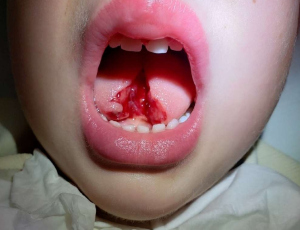
Figure 1: Acquired Bifid Tongue secondary to trauma.
The patient was monitored overnight for airway concerns and discharged the next morning. Early tongue mobilization was encouraged, non-steroidal analgesia was used, and liquid diet was started. The immediate postoperative course was completely unremarkable without any setbacks. The sutures were all absorbable. There was no deficit in speech, mobility and swallowing. At 6-month follow up visit, he was healing without any distortion (Figure 2). His parents denied any loss of sensation, taste, mobility, or speech (Figures 3 and 4).
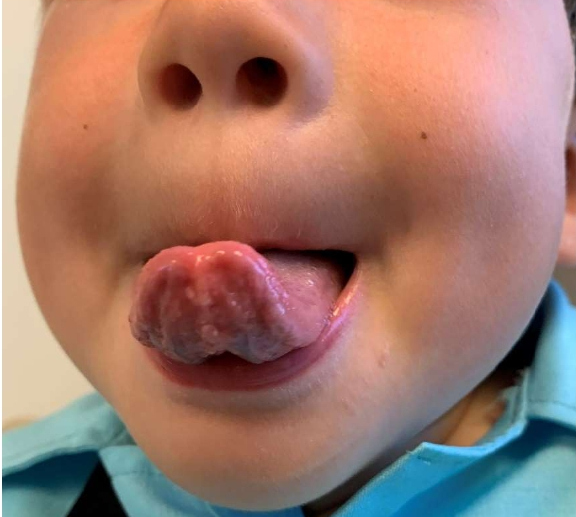
Figure 2: Healing status post repair of complex tongue laceration at 6-months follow-up.
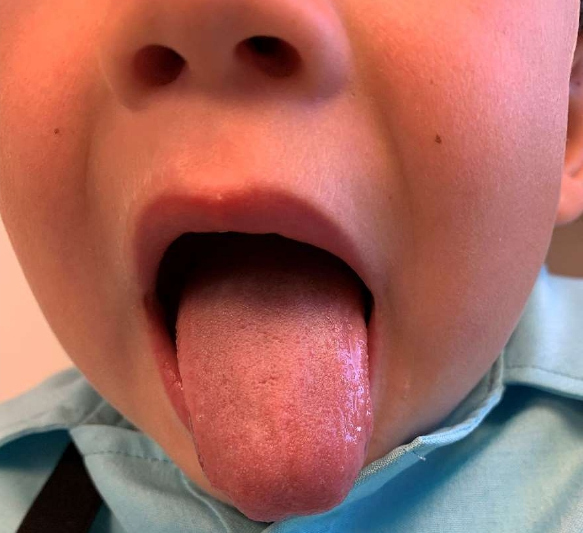
Figure 3: Healing status post repair of complex tongue laceration at 6-months follow-up.
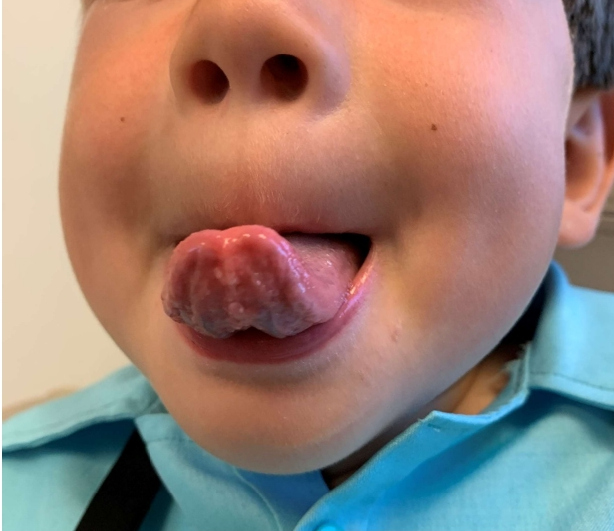
Figure 4: Healing status post repair of complex tongue laceration at 6-months follow-up.
Discussion
The severity of tongue injuries ranges from minor lacerations to complete amputation. Severe tongue injuries may lead to oral cavity dysfunction and reduction in the quality of life. While there is consensus in the management of extreme presentations, there is still debate whether less severe lacerations should be repaired with sutures or allowed to heal with secondary intention [3,6].
A prospective study of 28 pediatric patients with tongue trauma found the typical laceration was self-limiting and did not require intervention [4]. A retrospective study of 73 pediatric tongue trauma patients was used to develop Zurich Tongue Scheme to guide clinicians in determining when suturing is necessary. The authors recommend suturing for large flaps, uncontrolled bleeding, greater than 2 cm lacerations, and involvement of tip [3]. In general, interventions for severe tongue lacerations should begin as soon as possible,
preferably within 8 hours of injury as delay beyond 24 hours can worsen the outcome [2,4,7]. The technical aspects of the operation largely determine the postoperative functional and cosmetic recovery. The suture technique must close the muscular planes with absorbable sutures to stop the hemorrhage and prevent hematoma formation 1 with buried absorbable sutures to relieve tension [2]. Post-repair recommendation is liquid diet with rapid progression, oral hygiene and early mobility [2]. The potential complications of suturing include scarring, suture granuloma, and lisping [3]. In most trauma cases, the tongue is caught in between teeth and results in a horizontal- oriented injury. The injury in the present case is unique in being longitudinal and midline. The parents noted their basement is cemented with expansion joints separating concrete slabs. They suspect the child fell in a way that his tongue got caught between the teeth and expansion joint to cause the bifid pattern.
Anatomically, lingual arteries and veins run longitudinally along the ventral aspect of the tongue. The lingual nerve provides the somatic afferent innervation, chorda tympani fibers running with lingual nerve provides special visceral afferent sensation and hypoglossal nerve confers motor innervation [1]. The longitudinal midline nature of this injury preserved the laterally positioned neurovascular bundles. Therefore, no neurovascular repair was necessary. The full-thickness injury required multi-layered repair, including muscle layer, ventral mucosa, and dorsal mucosa.
An acquired bifid tongue in a child is an unusual presentation. Most cases of pediatric bifid tongue are congenital resulting from orofacial digital syndromes type I, II, IV and IV or syndromic cases such as Opitz G BBB syndrome, Klippel-Fiel anomaly or Larsen Syndrome [8]. This anomaly may also be seen in infants of Diabetic Mother Syndrome [9]. An acquired bifid tongue is more common in adults arising as a complication of tongue piercing or less frequently from intentional splitting. Both are forms of body art modifications that can lead to complications requiring surgical repair [10,11]. Given the severity of the injury in our patient, surgical repair under anesthesia was the obvious choice. In the operating room, the devitalized edges were freshened, and hemostasis was obtained. The tongue “halves” were orientated. Instead of selectively identifying individual muscle bundles, single layer of buried absorbable sutures were used followed by a second layer of running absorbable sutures. We believe, the midline location protected the neurovascular supply and resulted in a favorable outcome.
Conclusion
The presentation of tongue trauma varies, from minor injury requiring healing with secondary intention, to a major deformity requiring surgical repair. In our pediatric patient, a midline full- thickness laceration through median fibrous septum, resulted in an acquired bifid tongue. The patient underwent an immediate surgical repair. Given the midline location, neurovascular supply was protected, and patient enjoyed essentially a complete, uneventful recovery.
References
2. Das UM, Gadicherla P. Lacerated tongue injury in children. International Journal of Clinical Pediatric Dentistry. 2008 Sep;1(1):39.
3. Seiler M, Massaro SL, Staubli G, Schiestl C. Tongue lacerations in children: to suture or not?. Swiss Medical Weekly. 2018 Oct 22;148:w14683.
4. Lamell CW, Fraone G, Casamassimo PS, Wilson S. Presenting characteristics and treatment outcomes for tongue lacerations in children. Pediatric Dentistry. 1999 Jan 1;21:34-8.
5. English GM. Otolaryngology: a textbook. HarperCollins Publishers; 1976.
6. Brown DJ, Jaffe JE, Henson JK. Advanced laceration management. Emergency Medicine Clinics of North America. 2007 Feb 1;25(1):83-99.
7. Patel A. Tongue lacerations. British Dental Journal. 2008 Apr;204(7):355.
8. Surej KL, Kurien NM, Sivan MP. Isolated congenital bifid tongue. National Journal of Maxillofacial Surgery. 2010 Jul;1(2):187.
9. James AW, Culver K, Hall B, Golabi M. Bifid tongue: a rare feature associated with infants of diabetic mother syndrome. American Journal of Medical Genetics Part A. 2007 Sep 1;143(17):2035-9.
10. Fleming PS, Flood TR. Bifid tongue - a complication of tongue piercing. British Dental Journal. 2005 Mar;198(5):265-6.
11. Kang AS, Kang KS. Traumatic bifid tongue: A rare presentation in a child. Case report. Annals of Medicine and Surgery. 2020 Sep 1;57:11-3.