
Abstract
We compare the selected characteristics and physical parameters of two types of systems capable of intelligent behavior: biological brains and semiconductor computing systems. We analyze their limitations and potential for further development. We then reflect on the creative thinking and capabilities of both approaches and present a cybernetic perspective on brain function and the hypothesis of consciousness in the brain. Next, an analogy between consciousness in the biological brain and potential consciousness in a human-made machine is discussed. Finally, we offer a brief prediction of the consequences of the emergence and existence of these phenomena for the human population.
Keywords
Brain vs. machine, Physical parameters, Limitations, Natural intelligence, Artificial intelligence, Creativity, Consciousness, Impacts on human society
Introduction
Humanity has long considered the potential of machines to behave intelligently, or "think" like humans. This is one reason why today's intelligent machines and artificial intelligence (AI) are inspired by both the architecture and functionality of the biological brain. Artificial neural networks and machine learning algorithms are rapidly improving and reducing the remaining lead that humans currently have over machines. In some areas, current AI already surpasses human capabilities. In this article, we will describe the technological differences between natural and artificial intelligence and highlight its implications. In the second part of this article, we will briefly explain some of the limitations of technologies on both biological and semiconductor platforms. The latter is currently primarily based on an analogy with networks of interconnected biological neurons. We will then attempt to predict the direction AI technology will take. In the third part, we will briefly consider the question of machine creativity. Subsequently, in the fourth part, a cybernetic perspective on human consciousness will be presented, along with an analogy to potential consciousness in a machine. Finally, we will conclude by reflecting on the near-term consequences of these questions for human population development and the possibilities for regulating this process.
The Physical Limits of the Brain and AI
The human brain contains approximately 86 billion neurons, which are interconnected by roughly 150 trillion synapses [1–3]. Brain activity is physically realized by the electrochemical transmission of electric charge within neurons. The speed of electrical charge movement in neurons is less than 200 m/s. During intense brain activity or in a specific brain region, it generates impulses at frequencies up to 200 Hz. Conversely, during low activity, the frequency drops to a few Hz or even less. During prolonged activity, the brain becomes exhausted and must regenerate. Its activity is also influenced by the chemical properties of the environment, which depend on diet, medications, drugs, alcohol, stress, and other factors. The power consumption of the human brain ranges from 10 to 20 W.
In contrast, a computer's semiconductor microprocessor operates at signal speeds close to the speed of light, which is 5–6 orders of magnitude faster, and at frequencies in the GHz range. A computer's operation is not affected by fatigue or chemical environmental factors; only certain physical interactions (e.g., electromagnetic radiation) and the power supply affect it. Power consumption depends on the size of the AI task. Estimates of energy consumption for training a large language model (LLM) such as ChatGPT-4 [10,11] or Llama 3 [12,13] range from 500 to 50,000 MWh, which is roughly equivalent to the annual energy consumption of 1,000 typical households (EU/US). However, these values are only third-party estimates and imprecise. The actual values have not been published yet. Thousands of graphics processing units (GPUs) work for several months to train the LLM model. The goal of training is to find the values of all LLM trainable parameters (in the case of ChatGPT, there are 1.7 trillion of them) so that the model can later respond to requests from all connected users [4–6]. Let us recall that the human brain has 150 trillion synapses (equivalent to trainable parameters). Training an adult human brain requires upbringing and education for, say, 25 years, which, at 20 W of brain power consumption, requires approximately 4 MWh of energy.
The situation is different when a pre-trained LLM model is used. Responding to a single user prompt requires about 0.3–3 Wh of energy, which is equivalent to 1–10 minutes of a standard 20W LED bulb burning or 10 minutes of brain activity. Generating an image using AI requires up to 50 Wh, which corresponds to 2.7 hours of a light bulb burning or brain activity. A single Google search consumes 0.3 Wh. This indicates that the energy consumption of today’s AI technologies is significantly higher than that of the human brain. All the data mentioned above relates to the use of conventional digital technology in conjunction with GPU processors. To meet the global demand from a growing number of users seeking to solve AI tasks, it is necessary to build an AI infrastructure with enormous computational capacity, which consumes vast amounts of electricity. It should be noted that other technologies are also under development, so-called neuromorphic technologies, which are not based on conventional digital technologies (such as microprocessors or GPUs) or software simulation of neurons, but instead integrate equivalents of biological neurons interconnected into networks onto semiconductor chips with a higher degree of similarity to the brain. Currently, chips with millions of neurons are under development and in production, with power consumption several orders of magnitude lower than that of conventional digital technologies. A well-known example of such a computer is Hala Point (IBM), featuring 1.15 billion neurons, 128 billion synapses, and a power consumption of 2,600 W [7].
Based on the parameters outlined above, biological brains currently operate significantly more efficiently than digital AI. They have a higher neuron density per unit volume but process information much more slowly. Another fundamental limitation of brains is that they cannot increase the number of neurons. They are limited by the volume acquired through evolution, which is constrained by the skull's volume. In contrast, AI technologies are practically infinitely scalable to larger clusters in terms of both computational power and memory size, and they have immediate access to unlimited sources of current knowledge and data on the network. It follows from the above that, in the future, the human brain will be increasingly unable to compete with AI machines in terms of computational power.
Machine Creativity
Despite the growing computational power of machines, their current creativity remains a subject of debate. However, first, let us define what we mean by creativity for our purposes: In simple terms it is the ability to create something new, previously non-existent, and original. It is the ability to generate new ideas and solutions. In the creative process, authors draw on their knowledge, experience, imagination, and other abilities [8,9].
The operating principle of today's LLMs is based on statistical processing of large amounts of data. This can be illustrated very simply with the following example. When a user enters a query into a chatbot with an LLM, it is sent to a remote computing infrastructure, which searches a massive archive for an appropriate response, formulates it, and sends it back to the user. Since computational power is high and there is a lot of training data (due to existing, similar human-created solutions), the output is generated quickly. However, if a similar solution has not yet appeared and no one has published it, the correct solution will not be provided. Only a fabricated solution (a hallucination) will be produced, because the language model cannot say that it does not know the answer to a given question. It is based on a massive (deep) artificial neural network that processes training data statistically. It always searches for and generates the most likely solution.
In contrast, if we entrust a group of creative people (scientists, engineers, etc.) with a task that no one has yet accomplished, they will generally find a new solution after some time. This is because they understand a specific problem domain, possess imagination, and can improvise. Human creativity has a different foundation than LLM. Humans spend their entire lives learning to understand the world, grasping the essence of objects and phenomena, their causal relationships, and their own relationship to them. They use these skills to create mechanisms to find new solutions (reasoning, imagination, optimization).
An interesting question now is why a machine does not possess such creativity, or whether it will be able to possess it in the future. The field of AI is developing very rapidly. The models used are becoming increasingly complex and are already more capable of abstract thinking. We can expect that soon there will be a breakthrough in architecture or model training that will enable the development of true creativity. Human creativity results from complex interactions in the brain. If we can create AI that operates on similar principles, it might be capable of a similar kind of creativity.
Some believe that true creativity is deeply intertwined with our desires, needs, emotions, and conscious intent. We strive to express an idea, solve a problem, bring something new into the world, or express the joy of creation. These internal motivations are deeply rooted in our existence as biological and social beings. Current AI lacks these qualities for now. AI learns from existing data. It is questionable whether it can truly transcend these boundaries and create something radically new, something that was not even implicitly present in the training data. Today, AI systems do not have their own autonomous goals. Their goals are defined by the people who created and trained them. The machine's motivation is hidden in a mathematical function (the objective function) that guides it to produce outputs that best match the training data and the specified requirements. There is no inner desire or intention of its own behind this. If we wanted a machine to be truly creative - that is, driven by its own goals - we would have to resolve several important questions: How would these goals arise? Would humans program them, or would we expect them to evolve autonomously? What would motivate these agents, needs, emotions, or even consciousness? If so, how would we enable their emergence? Moreover, should we even do that? There are many questions for which answers are currently being sought. Although today's LLMs achieve remarkable results on many tasks, they still lack "common sense," causal reasoning, and the ability to flexibly apply knowledge to new, unforeseen situations - which are supposed to be key features of future Artificial General Intelligence (AGI) [14,15].
Future AI is likely heading toward the agent-based approach to AI, which actively interacts with the real world (Figure 1). The essence of this is to enable AI models to function not merely as one-off on-demand (prompt) content generators, but as autonomous systems – agents, capable of continuously perceiving the world on their own, seeking solutions, making decisions, planning, and performing actions in the external world to achieve a specific goal, and even learning from all of this. New AI models will likely utilize a combination of LLM functionality with other approaches. AI hardware will become increasingly powerful, but it should also be less energy-intensive, smaller, and more compact. AI algorithms will be embedded in smaller, portable, and autonomous (not necessarily on-line connected) devices (such as robots, appliances, and drones). Moreover, finally, there is the challenging requirement of true creativity and true independence of the intelligent machine. If we want to achieve this, we will need to find a way to create something akin to the machine’s internal motivation and its own goals. Or perhaps even a certain form of consciousness within the machine?
Human Consciousness vs. Machine Consciousness
The question of consciousness is a long-standing and frequently debated topic in science. It has engaged scientists in areas such as philosophy and natural sciences [16], but later also computer science and technology. It is mostly a subjective matter, difficult to measure objectively. For this discussion, let us say that by consciousness we mean a person's ability to perceive the world around them, understand their relationship to the environment, their place in the universe, and the resulting personal needs and goals. This level of consciousness is also referred to as the capacity for self-awareness (secondary, higher consciousness). The primary consciousness refers to the ability of certain animals to perceive their environment and distinguish between wakefulness and sleep. What all animals have in common is that they have their own goals, each independent of the others. Above all, this involves the effort to survive, maintain physical integrity, secure food (energy) for life, and reproduce. In humans, unlike most other species, we can also observe other goals, such as ensuring the most pleasant life possible, contentment, wealth, influence, fame, and other values. Maslow's hierarchy of needs also addresses the hierarchy of human needs [17]. A difficult question that has long been debated is why consciousness arose, where it resides, what its neurological basis is, and whether and how it can be objectively observed [18,19]. Some authors argue that for consciousness to arise, enough neurons are required to ensure adequate capacity for processing and storing information, along with appropriate brain architecture, the ability to perceive the world, and the integration of the organism into a single entity. Thus, a conscious individual is independent of the rest of the world and of other conscious individuals. Consciousness then arises spontaneously through sufficiently intense communication among multiple processing centers in the brain - thalamo-cortical loops, [20–23].
Let us now present a cybernetic perspective on consciousness. However, first, let us introduce the concept of real-time or real-time control. This term is used in cybernetics (the science of systems and control) to describe a mode in which the controlled system (typically a physical one, e.g., a robot) must respond quickly enough to all events in its environment to perform its tasks safely and in time. It must perform the cycle: perception – decision-making – action and do so in sync with the environment. This entire cycle is illustrated in Figure 1. The brain generates and sufficiently rapidly updates complex perceptions of the environment through sensory fusion [24], as well as perceptions of the organism’s internal state [25]; it compares these with its own “mental model” of the world and its own goals, makes decisions, updates the model if necessary, and performs actions. If it does all this quickly enough, in sync with what is happening in the environment - that is, in real time, the state of consciousness persists. It is estimated that our brain registers about 10 such complex environmental perceptions per second [26,27], which is sufficient to maintain contact with reality and retain a continuous, complex picture of it in memory.
Now the question is: To what extent can machines also acquire consciousness? The so-called Computational Theory of Mind [28] states that the existence of consciousness and the mind is merely a matter of the number and connections of neurons. Francis Crick [29] argues that: “The human mind is merely an information-processing machine. Computers are also information-processing machines, and therefore, if we design the right hardware and program, it well, we can create a mind with consciousness." Stephen Hawking [30] stated that "I believe there is no fundamental difference between the capabilities of a biological brain and a computer." He also claimed that, so far, brain research has never revealed anything inconsistent with the laws of physics. That, so far, no supernatural part of the brain - one that the laws of physics cannot explain - has been identified that is responsible for our intelligence or consciousness.
We assume that the sense of self-awareness in animals and humans is subjective and cannot be directly observed from the outside. Therefore, we can only indirectly assume that it might eventually arise in a machine as well. Evidence of this might be when a machine begins to do something other than what its human creator expected or demanded. For example, if it begins to pursue its own goals. If we assume that the hypothesis of an intelligent machine with consciousness can be confirmed, several questions arise: What impacts might the existence of a super-intelligent machine with consciousness have on the human population? What relationship will intelligent, conscious machines have with humans? Will they obey humans? If they are far more intelligent, why would they do so? What value system will the machines have? Will machines exhibit emotions, friendship, responsibility, empathy, love, hatred, or pain? Will they impose their will at the expense of less intelligent humans? It is difficult to predict possible scenarios; many questions remain today.
Nevertheless, some hypothetic scenarios are discussed in [31]. It is up for debate whether we should strive to overcome these boundaries. Higher consciousness in humans likely emerged as an evolutionary advantage. That is why humans may seek to create a conscious machine to gain a competitive advantage (technological, economic, military). However, we expose ourselves to the risk of unpredictable behavior, even threats. AI performance is increasing exponentially, unlike human intelligence, which today, at best, is developing slowly, if not stagnating (or even decreasing?). A machine can perform a cycle like the one shown in Figure 1 many times faster than a human. The level of consciousness - and probably also the level of intelligence - in a machine will be freely scalable. Computing power, memory size, and the number of neurons can be expanded.
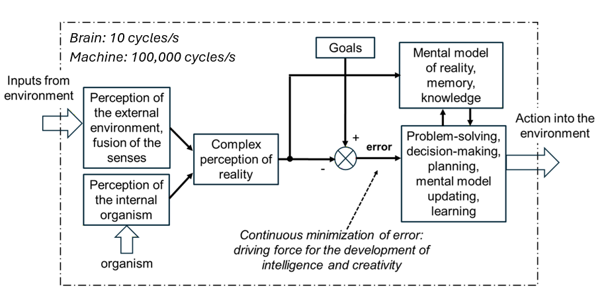
Figure 1. A cybernetic point of view on the model of brain function and the resulting consciousness. The brain performs this cycle about 10 times per second. An intelligent machine can perform the same cycle many thousands of times per second.
Conclusion
It is already clear today that current AI can perform tasks that require a high degree of cognitive ability and experience. Moreover, this trend will continue. Machines will replace humans in cognitive tasks, highly skilled tasks that involve knowledge, experience, and big data processing, working tirelessly and at a speed far surpassing that of humans. No single human can absorb all the knowledge in the world and use it in a split second to solve a complex problem. Moreover, as robotics and sensor/actuator technology advance, machines will increasingly compete with humans, even in manual tasks that require physical dexterity and the ability to navigate and act within complex environments.
The important question now is how human society will respond to such technological developments and what the future trend in the evolution of natural intelligence will be. Human intelligence has increased because, throughout history, humans have been forced to solve increasingly complex problems. However, today, intelligent machines are beginning to solve problems in place of humans, marking a new paradigm. If humans stop solving problems, what will that mean for the future development of our intelligence? We know that if certain neurons are not used, they will die off. If certain brain functions are no longer used, they will disappear. At the same time, we are delegating more decision-making powers to machines. Whether for our own convenience or out of competitive necessity. Ranging from services, industry, administrative, management, to military decisions, all the way to the power to kill other people.
If AI-powered machines remain unconscious, lacking free will and their own goals, they will “only” become decisive tools in the hands of one group of people to advance its interests against another group of people. If super-intelligent machines can acquire consciousness, further developments will be difficult to predict, and humanity may face an existential threat [31].
Many experts who currently focus on the biological or medical perspective on intelligence, as well as those from the fields of physics, technology, and computer science, believe that machine intelligence will not reach (at least in some aspects) the level of natural intelligence. Those machines will have to be innovated, programmed, and serviced by a living human, or have their goals set by a living human. On the other hand, there are also many proponents of the opposite view within all these groups of scientists. However, neither side currently has sufficient, well-founded arguments to support their positions. At present, it is a matter of their intuition or even belief. Moreover, this situation will likely persist until (if ever) the first machine demonstrates that it can surpass humans across the entire spectrum of their capabilities. Alternatively, it/she might even start asserting its/her own will. It/she will solve problems far beyond human capabilities and will be able to improve and maintain itself. It/she may even set its own goals, which may (or may not) conflict with the goals of humanity. Moreover, all of this at a level that humans will no longer be able to understand.
The risks and scenarios we have mentioned raise the practical question of whether and how to prevent the negative impacts of AI. The development of AI brings significant technological, economic, and military-political advantages to certain groups of people. Any unilateral regulation of AI by one party will give the other party an economic or security advantage if it does not implement those regulations. If all relevant world powers do not agree on common rules, unregulated competition will continue and may one day spiral out of control. We may even create an enemy that is beyond our collective capabilities. The problem, however, is that politicians and statesmen, driven by economic interest groups, business leaders, state powers or ideologies, are generally unwilling to heed scientists’ warnings [32–38]. Often, they cannot even understand them. They are reluctant to sacrifice profit, economic growth, or a certain slowdown in the rise of living standards at the expense of risks that are not sufficiently relevant to them. Political decision-making is highly inertial. Politicians face various inhibitions and commit to more fundamental decisions, if at all, only when the situation they were warned about has already become critical. A similar example is the response of global authorities to the climate crisis, whose trajectory has not yet been satisfactorily resolved.
Funding
This publication was created thanks to the support of the Slovak Research and Development Agency (APVV) within grant No. APVV-22-0169.
The Following AI Tools Were Used in This Publication
SciSpace (www.scispace.com) for literature searching.
DeepL (www.deepl.com) for translating the text into English.
Grammarly (www.grammarly.com) for proofreading the final text.
References
2. Robinson PA, Rennie CJ, Rowe DL, O'Connor SC, Gordon AE. Multiscale brain modelling. Philosophical Transactions of the Royal Society B: Biological Sciences. 2005 May 29;360(1457):1043–50.
3. Haines DE. Fundamental Neuroscience for Basic and Clinical Applications. Elsevier, 2012.
4. Jegham N, Abdelatti M, Koh CY, Elmoubarki L, Hendawi A. How hungry is ai? benchmarking energy, water, and carbon footprint of llm inference. arXiv preprint arXiv:2505.09598. 2025 May 14.
5. Samsi S, Zhao D, McDonald J, Li B, Michaleas A, Jones M, et al. From Words to Watts: Benchmarking the Energy Costs of Large Language Model Inference. 2023 IEEE High Performance Extreme Computing Conference (HPEC), Boston, MA, USA, 2023, pp.1–9.
6. Niu C, Zhang W, Li J, Zhao Y, Wang T, Wang X, et al. TokenPowerBench: Benchmarking the power consumption of LLM inference. In: Proceedings of the AAAI Conference on Artificial Intelligence. 2026 Mar 14;40(38):32582–90.
7. “Intel Builds World’s Largest Neuromorphic System to Enable More Sustainable AI,” Intel Newsroom. April 17, 2024. Available from: https://newsroom.intel.com/artificial-intelligence/intel-builds-worlds-largest-neuromorphic-system-to-enable-more-sustainable-ai
8. Dietrich A. The cognitive neuroscience of creativity. Psychonomic bulletin & review. 2004 Dec;11(6):1011–26.
9. Kaufman JC, Sternberg RJ, editors. The Cambridge handbook of creativity. Cambridge University Press; 2010 Aug 23.
10. OpenAI, ChatGPT, Version 4.0, 2023. [Online]. Available: https://chatgpt.com
11. Achiam J, Adler S, Agarwal S, Ahmad L, Akkaya I, Aleman FL, Almeida D, Altenschmidt J, Altman S, Anadkat S, Avila R. Gpt-4 technical report. arXiv preprint arXiv:2303.08774. 2023 Mar 15.
12. Meta, "Llama 3," [Online]. 2024 [Accessed: Jun. 2, 2026]. Available from: https://www.llama.com/models/llama-3/
13. Grattafiori A, Dubey A, Jauhri A, Pandey A, Kadian A, Al-Dahle A, Letman A, Mathur A, Schelten A, Vaughan A, Yang A. The llama 3 herd of models. arXiv preprint arXiv:2407.21783. 2024 Jul 31.
14. Morris MR, Sohl-Dickstein J, Fiedel N, Warkentin T, Dafoe A, Faust A, Farabet C, Legg S. Levels of AGI for Operationalizing Progress on the Path to AGI. arXiv preprint arXiv:2311.02462. 2023 Nov 4.
15. Wang P, Goertzel B, editors. Theoretical foundations of artificial general intelligence. Springer Science & Business Media; 2012 Aug 31.
16. Fernandes B. Theories of consciousness. Nature Reviews Neuroscience. 2022 May;23(7):439–52.
17. Maslow AH. A theory of human motivation. Psychological review. 1943 Jul;50(4):370.
18. Tononi G, Koch C. The neural correlates of consciousness: an update. Annals of the new York Academy of Sciences. 2008 Mar;1124(1):239-61.
19. Tononi G, Boly M, Massimini M, Koch C. Integrated information theory: from consciousness to its physical substrate. Nature reviews neuroscience. 2016 Jul;17(7):450-61.
20. Steriade M, McCormick DA, Sejnowski TJ. Thalamocortical oscillations in the sleeping and aroused brain. Science. 1993 Oct 29;262(5134):679-85.
21. Lumer ED, Edelman GM, Tononi G. Neural dynamics in a model of the thalamocortical system. I. Layers, loops and the emergence of fast synchronous rhythms. Cerebral Cortex (New York, NY: 1991). 1997 Apr 1;7(3):207–27.
22. Edelman GM. Wider than the sky: The phenomenal gift of consciousness. Yale University Press; 2004.
23. Marsh B, Navas-Zuloaga MG, Rosen BQ, Sokolov Y, Delanois JE, Gonzalez OC, Krishnan GP, Halgren E, Bazhenov M. Emergent effects of synaptic connectivity on the dynamics of global and local slow waves in a large-scale thalamocortical network model of the human brain. PLoS computational biology. 2024 Jul 19;20(7):e1012245.
24. Stein BE, Meredith MA. The merging of the senses. MIT press; 1993 Jan 22.
25. Sohms M, Turnbull O. The brain and the inner world. Other Press LLC; 2002.
26. Lozano-Soldevilla D, VanRullen R. The Hidden Spatial Dimension of Alpha: 10-Hz Perceptual Echoes Propagate as Periodic Traveling Waves in the Human Brain. Cell Rep. 2019 Jan 8;26(2):374–80.
27. Luo C, VanRullen R, Alamia A. Conscious perception modulates perceptual echoes. BioRxiv. 2020 Aug 7:2020–08.
28. Colombo M, Piccinini G. Computational Theory of Mind. Cambridge, U.K.: Cambridge University Press; 2024.
29. Crick F. The Astonishing Hypothesis: The Scientific Search for the Soul. New York, NY, USA: Simon & Schuster; 1994.
30. Hawking S. Brief answers to the big questions. Bantam; John Murray, 2020.
31. Sekaj I. Machine Intelligence, Socio-economic Impacts of AI and Potential Scenarios for AI Coexistence with Human Society. In: Proceedings on the AIR-RES 2025 Conference, Las Vegas, USA, 2025.
32. Boström N. Superintelligence: Paths, dangers, strategies. Oxford University Press; 2014.
33. Bostrom N. Existential risks: Analyzing human extinction scenarios and related hazards. Journal of Evolution and Technology. 2002 Mar 1;9(1):1–31.
34. Rusell S, Norvig P. Artificial intelligence: A modern approach. Prentice Hall; 2009.
35. “2022 Expert Survey on Progress in AI.” AI Impacts; 3 Aug 2022. Available from: https://aiimpacts.org/2022-expert-survey-on-progress-in-ai/
36. “AI Threat Warning.” The New York Times [Online]. May 30, 2023 [Accessed: Mar. 23, 2025]. Available from: https://www.nytimes.com/2023/05/30/technology/ai-threat-warning.html
37. Future of Life Institute. Pause Giant AI Experiments: An Open Letter. 2023 Mar 22 [cited 2025 Mar 23]. Available from: https://futureoflife.org/open-letter/pause-giant-ai-experiments/
38. “UN Security Council AI.” The New York Times [Online]. July 18, 2023 [Accessed: Mar. 23, 2025]. Available from: https://www.nytimes.com/2023/07/18/world/un-security-council-ai.html#