

Abstract
Alkaptonuria is an uncommon autosomal recessive disorder of tyrosine metabolism. It poses a significant anesthetic challenge due to systemic ochronosis, which is caused by the deposition of ochronotic pigments in connective tissues. We report the case of a 68-year-old male with alkaptonuria who required surgical fixation for a D11 fracture. The patient presented classical features of ochronotic effects comprising scleral melanosis, arthropathy, and constrictive lung functions. The multidisciplinary assessment revealed hypertension, mixed delirium, and low functional capacity. A difficult airway was expected due to rigidity of the cervical spine and possible laryngeal involvement; therefore, tracheal intubation was done with the aid of videolaryngoscopy. Induction and intubation of the case was done with intravenous propofol, fentanyl, rocuronium, sevoflurane and oxygen and maintenance of the anesthesia was done with sevoflurane, rocuronium and oxygen. Invasive hemodynamic monitoring was also done. The patient had an uncomplicated postoperative recovery in the high-dependency unit under careful monitoring. Three important anesthetic considerations concerning alkaptonuria are provided by this case: (1) preoperative evaluation of airway, cardiovascular, and renal systems is mandatory; (2) advanced airway management is required because of the involvement of ochronotic cartilage; (3) a personalized pharmacologic approach should take into consideration possible metabolic changes. The interdisciplinary planning aspect has been proven effective over our experience in maximizing the outcomes of such complex patients.
Keywords
Alkaptonuria, Anesthesia management, Ochronosis, Musculoskeletal complications, Joint degeneration, Connective tissue damage
Introduction
Alkaptonuria is a hereditary inborn error of metabolism that is caused by autosomal recessive mutation in the homogentisate 1,2-dioxygenase (HGD) gene, hence, inhibiting the activity of the HGD, which lies in the pathway of degrading tyrosine [1]. Defective HGD activity initiates the systemic accumulation of homogentisic acid (HGA), which consequently oxidizes than is polymerized and excretes as ochronotic pigments in connective tissues, a pathophysiologic process known as ochronosis [2]. This type of disorder has its main disease manifestations such as progressive degenerative forms of arthropathies, valvular calcification, renal malfunctions, and typical bluish-black coloration pigmentations of the skin, its manifestations generally begins in adulthood [3]. The multisystem nature of alkaptonuria presents its own unique perioperative studies particularly through surgical intervention when the ochronotic changes in the airway, spine and cardiac system increase perioperative risks significantly [4].
Specific note ought to be taken of the possibility of challenging intubation due to laryngotracheal stiffness because of deposition of ochronotic pigment within cartilaginous elements of the upper airway [5]. These restrictive pulmonary mechanics may also occur as a secondary to costochondral calcification as renal impairment can alter pharmacokinetic parameters [6]. In addition, brittle nature of ochronotic cartilage requires precautions against positioning induced injuries and elimination of neuraxial anesthesia in patients who have significant spinal degeneration [7]. Though there are few evidence-based guidelines, one has to tailor perioperative management in accordance with the severity of the disease and the opportunities of the surgery [8].
The current case report presents anesthetic management of an advanced alkaptonuria patient (male, 68 years old), who had undergone spinal fracture fixation process, revealing the interaction between the metabolic pathophysiology and the anesthetic factors. Peri-operative morbidity was minimized through a concerted effort involving multimodal evaluation, advanced airway management, and continuous invasive hemodynamic monitoring. This case contributes to the understanding of alkaptonuria's anesthetic implications, underscoring the critical importance of preoperative optimization, meticulous intraoperative management, and structured postoperative care to improve outcomes for these high-risk patients [1,4].
Case Presentation
Case history/ Examination
A 68 years old, 50 kg male with a history of alkaptonuria since many years reported to undergo surgical restoration of D11 (thoracic vertebral) fracture (Figure 1) which was acquired during a mechanically induced fall. The case under discussion was a multifactorial combination of metabolic disorder, degenerative disease process in the spine and traumatic injury, which made perioperative care all the more challenging. His significant past medical history included poorly-controlled systemic hypertension and bilateral hip arthroplasty 12 years prior for progressive ochronotic arthropathy. Notably, he had recently developed mixed delirium, which was managed with a psychiatric consultation. This led to the discontinuation of tapentadol and zolpidem and the initiation of haloperidol. Furthermore, his baseline functional capacity was significantly impaired, with metabolic equivalents (METs) below 4 and a lack of ambulatory support, even prior to the current vertebral injury.

Figure 1. Computed tomography imaging shows D11 vertebra fracture.
Clinical inspection revealed the appearance of the classical triad of alkaptonuria manifestations, that is, the pigmentation of the sclera of a slate gray, the palmar folds hyper pigmentation, and the stain of the nail beds of an ochronotic (Figure 2). Major vital findings include blood pressure of 166/80 mm, Hg and a normal sinus rhythm of 88 beats per minute. The result of the airway assessment was a modified Mallampati grade II visualization, a thyromental distance of over 6.5 cm and significantly limited cervical movement, which implies that it might not be possible to intubate the trachea easily. Physical examination was significant for a barrel-shaped chest, while the neurological exam was notable only for age-related cognitive changes.
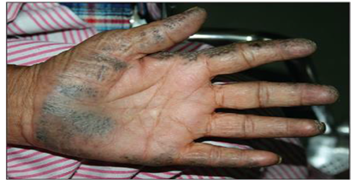
Figure 2. Black-colored pigmentation noted on the palm, knuckles, and nail bed.
Methods (differential diagnosis, investigations and treatment)
The preoperative assessment was a multidisciplinary effort, beginning with laboratory studies. The biochemical tests included liver function tests (ALT, AST, Albumin, Bilirubin), renal function tests (Creatinine, BUN), and electrolytes, were within normal limits. An echocardiogram confirmed normal ventricular function, with only minor valvular irregularities that were not clinically significant. Pulmonary function tests revealed a moderate restrictive pattern with Forced Expiratory Volume on 1 second (FEV1)/ Forced Vital Capacity (FVC) ratio of 0.78 (65 percent of the predicted FVC). CT-imaging of the cervical spine revealed highly-developed degenerative pathology in the stages of long-standing ochronosis. Multidisciplinary team which included the team of cardiologist, pulmonologist, and psychiatrist during the management of this case, with special consideration to respiratory complications and delirium worsening.
The case was planned under general anesthesia with invasive hemodynamic monitoring. Tracheal intubation was done with the aid of videolaryngoscope with minimal cervical movement. Manual in-line stabilization of cervical spine was provided through the intubation process. Vigilant hemodynamic monitoring was done with the invasive arterial line insertion and the central access by ultrasound picture in parallel. The balanced anesthesia method was based on the use of the maintenance of sevoflurane with a MAC of 1.0, with an addition of fentanyl at the dose of 2 mcg/kg and the use of atracurium at high doses through quantitative neuromuscular monitoring. Special care was given to the positioning of the patient, careful sitting on a Jackson table, and some special protective pressure point padding was used so that there might be no further injury to the delicate ochronotic tissues by the iatrogenic process.
The surgical process was proceeded without any complications within 120 minutes, with careful hemodynamic monitoring throughout the surgery. Parameters of ventilation were volume controlled ventilation mode (VCV) with tidal volume of 500 ml, respiratory rate of 15 per minutes, positive end expiratory pressure (PEEP) of 5 cm of H2O and end-tidal CO2 of 35–40 mmHg. Hemodynamic variables were maintained at less than 20% of their baseline readings by the careful use of fluids, not more than 10 ml/kg without crystalloid, and carefully adjusted use of Z-drugs. Multimodal analgesia was used involving scheduled administration of IV paracetamol along with the infiltration of local anesthetic into the surgical site, thus being effective in reducing the opioid needs of this patient predisposed to delirium.
Conclusion and result (outcome and follow-up)
A guideline of structured recovery pathway was followed postoperatively. Train-of-four monitor was utilized in such way that successful extubation was established only after the ratios confirmed their appropriate neuromuscular recovery amounting to more than 0.9. The patient was shifted to the high-dependency unit where he was under constant cardio respiratory monitoring and in the first 24 hours there were no critical complications that arose. A protocol of delirium management maintained as a pre-induction plan continued throughout the course of postoperative period and the teams of psychiatry observed that the cognition of a patient was improving progressively by the third postoperative day. After an uneventful recovery the patient was discharged.
Discussion
The anesthetic management of alkaptonuria presents a unique constellation of challenges stemming from the systemic manifestations of ochronosis, requiring careful consideration of multisystem involvement. Our case highlights several critical aspects of perioperative care in this rare metabolic disorder, supported by existing literature and providing new insights into optimal management strategies.
The pathophysiology of alkaptonuria involves deficient homogentisate 1,2-dioxygenase activity, leading to accumulation of homogentisic acid (HGA) and subsequent deposition of ochronotic pigment in connective tissues [1]. This process particularly affects cartilaginous structures, explaining our patient's cervical spine immobility and anticipated difficult airway - findings consistent with previous reports of laryngeal and tracheal cartilage involvement in advanced cases [9]. Our successful use of videolaryngoscopy aligns with recommendations from Kozanhan et al., who emphasized the value of advanced airway techniques in alkaptonuria patients undergoing orthopedic procedures [4]. The degenerative changes in the cervical spine observed in our patient mirror the progressive arthropathy well-documented in alkaptonuria, which typically begins in the third decade and leads to severe joint degeneration by the sixth decade [2].
Cardiovascular considerations in our management approach were informed by the recognized association between alkaptonuria and ochronotic valvular disease, particularly aortic and mitral valve calcification [10]. Invasive hemodynamic monitoring was done during the anesthetic management of this case [5]. The moderate restrictive pulmonary pattern observed in our patient reflects the characteristic respiratory complications of alkaptonuria, which may include costochondral joint calcification and reduced chest wall compliance [11]. These findings underscore the importance of preoperative pulmonary function assessment and careful intraoperative ventilation management in such cases.
The neurological manifestations in our patient, particularly the mixed delirium, represent an underreported but clinically significant aspect of alkaptonuria management. While the exact mechanism remains unclear, the association between metabolic disorders and cognitive dysfunction is well-established [8]. Our multidisciplinary approach to delirium management, involving psychiatry consultation and opioid minimization, follows current best practices for geriatric patients with metabolic comorbidities [12]. The successful postoperative cognitive recovery in our case suggests that proactive delirium prevention strategies may be particularly beneficial in alkaptonuria patients.
Pharmacological considerations in our case were guided by the potential for altered drug metabolism in alkaptonuria. The choice of atracurium, with its Hoffman elimination, reflects the theoretical advantage of organ-independent metabolism in patients with potential renal impairment from ochronotic nephropathy [13]. Our opioid-sparing analgesic regimen, incorporating paracetamol and local infiltration, was designed to mitigate delirium risk while addressing the recognized challenge of pain management in ochronotic arthropathy [14].
The successful outcome in this complex case reinforces several key principles in alkaptonuria management: the necessity of comprehensive preoperative assessment, the value of multidisciplinary collaboration, and the importance of individualized anesthetic planning. Our experience suggests that while alkaptonuria presents significant perioperative challenges, favorable outcomes can be achieved through systematic approach to airway management, hemodynamic stability, and postoperative cognitive protection. These findings contribute to the growing but still limited literature on anesthetic management of this rare metabolic disorder [6].
Conclusion
This case offers several critical insights for the management of alkaptonuria patients requiring surgical intervention. The extensive ochronotic cartilage degeneration characteristic of this disease process necessitates particularly rigorous airway planning, preferably incorporating advanced visualization technologies. The systemic nature of ochronosis demands thorough preoperative evaluation of all potentially affected organ systems, with special attention to cardiovascular and respiratory function. Elderly alkaptonuria patients represent a high-risk population for postoperative delirium, requiring proactive screening and management protocols. Perhaps most importantly, the fragility of ochronotic tissues mandates extreme care during patient positioning to prevent iatrogenic injury, emphasizing the need for specialized equipment and techniques. These lessons collectively underscore the importance of a multidisciplinary, systematically vigilant approach to perioperative care in this rare but clinically challenging metabolic disorder.
Author Contributions
Rahul Kumar Chaudhary: conceptualization, writing – original draft, writing – review and editing.
Byre Gowda: conceptualization.
Acknowledgments
Authors are thankful to the patient's family members for their cooperation.
Consent
Written informed consent was obtained from the patient to publish this report in accordance with the journal's patient consent policy.
Conflicts of Interest
The authors declare no conflicts of interest.
References
2. Phornphutkul C, Introne WJ, Perry MB, Bernardini I, Murphey MD, Fitzpatrick DL, Anderson PD, Huizing M, Anikster Y, Gerber LH, Gahl WA. Natural history of alkaptonuria. N Engl J Med. 2002 Dec 26;347(26):2111–21.
3. Mannoni A, Selvi E, Lorenzini S, Giorgi M, Airó P, Cammelli D, Andreotti L, Marcolongo R, Porfirio B. Alkaptonuria, ochronosis, and ochronotic arthropathy. Semin Arthritis Rheum. 2004 Feb;33(4):239–48.
4. Kozanhan B. Manejo anestésico de dois pacientes com ocronose alcaptonúrica para artroplastia total do joelho [Anesthetic management of two patients with alkaptonuric ochronosis for total knee arthroplasty]. Braz J Anesthesiol. 2018 May-Jun;68(3):307–10.
5. Pandey R, Kumar A, Garg R, Khanna P, Darlong V. Perioperative management of patient with alkaptonuria and associated multiple comorbidities. J Anaesthesiol Clin Pharmacol. 2011 Apr;27(2):259–61.
6. Ahuja V, Atter P, Mundotiya S, Garg S. Perioperative anesthetic challenges in Alkaptonuria patient with comorbid conditions. J Anaesthesiol Clin Pharmacol. 2022 Jan-Mar;38(1):152–3.
7. Van Offel JF, De Clerck LS, Francx LM, Stevens WJ. The clinical manifestations of ochronosis: a review. Acta Clin Belg. 1995;50(6):358–62.
8. Ranganath LR, Psarelli EE, Arnoux JB, Braconi D, Briggs M, Bröijersén A, et al. Efficacy and safety of once-daily nitisinone for patients with alkaptonuria (SONIA 2): an international, multicentre, open-label, randomised controlled trial. Lancet Diabetes Endocrinol. 2020 Sep;8(9):762–72.
9. Fisher AA, Davis MW. Alkaptonuric ochronosis with aortic valve and joint replacements and femoral fracture: a case report and literature review. Clin Med Res. 2004 Nov;2(4):209–15.
10. Phornphutkul C, Introne WJ, Perry MB, Bernardini I, Murphey MD, Fitzpatrick DL, Anderson PD, Huizing M, Anikster Y, Gerber LH, Gahl WA. Natural history of alkaptonuria. N Engl J Med. 2002 Dec 26;347(26):2111–21.
11. Kobak AC, Oder G, Kobak S, Argin M, Inal V. Ochronotic arthropathy: disappearance of alkaptonuria after liver transplantation for hepatitis B-related cirrhosis. J Clin Rheumatol. 2005 Dec;11(6):323–5.
12. Marcantonio ER. Delirium in Hospitalized Older Adults. N Engl J Med. 2017 Oct 12;377(15):1456–66.
13. Naguib M, Lien CA. Pharmacology of muscle relaxants and their antagonists. In: Miller's Anesthesia. 8th ed. Philadelphia: Elsevier Saunders; 2015. p. 958–94.
14. Berger-Estilita J, Bilotta F. The fine line between relief and risk: new insights into postoperative delirium. Br J Anaesth. 2025 Jan;134(1):14–18.