

Commentary
Many questions arise from what may or may not be applicable for an elite soccer player to do during the competitive match day. Currently, we know that athletes are concentrated in hotels and there they receive all the food for the day, i.e., the match day diet. Besides that, the supplementation is usually offered at the stadium. But how would the diet and supplementation recommendations of this day specifically be?
Speaking about the diet, breakfast should contain an intake of 1 g of carbohydrates .kg-1 and at least 0.4 g of protein .kg-1, a mid-morning snack containing 1g of carbohydrates .kg-1 and more 0.4 g of protein .kg-1 with the subsequent initiation of hydration (5 to 7 mL .kg-1) before lunch that should contain 3 g of carbohydrates .kg-1 with at least 0.4g of protein .kg-1, including an additional hydration intake (5 to 7 mL .kg-1) between lunch and going to the stadium, Finally, after the match and at dinner, the guidelines revolve around 2 g of carbohydrates .kg-1 with 20 to 30 g whey protein and 1 g of carbohydrates .kg-1 and at least 0.4 g of protein .kg-1, respectively, therefore being interesting strategies for elite soccer players that have been scientifically proven [1].
In halftime, the athlete should drink 0.5 to 0.7 g sodium. L-1 in 4 to 6% carbohydrates concentration. After match the recommendation is to drink around 1.5 L for every kg of body weight lost during the match, besides that use of carbohydrate-gel can be welcome during the break, including other alternatives that can deliver sodium and electrolytes [2]. Still about the halftime, the carbohydrate-gel ingestion (about 20 g) may be increases the intermittent endurance capacity [3] and within about 100 mg of caffeine addition, this carbohydrate-gel ingested (about 20 g) may be performance improved [4].
And to improve the performance of elite soccer athletes, the most studied ergogenic and dietary supplements by the scientific community are creatine (3 - 5 g. day−1 or 0.075 g kg−1 BW day−1) it is indicated to consume after a meal due to the need for metabolism in insulin action, caffeine (6 mg. kg−1 BW) it is indicated to consume 30 min before match, sodium bicarbonate (0.4 g. kg−1 BW) it is indicated to dilute in 500 mL of water, adding some flavoring and drinking during the hour before the warm-up start, beta-alanine (3.2 - 6.4 g. day−1) it is indicated to consume until 30 min before match, nitrate-rich beet juice (6 mmol of NO3− L) it is indicated to consume 60 to 80 g beet root in 200 to 250 mL water [5]. A drawing with all the recommendations brought by the author is illustrated in Figure 1.
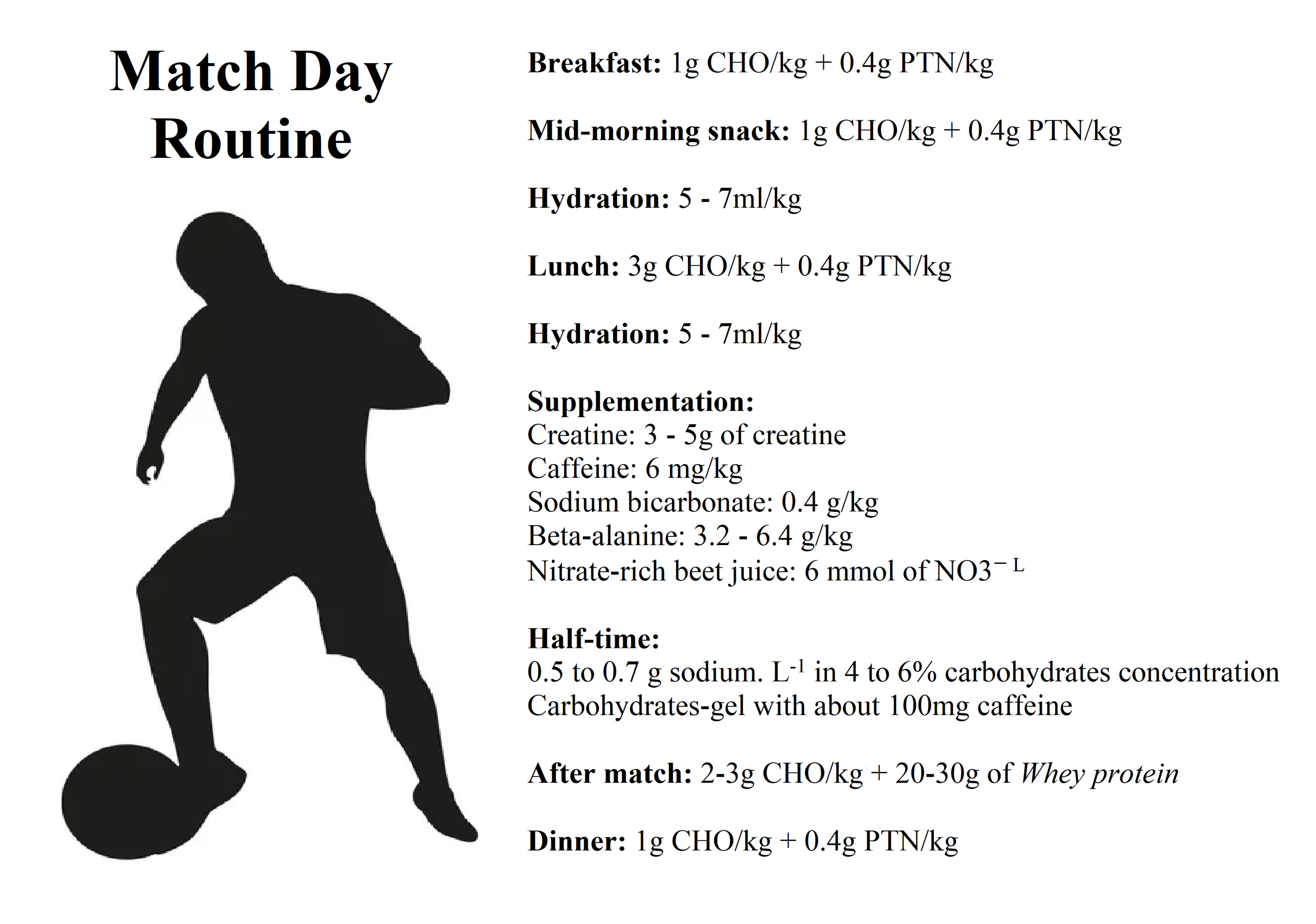
Figure 1. The main recommendations for elite soccer players during a routine of the match day. Abbreviations: CHO: Carbohydrates; PTN: Proteins.
Disclosure of Interest
The authors declare that they have no competing interests.
Acknowledgments
I would first like to thank my family and close friends for always believing in my research potential.
References
2. Fernandes HS. Hydration Strategies for Elite Soccer Players. Sch J Food Nutr. 2020;3:390-393.
3. Phillips SM, Turner AP, Sanderson MF, Sproule J. Carbohydrate gel ingestion significantly improves the intermittent endurance capacity, but not sprint performance, of adolescent team games players during a simulated team games protocol. European Journal of Applied Physiology. 2012 Mar;112:1133-41.
4. Scott AT, O’Leary T, Walker S, Owen R, Scott A. Caffeinated carbohydrate gel ingestion improves 2000 metre rowing performance. Int J Sports Physiol Perform. 2014;10:464-8.
5. Fernandes H. Dietary and ergogenic supplementation to improve elite soccer players’ performance. Annals of Nutrition and Metabolism. 2021;77(4):197-203.