

Abstract
Triple-negative breast cancer (TNBC) remains a major clinical challenge due to the absence of validated molecular targets and limited durability of current immunotherapies. Survivin, a tumor-associated inhibitor of apoptosis, is highly expressed in TNBC and contributes to tumor progression, therapeutic resistance, and poor clinical outcomes, making it an attractive but immunologically challenging target. In this commentary, we discuss recent preclinical findings describing a rationally engineered dendritic cell targeted anti-Survivin vaccine, DCSurvivin-LTB, designed to overcome immune tolerance to this self-antigen. The reported study demonstrates strong induction of humoral and cellular immune responses, significant inhibition of tumor growth, modulation of angiogenesis and apoptotic pathways, and an encouraging safety profile in a murine TNBC model. We highlight the immunological principles underlying this vaccine strategy, critically evaluate its translational potential, and discuss future directions, including mechanistic immune profiling and combinatorial treatment approaches. Collectively, these findings highlight the potential of Survivin-directed vaccination to complement existing immunotherapies and provide a conceptual framework for developing advanced cancer vaccines targeting self-antigens in immunologically resistant tumors such as TNBC.
Keywords
Breast cancer, Dendritic cells, Immunotherapy, Survivin, TNBC
Commentary
Triple-negative breast cancer (TNBC) continues to represent one of the most difficult malignancies to treat in oncology. Characterized by the absence of estrogen receptor, progesterone receptor, and HER2 expression, TNBC lacks validated molecular targets and is associated with aggressive clinical behavior, early metastasis, and high rates of recurrence [1–3]. Majority of TNBC cases fail to mount durable anti-tumor immune responses. This limitation has generated interest in therapeutic strategies that actively prime tumor-specific immunity rather than relying solely on the reinvigoration of pre-existing immune responses. In this context, the study by Rashid et al. [4] offers an important contribution by evaluating a rationally engineered Survivin-targeted vaccine, DCSurvivin-LTB, formulated with Mycobacterium indicus pranii (MIP). It provides a good insight into how immune tolerance to a tumor-associated self-antigen can be modulated at the cellular level.
Survivin occupies a unique position among tumor antigens. As a member of the inhibitor of apoptosis (IAP) family, it is critically involved in mitotic progression, inhibition of Caspase activation, and maintenance of cellular viability (Figure 1) [5]. Its overexpression in a large number of malignant tissues, combined with minimal expression in most differentiated adult tissues, makes Survivin an attractive immunotherapeutic target [6,7].
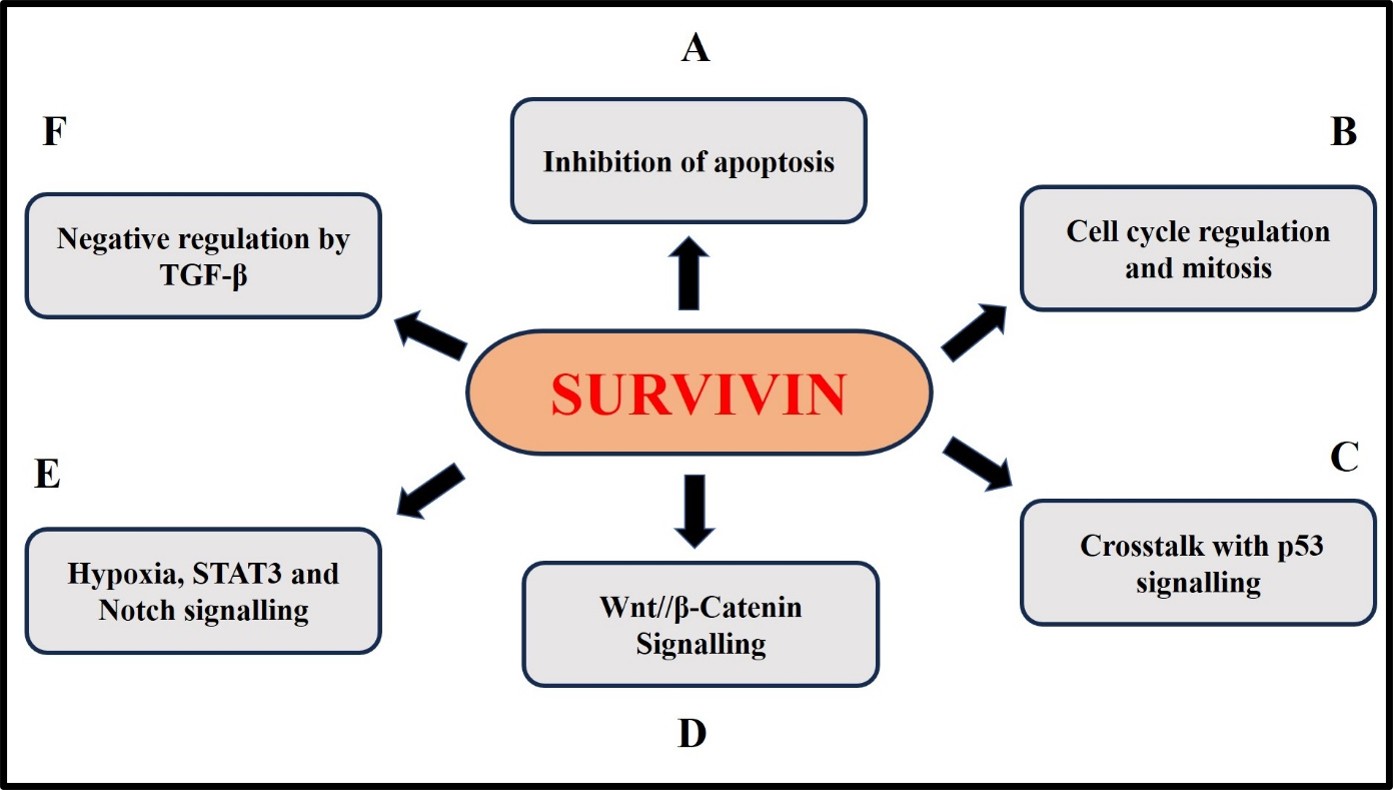
However, as a self-protein, Survivin is subject to central and peripheral tolerance mechanisms that limit the magnitude and quality of immune responses directed against it. The ability to overcome this tolerance without inducing autoimmunity represents a major conceptual hurdle in cancer vaccine development [8]. The present study addresses this challenge through a multi-component vaccine design that integrates antigen targeting, innate immune activation, and adjuvant synergy.
A key conceptual strength of the DCSurvivin-LTB vaccine lies in its focus on antigen delivery and presentation rather than antigen identity alone. Targeting Survivin to dendritic cells via DEC205 exploits a well-characterized endocytic receptor involved in antigen uptake and cross-presentation [9,10]. From a cellular immunology standpoint, this strategy is particularly relevant because efficient cross-presentation is a prerequisite for the activation of cytotoxic CD8+ T lymphocytes against intracellular tumor antigens. By enhancing the probability that Survivin-derived peptides are presented on MHC class I molecules in an immune-activating environment, the vaccine is designed to overcome immune tolerance and promote effective anti-tumor T-cell responses [11,12].
The inclusion of the Escherichia coli heat-labile enterotoxin B subunit (LTB) further strengthens this approach by providing potent immunostimulatory signals. LTB has been shown to enhance antigen uptake, promote dendritic cell maturation, and amplify co-stimulatory signaling [13,14]. In the context of a self-antigen vaccine, such “danger signals” are essential for converting antigen recognition from a tolerogenic to an immunogenic event. The study’s findings suggest that LTB contributes not only to enhanced humoral responses but also to the qualitative programming of cellular immunity, an important yet often overlooked factor in cancer vaccine design [15,16].
The importance of vaccine-induced immunity is further signified by the dose-optimization experiments. The observation that antibody titers increased progressively up to an optimal dose and plateaued thereafter highlights a fundamental principle of immune regulation: more antigen does not necessarily equate to better immunity. Excessive antigen exposure, particularly in the context of self-proteins, can promote T-cell anergy, exhaustion, or the expansion of regulatory populations [17,18]. The identification of an optimal immunogenic dose therefore reflects an understanding of immune thresholds and reinforces the notion that effective vaccination requires precise tuning of antigenic and inflammatory signals [19,20].
Another notable feature of the study is the demonstrated synergy between alum and MIP. Alum has been a commonly used adjuvant in human vaccines and is well known for its ability to enhance antibody responses through depot formation and inflammasome activation [21]. However, alum alone is often insufficient to elicit robust Th1 or cytotoxic T-cell responses, which are critical for tumor control [22]. The addition of MIP, a heat-killed mycobacterial preparation with strong innate immune-activating properties, appears to complement alum by promoting Th1-skewed immunity and enhancing dendritic cell activation [23]. From a cellular immunology perspective, this combination likely engages multiple receptors and signaling pathways, resulting in a more balanced Th1/Th2 immune milieu capable of supporting both antibody production and cytotoxic effector function.
The functional consequences of this immune programming are evident in the reported tumor growth inhibition and survival benefit in vaccinated mice. Importantly, the study demonstrates that tumor control persists even as circulating antibody titers decline following tumor challenge. This suggests that humoral immunity, while contributory, is unlikely the sole mediator of anti-tumor efficacy. Instead, the elevated levels of Granzyme B and Th1-associated cytokines such as IFN-γ and IL-12 point toward the activation of cytotoxic lymphocytes as a dominant effector mechanism. Granzyme B-mediated apoptosis represents a canonical pathway by which CD8+ T cells and natural killer cells eliminate malignant targets, and its sustained elevation provides indirect evidence of ongoing cellular immune engagement [24].
Beyond direct tumor cell killing, the study highlights the capacity of vaccine-induced immunity to remodel the tumor microenvironment. The observed reduction in vascular endothelial growth factor (VEGF) expression in vaccinated tumors suggests that immune pressure can suppress angiogenic pathways that are essential for tumor growth and dissemination. This finding is particularly relevant in TNBC, where angiogenesis contributes to rapid progression and metastatic spread. Concurrently, increased expression of Caspase-3 in tumor tissues indicates restoration of apoptotic sensitivity, that cancer cells often evade programmed cell death. Together, these observations illustrate how immune responses can exert multi-dimensional control over tumor biology, extending beyond direct cytotoxicity to influence stromal and vascular components.
The cytokine kinetics reported in this study offer additional insight into immune regulation over time. The delayed yet sustained elevation of IL-2, IL-12, and IFN-γ suggests prolonged immune activation rather than an acute inflammatory burst. Such patterns are consistent with the development of memory-like immune responses capable of responding to ongoing antigenic stimulation. The subsequent decline in cytokine levels may reflect the activation of regulatory pathways that limit immune-mediated pathology and restore homeostasis. From a translational perspective, this balance between sustained effector function and immune regulation is desirable, as it reduces the risk of chronic inflammation or autoimmunity.
Safety is a major concern when vaccines target self-antigens, especially proteins like Survivin that play important roles in normal cell function. Therefore, the lack of observable toxicity, organ damage, or metabolic problems in vaccinated animals is an important observation. These results suggest that tumor-associated self-antigens can be safely targeted by the immune system when antigen presentation is carefully regulated and limited to cancer cells. However, further long-term studies and detailed evaluations of possible unintended effects, will be essential before this strategy can be applied clinically.
Despite its strengths, the study also highlights areas that warrant further investigation. The relative contributions of CD8+ T cells, CD4+ helper subsets, regulatory T cells, and innate lymphoid populations to tumor control remain to be fully elucidated. Detailed phenotypic and functional analyses of tumor-infiltrating immune cells would provide valuable insight into the cellular networks driving vaccine efficacy. Moreover, while prophylactic vaccination models are informative, evaluation in therapeutic settings, where established tumors exert strong immunosuppressive effects, will be critical to assess clinical relevance. Combination strategies incorporating immune checkpoint blockade, chemotherapy, or radiotherapy may further enhance vaccine efficacy by alleviating tumor-mediated immune suppression.
In a broader context, this work contributes to an evolving shift in cancer immunology that focuses on training the immune system rather than rescuing a failing immune response. By actively programming the immune system to recognize and respond to tumor-associated self-antigens, vaccines such as DCSurvivin-LTB have the potential to complement existing immunotherapies and expand the pool of patients who benefit from immune-based interventions. The principles demonstrated here: targeted antigen delivery, adjuvant synergy, immune calibration, and microenvironmental modulation, are broadly applicable and may guide the development of next-generation vaccines targeting other cancer-related self-proteins.
In conclusion, the study [4] shows that rational vaccine engineering based on principles of cellular immunology can overcome intrinsic immune tolerance to Survivin and generate functionally meaningful anti-tumor immunity in TNBC. By integrating dendritic cell targeting, innate immune activation, and balanced Th1/Th2 responses, the DCSurvivin-LTB platform represents an advanced strategy for cancer vaccine development. Beyond its immediate implications for Survivin-expressing tumors, this work offers a conceptual framework for harnessing the immune system against malignancies that resist immunological control.
Clinical and Translational Implications
From a translational perspective, the DCSurvivin-LTB vaccine shows strong potential for use as a part of multimodal treatment strategies for Survivin-expressing malignancies. Its favorable safety profile, combined with durable immune response, supports potential use in adjuvant settings, particularly following surgical tumor resection when immunosuppressive tumor burden is reduced. Moreover, the modular design of this vaccine platform, combining dendritic cell targeting, immune-stimulating components, and clinically acceptable adjuvants, allows it to be adapted for use against other tumor-associated self-antigens. Future evaluation in therapeutic models, humanized systems, and early-phase clinical trials will be critical to define its role in personalized cancer immunotherapy and to determine whether Survivin-directed vaccination can meaningfully reduce recurrence and metastatic progression in high-risk cancers such as TNBC.
Competing Interest
The authors declare no conflict of interest.
References
2. Pareja F, Geyer FC, Marchiò C, Burke KA, Weigelt B, Reis-Filho JS. Triple-negative breast cancer: the importance of molecular and histologic subtyping, and recognition of low-grade variants. NPJ Breast Cancer. 2016 Nov 16;2:16036.
3. Zagami P, Carey LA. Triple negative breast cancer: Pitfalls and progress. NPJ Breast Cancer. 2022 Aug 20;8(1):95.
4. Rashid A, Krishnan A, Gupta S, Gupta JC, Talwar GP. Survivin targeting triple-fusion vaccine DCSurvivin-LTB inhibits tumor growth in mouse model of triple-negative breast cancer. Med Oncol. 2025 Dec 4;43(1):35.
5. Albadari N, Li W. Survivin Small Molecules Inhibitors: Recent Advances and Challenges. Molecules. 2023 Feb 1;28(3):1376.
6. Wheatley SP, Altieri DC. Survivin at a glance. J Cell Sci. 2019 Apr 1;132(7):jcs223826.
7. Siragusa G, Tomasello L, Giordano C, Pizzolanti G. Survivin (BIRC5): Implications in cancer therapy. Life Sci. 2024 Aug 1;350:122788.
8. Kusner LL. Extended abstract: cancer and autoimmunity: survivin as a driver of sustaining autoreactive cells and its role in neoplasia. Mediastinum. 2024 May 29;8:21.
9. Birkholz K, Schwenkert M, Kellner C, Gross S, Fey G, Schuler-Thurner B, et al. Targeting of DEC-205 on human dendritic cells results in efficient MHC class II-restricted antigen presentation. Blood. 2010 Sep 30;116(13):2277–85.
10. Hossain MK, Wall KA. Use of Dendritic Cell Receptors as Targets for Enhancing Anti-Cancer Immune Responses. Cancers (Basel). 2019 Mar 24;11(3):418.
11. Yong X, Xiao YF, Luo G, He B, Lü MH, Hu CJ, et al. Strategies for enhancing vaccine-induced CTL antitumor immune responses. J Biomed Biotechnol. 2012;2012:605045.
12. Ciesielski MJ, Ahluwalia MS, Munich SA, Orton M, Barone T, Chanan-Khan A, et al. Antitumor cytotoxic T-cell response induced by a survivin peptide mimic. Cancer Immunol Immunother. 2010 Aug;59(8):1211–21.
13. Gong Z, Li H, Qian M, Bai Y, Jin H, Sun J, et al. Incorporation of Escherichia coli heat-labile enterotoxin B subunit into rabies virus particles enhances its immunogenicity in mice and dogs. Biosaf Health. 2023 May 9;5(5):308–19.
14. Yin J, Wu H, Li W, Wang Y, Li Y, Mo X, et al. Escherichia coli heat-labile enterotoxin B subunit as an adjuvant of mucosal immune combined with GCRV-II VP6 triggers innate immunity and enhances adaptive immune responses following oral vaccination of grass carp (Ctenopharyngodon idella). Fish Shellfish Immunol. 2024 Nov;154:109969.
15. da Silva Ramos Rocha A, Conceição FR, Grassmann AA, Lagranha VL, Dellagostin OA. B subunit of Escherichia coli heat-labile enterotoxin as adjuvant of humoral immune response in recombinant BCG vaccination. Can J Microbiol. 2008 Aug;54(8):677–86.
16. Martin K, Nashar TO. E. coli Heat-labile Enterotoxin B Subunit as a Platform for the Delivery of HIV Gag p24 Antigen. J Clin Cell Immunol. 2013 Apr;4(2):140.
17. Schietinger A, Greenberg PD. Tolerance and exhaustion: defining mechanisms of T cell dysfunction. Trends Immunol. 2014 Feb;35(2):51–60.
18. Kuczma MP, Szurek EA, Cebula A, Ngo VL, Pietrzak M, Kraj P, et al. Self and microbiota-derived epitopes induce CD4+ T cell anergy and conversion into CD4+Foxp3+ regulatory cells. Mucosal Immunol. 2021 Mar;14(2):443–54.
19. Benest J, Rhodes S, Evans TG, White RG. Mathematical Modelling for Optimal Vaccine Dose Finding: Maximising Efficacy and Minimising Toxicity. Vaccines (Basel). 2022 May 11;10(5):756.
20. Billeskov R, Beikzadeh B, Berzofsky JA. The effect of antigen dose on T cell-targeting vaccine outcome. Hum Vaccin Immunother. 2019;15(2):407–11.
21. Stillman ZS, Decker GE, Dworzak MR, Bloch ED, Fromen CA. Aluminum-based metal-organic framework nanoparticles as pulmonary vaccine adjuvants. J Nanobiotechnology. 2023 Feb 3;21(1):39.
22. Ebensen T, Delandre S, Prochnow B, Guzmán CA, Schulze K. The Combination Vaccine Adjuvant System Alum/c-di-AMP Results in Quantitative and Qualitative Enhanced Immune Responses Post Immunization. Front Cell Infect Microbiol. 2019 Feb 19;9:31.
23. Dogra S, Jain S, Sharma A, Chhabra S, Narang T. Mycobacterium Indicus Pranii (MIP) Vaccine: Pharmacology, Indication, Dosing Schedules, Administration, and Side Effects in Clinical Practice. Indian Dermatol Online J. 2023 Oct 17;14(6):753–61.
24. Hay ZLZ, Slansky JE. Granzymes: The Molecular Executors of Immune-Mediated Cytotoxicity. Int J Mol Sci. 2022 Feb 6;23(3):1833.