

Abstract
Placebo-controlled randomized trials are widely regarded as the gold standard in clinical research. However, their routine application in infant vaccine studies has not been systematically re-evaluated in light of advances in immunology, trial design, and ethical frameworks. Infants lack the cognitive capacity required for classical placebo effects, and primary vaccine endpoints—such as immunogenicity, laboratory-confirmed infection, and severe disease—are inherently objective and biologically determined.
Although caregiver-mediated behavioral biases may influence certain outcomes, these effects are limited in scope and can be mitigated through alternative methodological approaches. We propose that placebo control in infant vaccine trials should not be considered a default requirement, but rather a context-dependent tool. A shift toward endpoint-driven trial design would better align methodological rigor with biological plausibility and ethical considerations.
Keywords
Infant vaccines, Placebo control, Immunobridging, Correlates of protection, Clinical trial design, Vaccine ethics
Introduction
Placebo-controlled trials have long been considered the most rigorous approach for evaluating medical interventions [1]. In vaccine research, this paradigm has been broadly applied across populations, including infants [2–4]. However, this practice assumes that placebo control uniformly addresses key sources of bias across all populations. This assumption warrants re-examination in infant populations, where the biological and cognitive context differs fundamentally from that of adults [5].
Here, we present a mechanistic and methodological perspective on placebo use in infant vaccine trials. Rather than arguing against placebo-controlled trials per se, we challenge their routine and uncritical application in this context. We propose that the necessity of placebo control should be determined by biological plausibility, endpoint characteristics, and the availability of alternative methodological approaches. Its role should not be overgeneralized; instead, a shift toward endpoint-driven trial design is both scientifically justified and practically feasible.
The Biological Implausibility of Placebo Effects in Infants
The classical placebo effect is mediated by expectation, belief, and conditioning—processes that require cognitive awareness and prior experience. These mechanisms are well documented in adults and can significantly influence subjective outcomes [6–8].
Infants, particularly in early life, lack the cognitive framework necessary for expectation-driven responses. While non-cognitive mechanisms such as conditioning may exist, there is no evidence that these processes can induce antigen-specific immune responses in the absence of antigen exposure.
Accordingly, placebo lacks a biologically plausible pathway to influence primary immunological outcomes in infant vaccine trials.
Objective endpoints are intrinsically placebo-insensitive
Primary endpoints in vaccine trials are predominantly objective and biologically grounded. These include antibody titers and seroconversion, cellular immune responses, laboratory-confirmed infection [9], and hospitalization or severe disease. Such endpoints are independent of perception and are driven by antigen-specific immune activation [10].
Across randomized trials, placebo recipients consistently exhibit baseline-level immune responses, with no evidence of vaccine-specific activation. This observation supports the conclusion that placebo is functionally equivalent to no antigen exposure with respect to immunological endpoints.
Functional equivalence of placebo and no intervention
Direct randomized comparisons between placebo and no-intervention controls are limited. Nevertheless, converging lines of evidence support their functional equivalence in infant populations.
Infection rates observed in placebo groups closely mirror those reported in unvaccinated populations under comparable epidemiological conditions [11]. Similarly, immunogenicity remains absent in placebo recipients, consistent with the absence of antigen exposure [10]. Moreover, studies employing different designs—including blinded placebo-controlled trials, open-label studies, and immunobridging approaches—yield consistent estimates for objective endpoints [12,13].
Taken together, these findings indicate that placebo and no-treatment controls are functionally indistinguishable with respect to primary vaccine outcomes in infants. While acknowledging the scarcity of direct randomized comparisons, the convergence of mechanistic, immunological, and epidemiological evidence provides strong support for this conclusion.
Caregiver-Mediated Bias: Scope and Limitations
A more relevant source of bias in infant trials arises from caregiver-mediated behaviors, including care-seeking patterns, symptom reporting, and adherence to follow-up [14]. These factors may influence the detection of mild or subjective outcomes.
However, their impact is constrained in several important respects. Severe outcomes, such as hospitalization, are unlikely to be missed. Laboratory-confirmed endpoints are independent of caregiver perception. In addition, active surveillance strategies can decouple case detection from care-seeking behavior [13].
Thus, the influence of caregiver-mediated bias is primarily confined to mild or early clinical presentations. The role of placebo in infant trials is therefore predominantly behavioral rather than biological, and its relevance depends critically on endpoint selection.
Alternative Methodological Approaches
Modern trial designs offer effective alternatives to placebo control. These include active surveillance with routine testing independent of symptoms, prioritization of objective endpoints (such as confirmed infection and severe disease), blinded outcome assessment through independent adjudication, and immunobridging strategies based on validated correlates of protection.
Collectively, these approaches can mitigate caregiver-related bias while preserving methodological rigor, thereby reducing or eliminating the need for placebo control in many settings [12,13].
Ethical Considerations
The use of placebo in infant trials raises important ethical considerations, including exposure to invasive procedures without direct benefit and, in some contexts, the withholding of effective interventions. Ethical guidelines emphasize that placebo use is not required when effective alternatives exist or when withholding intervention poses risk [3,4].
Fleming and colleagues [15] have highlighted the challenges of conducting large-scale randomized controlled trials for new populations when such trials are ethically or logistically infeasible. Similarly, Earle and colleagues [16] provide strong evidence supporting the use of post-immunization antibody titers as correlates of protection, enabling vaccine evaluation without large-scale efficacy trials. The WHO has further advanced this framework by emphasizing immune correlates as a basis for vaccine evaluation, particularly for priority pathogens [17].
When placebo is not methodologically necessary, its routine use becomes difficult to justify. Ethical rigor should be aligned with scientific necessity rather than historical convention. Box 1 shows when the placebo control in vaccine trials is required.
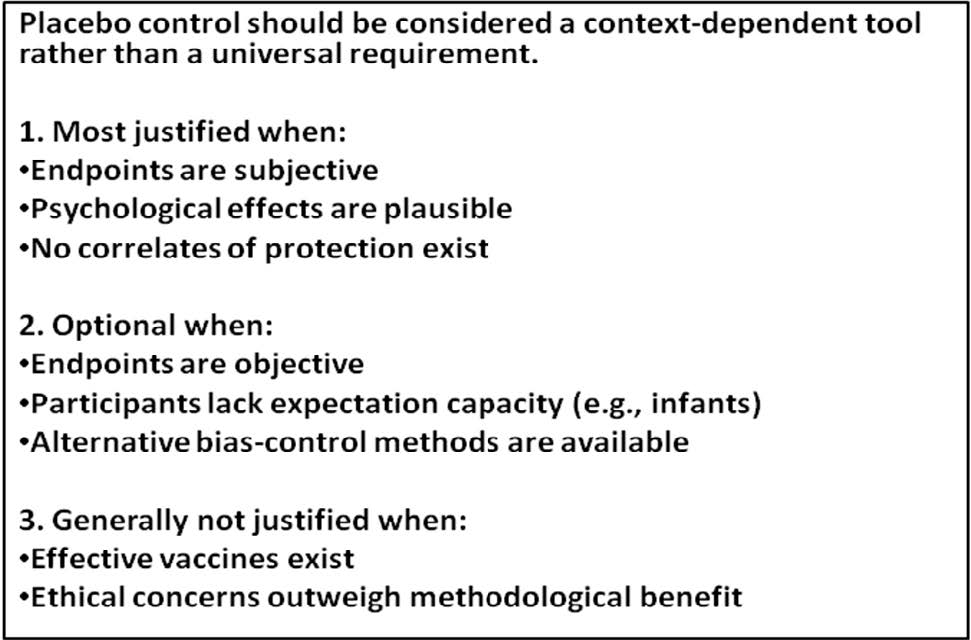
Box 1. When is placebo control necessary in vaccine trials?
Implications for Next-Generation Vaccine Evaluation
Vaccine development is increasingly driven by mechanistic insights, including correlates of protection, systems immunology, and AI-assisted antigen design [9,18–20]. As evaluation shifts toward immune signatures and predictive models, reliance on placebo-controlled paradigms is likely to diminish.
Accordingly, the central question is evolving from “Does it work compared with placebo?” to “Does it induce the appropriate immune response?”
When Placebo Control Remains Important
Despite the arguments presented, placebo control remains important in specific contexts. These include early-phase trials focused on safety and reactogenicity, studies involving subjective or patient-reported outcomes, and settings in which validated correlates of protection are not available.
In such scenarios, placebo provides valuable baseline comparisons and helps disentangle nonspecific effects. The objective is therefore not to eliminate placebo use, but to define more precisely when it is methodologically necessary.
Conclusion
The routine use of placebo control in infant vaccine trials reflects historical convention more than methodological necessity.
In this population, the absence of expectation-driven placebo effects and the objective nature of primary endpoints fundamentally limit the role of placebo in establishing efficacy. While caregiver-mediated biases are relevant, they are endpoint-specific and can be addressed through alternative approaches.
We therefore propose a shift from a placebo-default paradigm to an endpoint-driven framework, in which placebo use is justified only when it addresses a clearly defined methodological need. Such a transition would better align trial design with biological plausibility, ethical responsibility, and the evolving landscape of vaccine science.
References
2. Rid A, Saxena A, Baqui AH, Bhan A, Bines J, Bouesseau MC, et al. Placebo use in vaccine trials: recommendations of a WHO expert panel. Vaccine. 2014 Aug 20;32(37):4708–12.
3. Rid A, Lipsitch M, Miller FG. The Ethics of Continuing Placebo in SARS-CoV-2 Vaccine Trials. JAMA. 2021 Jan 19;325(3):219–20.
4. World Health Organization. Guidelines on clinical evaluation of vaccines: regulatory expectations. United States: WHO; 2016. Available from: https://www.who.int/publications/m/item/WHO-TRS-1004-web-annex-9
5. Caplan A, Pasadyn FL, Mamo N. Fool's-gold science: The ethical and scientific perils of testing most vaccines using placebo-controlled randomized trials. EMBO Rep. 2025 Aug;26(16):3979–81.
6. Benedetti F. Placebo effects: understanding the mechanisms in health and disease. Oxford University Press; 2021.
7. Beecher HK. The powerful placebo. Journal of the American Medical Association. 1955 Dec 24;159(17):1602–6.
8. Dodd S, Dean OM, Vian J, Berk M. A Review of the Theoretical and Biological Understanding of the Nocebo and Placebo Phenomena. Clin Ther. 2017 Mar;39(3):469–76.
9. Plotkin SA. Correlates of protection induced by vaccination. Clin Vaccine Immunol. 2010 Jul;17(7):1055–65.
10. Javid PJ, Sanchez SE, Jacob S, McNeal MM, Horslen SP, Englund JA. The Safety and Immunogenicity of Rotavirus Vaccination in Infants With Intestinal Failure. J Pediatric Infect Dis Soc. 2014 Mar;3(1):57–65.
11. Orenstein WA, Bernier RH, Dondero TJ, Hinman AR, Marks JS, Bart KJ, et al. Field evaluation of vaccine efficacy. Bulletin of the World Health Organization. 1985;63(6):1055.
12. Krause PR, Gruber MF. Emergency use authorization of Covid vaccines—safety and efficacy follow-up considerations. New England Journal of Medicine. 2020 Nov 5;383(19):e107.
13. Hodgson SH, Mansatta K, Mallett G, Harris V, Emary KR, Pollard AJ. What defines an efficacious COVID-19 vaccine? A review of the challenges assessing the clinical efficacy of vaccines against SARS-CoV-2. The Lancet Infectious Diseases. 2021 Feb 1;21(2):e26–35.
14. Amanzio M, Mitsikostas D, Giovannelli F, et al. Adverse events of active and placebo groups in SARS-CoV-2 vaccine randomized trials: A systematic review. The Lancet Regional Health – Europe. 2021;12.
15. Fleming TR, Garnett CE, Conklin LS, Corriol-Rohou S, Hariharan S, Hsu D, et al. Innovations in Pediatric Therapeutics Development: Principles for the Use of Bridging Biomarkers in Pediatric Extrapolation. Ther Innov Regul Sci. 2023 Jan;57(1):109-120.
16. Earle KA, Ambrosino DM, Fiore-Gartland A, Goldblatt D, Gilbert PB, Siber GR, et al. Evidence for antibody as a protective correlate for COVID-19 vaccines. Vaccine. 2021 Jul 22;39(32):4423–8.
17. World Health Organization. WHO Expert Committee on Biological Standardization: seventy-eighth report. Geneva: World Health Organization; 2024 Apr 25.
18. Khoury DS, Cromer D, Reynaldi A, Schlub TE, Wheatley AK, Juno JA, et al. Neutralizing antibody levels are highly predictive of immune protection from symptomatic SARS-CoV-2 infection. Nature Medicine. 2021 Jul;27(7):1205–11.
19. Zhang Y, Wang Y. Harnessing T Cells: Cellular Immunity’s Role in Vaccine Induced Protection. Journal of Vaccines, Medicine and Health Care, Review Article. 2024;2:01–12.
20. Zhang Y, Yu Y. CTL-mediated APC elimination: Constraining effective humoral immunity. Journal of Cellular and Molecular Immunology. 2025 Nov 29;4(1):40–5.