

Commentary
The professionals involved soccer should understand that due to the game’s rules there may not be possibility correct hydration for soccer players during the matches and the opportunities that may appear to drink electrolytic drinks are still limited [1], not only drinks, but also opportunities to offer carbohydrates in gel form during matches. Besides that, although the water it is the most sought-after element to quench thirst, there is a need to inform the soccer athlete that dehydration can occurs during a match even drinking water to quench thirst and that muscle glycogen stores are also depleted [2]. When on the soccer matches, there exists a lot of attacks and counterattacks, the total distance and high intensity tends to decrease due tiredness or athletes’ performance losses. This happens due to electrolyte losses through sweat of fluids containing sodium, potassium, magnesium, calcium, and chloride, causing liquid deficits, and by muscle glycogen stores decreases [3]. This way, it was proven that supply of electrolytic drinks can alleviate cramps and, although the water consumption should be ad libitum and encouraged, using water alone as rehydration basis athlete can increase the exercise-associated muscle cramp [4] in addition to not providing any associated carbohydrates and not helping in muscle glycogen depletion. Therefore, one must have knowledge about the strategies that can be used during halftime to make up for possible lack of opportunities to rehydrate and to prepare the soccer athlete performance again to return to second time of the match.
A study found an average loss of body mass 2.5 kg, an average dehydration 3.38% of body mass and an average sweat loss of 4448 ml in parallel to the average fluid intake 1948 ml monitoring 17 athletes between arrival in stadium and end of the match [5]. Findings like this help us to understand that the replacement fluids strategies during the soccer matches becomes a high-level concern among professionals involved in soccer and elite soccer players. Besides that, due to game rules, the opportunities to drink fluids or ingest another element, like caffeine caps or carbohydrate gels, are minimal. However, this cannot discourage professionals and athletes from looking for appropriate solutions to be applied during the game break. The elite soccer players should be stimulated and educated about the performance and hydration status to self-monitor body changes and seek rehydration and halftime supplements according to specific needs of everyone [6]. This may be avoided by the use of sports drinks that have carbohydrates combination and electrolytes for optimizing and restoring body fluids after activities over 80 minutes, like soccer [7].
Therefore, what may be applied into elite soccer players to improve hydration status is the consumption of isotonic drinks with osmolarity ranging from 270 to 330 mOsm / L during match is recommended in concentration of 0.5 to 0.7 g of sodium / L of water and may contain from 6 to 9% carbohydrates being offered every 15 or 20 minutes in an average volume 150 mL preferably between 15 and 20°C [8]. Dehydration is considered mild after losing 1% of body weight through sweat and considered severe when it reaches 5% of body weight loss. Besides that, if severe dehydration, there is care with fluids ingesting 5 to7 mL/kg of body weight 4 hours before match and 1.5 L fluids after rehydration process for each 1 kg body mass lost during match. In fact, environmental factors such as climate and temperature can influence this decision-making. In colder places, where the athlete will lose less fluid through sweat, analysis can be better established using urine color, which can vary from a yellowish color to a greenish color, demonstrating the athlete's dehydration. A recent study evaluated other studies based on athletes’ dehydration by 2-hour, continuous exercise (like soccer for example), the estimates were based on the following assumptions and data from the literature on cramp-prone athletes: an average sweat sodium concentration of 48.4 mmol/L (1.1 g/L), an average sweat potassium concentration of 5.4 mmol/L (0.21 g/L) and an average sweat rate of 2.23 L/h. This way, based on these assumptions, the athlete would need to replace 4.91 g of Na+ and 0.94 g of K+ [9]. On other hand, the industry can offers products on the market generally called "cramp block caps" and “salt caps”, formulated in capsules to be easily used by athletes on the halftime to help replace electrolytes lost during the first half of a match, such as sodium, potassium, magnesium, calcium, and chloride [3]. This way, it is interesting to approach capsules due to the low concentration of sodium and potassium in sports drinks available on the market [9], making it therefore interesting to use components that offer additional sodium and potassium for the correct rehydration of the athlete. Where, it is up to the responsible professional to assess the athlete's fluid loss through sweat or urine, evaluate the sports drink offered during the interval and, with the help of capsules, prescribe the amount that replaces electrolyte losses, individualizing hydration and supplementation strategies based on factors such as sweat rate, body composition, and individual preferences. Besides that, there is no scientific research evaluating possible side effects of using "cramp block caps" or "salt caps".
The carbohydrate gel is another supplement may be used to help performance and assist athletes during halftime in a practical way, a study demonstrated that ingestion of carbohydrate gel in doses of 0.7 to 0.8 g. kg-1 body weight can improve the intermittent endurance capacity and improved dribbling performance in elite football players [10]. Another supplement that can be used on halftime to assist athlete performance before return to second half, by moderate dosages, around 200 mg per dose, would be the caffeine [11]. The side effects with caffeine to improve performance happen with high doses of caffeine (> 6.0 mg. kg-1), from a practical perspective, using ~3.0 mg. kg-1 of caffeine may be the dose of choice to obtain the ergogenic benefits of caffeine with the lowest prevalence and magnitude of side effects [12]. In this case, when the athlete takes caffeine during the halftime, he/she can optimize his/her alertness and performance for the second half of the soccer match.
Conclusion
In summary, during halftime, the electrolyte replacement remains in the range of 0.5 to 0.7 g of sodium / L of fluid ingested, including a carbohydrate concentration of up to 9%. The athlete must then consume up to 500 mL of this drink. Cramp block and salt caps can also be used in the search for rehydration. The carbohydrates gels supply is also interesting and must contain 0.7 to 0.8 g / kg BW. Finally, caffeine replacement at an average of 200 mg also seems to help the elite soccer athlete to return at a high level in the second half of the match. The water ingestion is ad libitum. These recommendations are shown in summary at the Figure 1.
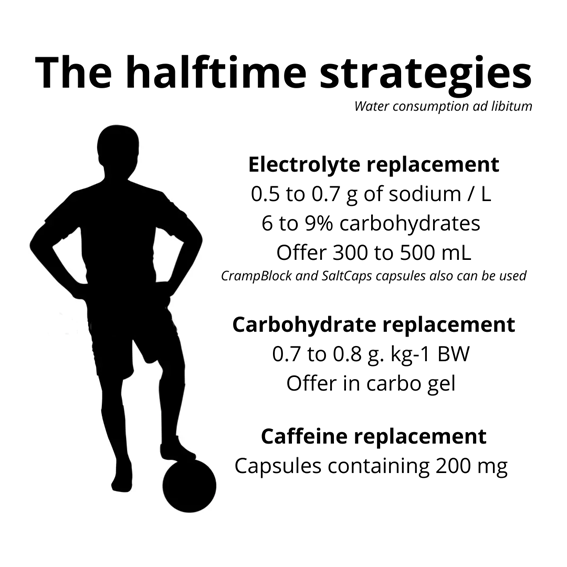
Figure 1. The halftime strategies applied to elite soccer players for improve performance and hydration status.
Limitations and Future Research Section
The article in question is a mini review with a practical basis, there are no guidelines available on such recommendations on any known search platform, such as PubMed, ScienceDirect, Scopus, etc. Therefore, more clinical research on each supplement covered and research with larger reviews on this topic are necessary to better validate all topic doubts.
References
2. Fernandes H. Hydration analysis and recommendations for elite soccer players. Science & Sports. 2022 May 1;37(3):223-5.
3. Shirreffs SM, Aragon-Vargas LF, Chamorro M, Maughan RJ, Serratosa L, Zachwieja JJ. The sweating response of elite professional soccer players to training in the heat. International Journal of Sports Medicine. 2005 Mar;26(02):90-5.
4. Lau WY, Kato H, Nosaka K. Effect of oral rehydration solution versus spring water intake during exercise in the heat on muscle cramp susceptibility of young men. Journal of the International Society of Sports Nutrition. 2021 Dec;18:1-9.
5. Aragón-Vargas LF, Moncada-Jiménez J, Hernández-Elizondo J, Barrenechea A, Monge-Alvarado M. Evaluation of pre-game hydration status, heat stress, and fluid balance during professional soccer competition in the heat. European Journal of Sport Science. 2009 Sep 1;9(5):269-76.
6. Edwards AM, Mann ME, Marfell-Jones MJ, Rankin DM, Noakes TD, Shillington DP. Influence of moderate dehydration on soccer performance: physiological responses to 45 min of outdoor match-play and the immediate subsequent performance of sport-specific and mental concentration tests. British Journal of Sports Medicine. 2007 Jun 1;41(6):385-91.
7. Taylor DG. Water: hydration and sports drink. Second Edi. Handb. Brewing, Third Ed. Elsevier Inc.; 2017.
8. American College of Sports Medicine. Sawka, MN, Burke, LM, Eichner, ER, Maughan, RJ, Montain, SJ y Stachenfeld, NS (2007). Exercise and Fluid Replacement. Medicine & Science in Sports & Exercise.;39(2):377-90.
9. Miller KC, McDermott BP, Yeargin SW, Fiol A, Schwellnus MP. An evidence-based review of the pathophysiology, treatment, and prevention of Exercise-Associated muscle cramps. Journal of Athletic Training. 2022 Jan 1;57(1):5-15.
10. Harper LD, Briggs MA, McNamee G, West DJ, Kilduff LP, Stevenson E, et al. Physiological and performance effects of carbohydrate gels consumed prior to the extra-time period of prolonged simulated soccer match-play. Journal of Science and Medicine in Sport. 2016 Jun 1;19(6):509-14.
11. Fernandes H. Dietary and ergogenic supplementation to improve elite soccer players’ performance. Annals of Nutrition and Metabolism. 2021 Oct 1;77(4):197-203.
12. de Souza JG, Del Coso J, Fonseca FD, Silva BV, de Souza DB, da Silva Gianoni RL, et al. Risk or benefit? Side effects of caffeine supplementation in sport: a systematic review. European Journal of Nutrition. 2022 Dec;61(8):3823-34.