

Case Report
A 22-day-old male neonate was admitted to the neonatal intensive care unit (NICU) with complaints of abnormal movements, fever, breath holding spells, refusal and bluish discoloration of skin. He was born at term with a birthweight of 2·72 kg to a mother with a history of positive polymerase chain reaction for SARS-Coronavirus-2 (SARS-COV-2) virus (RT-PCR-positive), asymptomatic 2019 novel coronavirus disease (COVID-19) at 32-33 weeks gestation, which did not require any supportive measures.
There were no fetal complications during the illness. The mother tested negative for polymerase chain reaction for SARS-COV-2 virus (RT-PCR-negative) at 34 weeks of gestational age. She was documented to be RT-PCR-negative again at 36 weeks of gestational age and two days before delivery. The family chose to deliver the baby by an elective caesarean-section which was uncomplicated. The neonate did not require any supportive care after the delivery. He was documented as RT-PCR-negative on day 2 and 5 of life.
The boy stayed well at home until day 18 of life when he was taken to hospital for not accepting feeds, “tight hands and legs”, “just not looking right”, holding his breaths and turning blue 3 times in the last 24 hours. He was investigated at another pediatric care center and was found to have no significant findings in the blood investigations. He was admitted for 2 days and during that period, the neonate accepted the feeds well and became increasingly alert. There were no breath holding spells reported and patient was discharged. Patient remained asymptomatic on day 21 of life but developed fever, abnormally “tight” body and upwards staring look on the day 22 of life. Patient was brought to emergency in state of cardiogenic shock and systemic hypoperfusion. There was no preceding history of rash, loose stools, abdominal distention or low urine output.
On day 1 of hospitalization, the patient looked dehydrated and was reported to have an increased tone while securing intravenous access. Immediately thereafter the patient had electrographic and clinical seizures (Figure 1). Five hours after admission the patient was febrile (101.2 F), lethargic with depressed primitive neonatal reflexes, tachycardic (heart rate of 224 beats per minute), hypotensive (mean blood pressure: 22 mm Hg) and tachypneic (respiratory rate of 52 breaths per minute) with chest retractions. Oxygen saturation was 94% without and 98% on supplemental oxygen, cool peripheries, and delayed capillary refill (4 seconds). Significant hepatomegaly was present with a liver span of 6.8 cm (documented by point of care ultrasound abdomen scan).
Musculoskeletal abnormalities, congenital malformations, syndromic presentation or dysmorphisms were not evident. The patient had severe metabolic acidosis with an arterial pH of 6.9 and lactate concentration of 31 mmol/L. The electrocardiogram showed sinus rhythm but the chest x-ray did not show any evidence of cardiomegaly or lung fields abnormality. The echocardiogram showed biventricular dysfunction with a left ventricular ejection fraction of 28%. Coronary arteries were normal in origin and dimensions, but appeared prominent and bright (hyperechoic). Point of care ultrasound brain (POCUS Brain) was carried out to rule out intracranial bleed and no significant findings were reported.
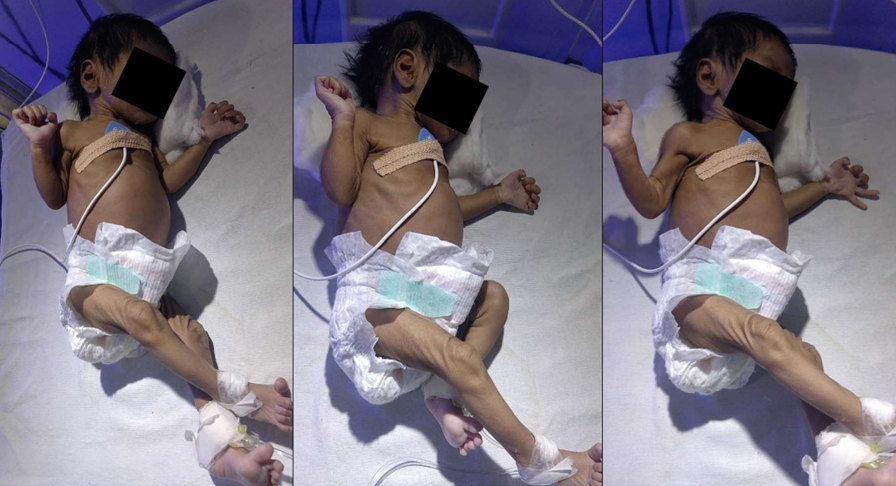
Figure 1: Presentation of MIS-N (Multisystem Inflammatory Syndrome in Neonate). The patient presented with dehydration, increased tone followed by electrographic and then clinical seizures. Lethargy, depressed primitive neonatal reflexes, seizures, respiratory distress (Neonatal Encephalopathy) and intermittent paroxysmal activities completely resolved within 72 hours of critical care management. The above image shows dehydrated skin with unprovoked jerking and spreading of arms (paroxysmal activity).
In absence of any positive findings in POCUS Brain, magnetic resonance imaging of brain was not carried out. Continuous, multichannel, electroencephalogram (EEG) record suggested background slowing , background amplitude of <30 microV, interburst interval of >30 seconds and electrographic seizures.
The aspartate aminotransferase concentration was 262 IU/L and the alanine aminotransferase concentration 92 IU/L, whereas the blood urea concentration was 68 mg/dL and the serum creatinine concentration 1.8 mg/dL. Inflammatory markers were elevated: the serum ferritin concentration was 1608 ng/mL and the serum lactate dehydrogenase concentration 920 U/L. The C-reactive protein concentration was 26.5 mg/L and the D-Dimer concentration 16 μg/mL. There was leucocytosis: total leucocyte count was 36,400 cells per microlitre (73% neutrophils) and platelet count was 724,000 cells per microlitre. Serum electrolytes was normal except for Serum Sodium at 118 mEq/L, 124 mEq/L, 132 mEq/L, 138 mEq/L on day 1, 2, 3 and 4 of hospitalization respectively, thyroid hormones were within normal limits, and vitamin D concentrations were low at 4 ng/ml.
Three blood cultures on hospitalization day 1, 3 and 5 were sterile (Biomerieux automated BACT/ALERT VIRTUO). Qualitative antibody assay detected IgG antibodies against SARS-COV-2 spike protein in both maternal and neonatal serum samples, with a titer of 44.28 in the maternal serum sample and a titer of 16.30 in the neonatal serum sample; no IgM antibodies were detected. Patient’s Nasopharyngeal swabs and rectal swab were negative for SARS-COV-2 on RT-PCR. Cerebrospinal fluid was tested and all parameters were within normal limits.
Multisystem involvement, significantly raised inflammatory markers, documented prenatal exposure to COVID-19, and laboratory evidence of reactive titers of IgG antibodies to SARS-COV-2, led us to consider the possibility of a hyperinflammatory response to prenatal exposure of SARS-COV-2 virus.
The management included aborting the seizures with Midazolam (intravenously 0.5 mg/kg, stat dose), mechanical ventilation for 2 days, inotropic support (intravenous infusions of epinephrine [0.02 μg/kg per min] for 2 days, then tapered and stopped), diuretic (intravenous infusion of frusemide [2.0 mg/kg per day] for 5 days), antimicrobial cover (intravenous infusion of parenteral meropenem (20 mg/kg/dose q8h) for 10 days, and protocol based fluid and electrolyte management.
Injection of methylprednisolone once daily for 3 days (5 mg/kg; slow infusion) was administered followed by tapering protocol. Continuous heparin infusion was added in a dose of 10 U/kg per hour and titrated for optimal anticoagulation. Calcium intravenous infusion of 4 mg/kg/day, PO vitamin D (400 IU OD), and PO zinc (10 mg OD) were commenced. Neurological status was altered initially, but improved and became normal within 72 hours of initiating the management. Clinical stability was attained within 72 hours of hospitalization. Laboratory markers of inflammation and end-organ functions showed improvements starting 48 hours after the initiation of treatment. Echocardiograms documented improvement in ventricular systolic function. The dose of methylprednisolone was halved to 2.5 mg/kg/day on days 4 and 5. Following a successful extubation on day 3, mechanical ventilation and inotropic support were discontinued. Oral prednisolone (2 mg/kg/day) was added after stopping IV methylprednisolone on day 6 of hospitalization. Post-extubation, enalapril (initiated and maintained at 0.25 mg twice daily orally), frusemide (1 mg/kg twice daily, orally) and aspirin (3 mg/kg once daily, orally) were added.
Vertical transmission of SARS-COV-2 to the newborn can manifest as fever, gastrointestinal, respiratory, neurological symptoms and abnormal radiologic imaging of the lungs [1]. Recent literature has described transplacental transfer of maternal IgG antibodies with a possible protective effect [2,3]. Multisystemic inflammatory Syndrome in children (MIS-C) is a diagnosis of exclusion and presents approximately 4 weeks after SARS-COV-2 infection. MIS-C is considered in presence of fever, laboratory markers of inflammation and a temporal association with SARS-COV-2 infection [4]. As neonates show poor pyrexial response, the diagnosis of MIS-C in a neonate (MIS-N) is challenging. An absence of past SARS-COV-2 infection, documented history of antenatal SARS-COV-2 exposure and evidence of transplacental transfer of maternal SARS-COV-2 IgG antibodies may suggest MIS-N.
This case was one of the four cases of MIS-N that we have managed so far (Tables 1a and 1b). All 4 cases (full term neonates) of MIS-N had raised inflammatory markers (D-Dimer and CRP) at the time of presentation and the chief presenting complaint was lethargy (excessive sleep, refusal to feed and “just not looking right”). The presentation was varied in terms of electrolyte imbalance, anemia, abnormal leucocyte counts, age at the time of admission, platelet counts and fever. Only the above described case (out of four neonates) had documented seizures. Interestingly, only one case of MIS-N had both thrombocytopenia and anemia.
Although children seem to have less severe clinical symptoms when infected by SARS-COV-2 virus, the pathophysiology, progression, immediate complications and long term sequalae of MIS-N remains largely unknown in newborn [5]. Fortunately, there is evidence to support that even though children are susceptible to SARS-COV-2 infection, the outcomes are more favorable in children younger than 12 years of age compared with adolescents and adults [6]. Studies have demonstrated (based on limited data) that, there is no evidence for intrauterine transmission of COVID-19 from infected pregnant women to their fetuses, even though mothers may be at increased risk for more severe respiratory complications [7]. However, MIS-N can occur in a neonate following in-utero exposure to SARS-COV-2, resulting in multiple organ injury.
To the best of our knowledge, this case report is the first case of neonatal hyperinflammatory syndrome following antenatal SARS-COV-2 exposure presenting with neonatal encephalopathy. Varying presentations of MIS-C (and MIS-N) warrants further and possibly a re-evaluation of its pathophysiology [8]. The medium to long term sequalae are still unknown, such cases might have critical influence on health professionals caring for peripartum women. Since neonatal spectrum of COVID-19 complications are more immunological in origin (MIS-C mimics Kawasaki disease in many aspects), it will be interesting to observe the impact of mass scale immunization on MIS-N [9]. Invariably broad spectrum higher antibiotics are needed to be instituted in the initial management of MIS-C and MIS-N because of its close clinical proximity to Toxic Shock Syndrome [10]. There has been a huge surge in use of antibiotics (possibly
|
Case |
Fever |
Thrombocytopenia |
Thrombocytosis |
Raised Ferritin |
Raised D-Dimer |
Raised CRP |
Anemia |
Leucocytosis |
Leucopenia |
Hypernatremia |
Hyponatremia |
Seizures |
Lethargy at presentation |
Gestational Age > 36 weeks |
|
1 |
|
|
+ |
|
+ |
+ |
|
+ |
|
+ |
|
|
+ |
+ |
|
2 |
|
+ |
|
|
+ |
+ |
+ |
|
|
|
+ |
|
+ |
+ |
|
3 |
+ |
|
+ |
+ |
+ |
+ |
|
+ |
|
|
+ |
+ |
+ |
+ |
|
4 |
|
|
+ |
+ |
+ |
+ |
|
|
+ |
|
|
|
+ |
+ |
|
Case |
GA of cases when maternal RT-PCR was positive |
GA of cases at birth |
Age at Presentation |
|
1 |
36-37 |
37-38 |
25 |
|
2 |
37-38 |
38-39 |
15 |
|
3 |
32-33 |
36-37 |
22 |
|
4 |
34-35 |
36-37 |
19 |
excessive and irrational) during the ongoing COVID-19 pandemic. Therefore, it would be a worthwhile investigation to follow the trends of antimicrobial resistance in future.
References
2. Ciobanu AM, Dumitru AE, Gica N, Botezatu R, Peltecu G, Panaitescu AM. Benefits and risks of IgG transplacental transfer. Diagnostics. 2020 Aug;10(8):583.
3. Ahmed M, Advani S, Moreira A, Zoretic S, Martinez J, Chorath K, et al. Multisystem inflammatory syndrome in children: a systematic review. EClinicalMedicine. 2020 Sep 1;26:100527.
4. Bhat CS, Gupta L, Balasubramanian S, Singh S, Ramanan AV. Hyperinflammatory syndrome in children associated with COVID-19: need for awareness. Indian Pediatrics. 2020 Oct;57(10):929-35.
5. Chen ZM, Fu JF, Shu Q, Chen YH, Hua CZ, Li FB, et al. Diagnosis and treatment recommendations for pediatric respiratory infection caused by the 2019 novel coronavirus. World Journal of Pediatrics. 2020 Jun;16(3):240-6.
6. Stockman LJ, Massoudi MS, Helfand R, Erdman D, Siwek AM, Anderson LJ, et al. Severe acute respiratory syndrome in children. The Pediatric Infectious Disease Journal. 2007 Jan 1;26(1):68-74.
7. Karimi-Zarchi M, Neamatzadeh H, Dastgheib SA, Abbasi H, Mirjalili SR, Behforouz A, et al. Vertical transmission of coronavirus disease 19 (COVID-19) from infected pregnant mothers to neonates: a review. Fetal and Pediatric Pathology. 2020 May 3;39(3):246-50.
8. Krikilion J, Nuyttens L, Daelemans S, François K, Mauel R, De Wolf D, et al. Varying presentations of multisystem inflammatory syndrome temporarily associated with COVID-19. Case Reports in Pediatrics. 2020 Nov 24;2020.
9. Riphagen S, Gomez X, Gonzalez-Martinez C, Wilkinson N, Theocharis P. Hyperinflammatory shock in children during COVID-19 pandemic. The Lancet. 2020 May 23;395(10237):1607-8.
10. Royal College of Paediatrics and Child Health. Guidance: Paediatric multisystem inflammatory syndrome temporally associated with COVID-19. London. 2020. Available at: https://www.rcpch.ac.uk/sites/default/files/2020-05/COVID-19-Paediatric-multisystem-inflammatory_syndrome-20200501.pdf.