

Clinical Image
A man in his 90s presented to clinic with a conjunctival lesion on the right eye noticed two months prior. The patient denied pain but endorsed worsening blurry vision. The patient’s past medical history was significant for skin cancer on the right ear removed 3 years ago, and a history of ocular surface lesion removal on one eye approximately 20 years ago that was negative for any neoplasia. Slit lamp photograph revealed a gelatinous and opalescent lesion suspicious for ocular surface squamous neoplasia (OSSN) and the high-resolution optical coherence tomography (HROCT) cut (arrow) (Figure 1A). The corresponding HROCT showed thickened hyperreflective epithelium (asterisk)
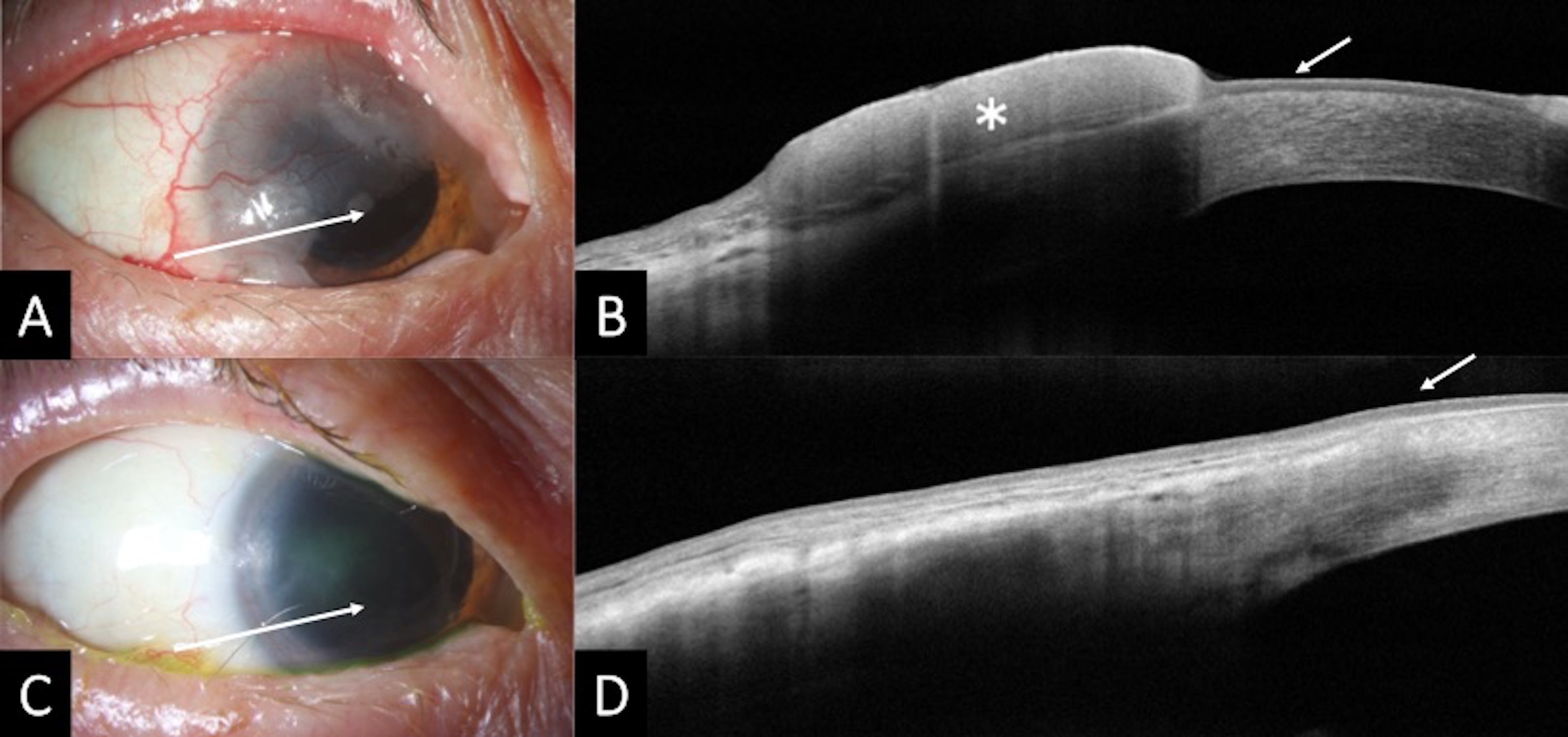
Figure 1: A. Slit lamp photograph prior to topical chemotherapy treatment with high-resolution optical coherence tomography cut (HROCT) (arrow). B. Corresponding HROCT showing thickened hyperreflective epithelium (asterisk) and abrupt transition from normal to abnormal (arrow), characteristic of ocular surface squamous neoplasia. C. Slit lamp photograph after topical chemotherapy treatment with HROCT cut (arrow). D. Corresponding HROCT showing normalized, thin epithelium (arrow).
with an abrupt transition from normal (arrow), characteristic of ocular surface squamous neoplasia (Figure 1B). While traditional treatment of OSSN involves surgical excision, the emerging alternative uses topical chemotherapy as the primary treatment. Topical chemotherapy, in the form of eyedrops, is less invasive and can treat extensive lesions while also targeting subclinical disease. The patient was started on topical 5-fluorouracil 1% (5-FU) compounded eyedrops four times a day for a week with 3 weeks off. This was done for 4 cycles and the tumor responded dramatically.
The follow-up slit lamp photograph revealed remarkable improvement and disappearance of the tumor after 4 cycles of the ophthalmic 5-FU eyedrops (arrow shows HROCT cut) (Figure 1C). The corresponding HROCT showed normalization of the epithelium (arrow), now thin and dark (Figure 1D). This case demonstrates the power of topical chemotherapy eyedrops in the treatment of ocular surface squamous neoplasia.
Conflict of Interest
The authors have no related financial disclosures or conflicts of interest.
Financial Support
NIH Center Core Grant P30EY014801, RPB Unrestricted Award, Dr. Ronald and Alicia Lepke Grant, The Lee and Claire Hager Grant, The H. Scott Huizenga Grant, The Grant and Diana Stanton-Thornbrough ,The Robert Baer Family Grant, The Emilyn Page and Mark Feldberg Grant, The Jose Ferreira de Melo Grant, The Richard and Kathy Lesser Grant, The Michele and Ted Kaplan Grant and the Richard Azar Family Grant(institutional grants).