

Abstract
A strong intergenerational divide in voting behaviour has become a frequently reported stylized fact in post-referendum analyses, raising the question of whether myopia of elderly voters is a cause for concern in ageing societies. However, identifying the origins of a generation gap is empirically challenging because age and birth cohort are collinear at any given point in time. Building on a previous study, we summarize how this problem can be overcome. We discuss an unconstrained rank regression approach that allows estimating the causal ageing effect on political attitudes conditional on arbitrary cohort effects in a flexible manner. As they age, voters of all cohorts become more politically conservative and less supportive of reform projects aimed at protecting the environment, benefitting the working population, and redistributing wealth from the rich to the disadvantaged. As population ageing progresses, forward-thinking reform projects will have declining chances of winning majorities in direct votes.
Keywords
Age, Cohort, Population ageing, Generation gap, Voting
Introduction
The world’s population is ageing at a concerning rate. In 2022, the worldwide population share of people aged 65 and older increased to 771 million, three times the size in 1980 (258 million). Recent projections indicate that the older population increases to 994 million by 2030 (12% of the world population) and 1.6 billion by 2050 (16%). Increasing life expectancy and reduced fertility foster this demographic trend; by 2050, one in every four persons in Europe and Northern America is predicted to be at least of age 65 [1].
This unprecedented global population ageing may have a wide range of economic, sociological, and political ramifications. For instance, population ageing can burden the social security systems and public welfare services [2,3]. Similarly, ageing societies may have severe consequences for the outcome of public votes. Let us assume that rational voters maximise their expected utility conditional on their age. As voters get older, the time span over which they expect to reap the benefits of a reform project shrinks, making them less likely to support projects with long-run benefits and short-run costs [4]. In line with these theoretical considerations, public welfare policies in various countries have been argued to be “elderly-biased” [5], and the findings of various empirical studies substantiate the belief that older voters more likely oppose reform projects that benefit the young, such as climate change mitigation, educational spending, and large infrastructure projects [6-8]. However, since any intergenerational divide can theoretically originate from both age and cohort effects, it is empirically challenging to identify the causal effect of ageing on reform attitudes [9].
This commentary synthesises the contributions of a recent study by Ahlfeldt, Maennig, and Mueller (2022) [10], in which we provide the first systematic assessment of an intergenerational divide in direct democratic voting outcomes as well as the first econometric analysis to identify its origins. Our main contribution is to separate the potential impacts of age and cohort effects on referendum voting by analysing how the reform attitudes of voters from different birth cohorts vary over time. To this end, we use Swiss post-vote survey data covering 305 federal referenda between 1981 and 2017. Exploiting the longitudinal dimension associated with this unique data set, we can estimate the causal effect of ageing on political attitudes conditional on arbitrary cohort effects. One of our key findings is that ageing is causally linked to voters becoming more politically conservative over their life-cycle; older voters are less supportive of reform projects aimed at benefitting young workers and families, redistributing income from the wealthy to the poor, and protecting the environment. These findings indicate that reform projects with long-run benefits and short-run costs will have declining chances of winning majorities in ageing societies, reinforcing the concern that the continuation of current demographic developments could lead to a state of “gerontocracy” [11,12].
From an empirical perspective, a generation gap can be caused by both age and cohort effects because age, birth year, and year of observation are perfectly multicollinear. From a theoretical perspective, individuals of similar birth cohorts experience similar social and political environments during their “formative” or “impressionable years”. As a result, values, attitudes, and norms tend to differ across generations [13,14]. If cohort effects cause an intergenerational divide, individuals from the same birth cohorts will maintain their political attitudes as they age; in this case, differences in political attitudes across generations are unlikely to be affected by population ageing. Moreover, older voters could prefer the status quo because they have experienced it over an extended period of time. Consequently, voters could become more averse to reform projects over their life-cycle due to habituation [15,16]. While population ageing would still negatively impact a society’s ability to implement reform projects, unlike age-dependent utility maximisation, a habituation-induced status-quo bias would not necessarily undermine policies that favour younger and future generations.
Our empirical strategy is designed to distinguish between age and cohort effects as well as utility-maximisation and habituation as theoretical drivers of age-related voting. First, we provide a novel panel rank regression approach that allows to separate age and cohort effects without imposing functional form constraints, a long-standing problem in the related literature. Second, we use the yes vs. no voting decisions recorded in the survey data and a referendum-specific mapping to specify two binary outcomes. The status-quo orientation indicates a vote that supports the status quo (vs. a vote for a change). To specify the political attitude, we use 24 official themes to categorise the 305 referenda into four policy areas: ideological, environmental, generational, and fiscal. We then assign the following attitudes to a vote decision in line with positions of the political left: liberal (vs. conservative), high priority (vs. low priority) environmentalist, pro-young (vs. pro-elderly), and pro progressive (vs. pro regressive) redistribution.
In brief, our findings show that the ageing effect on political attitudes is robust for controlling for arbitrary cohort effects and is caused by expected utility maximisation rather than a habituation-induced status-quo bias – population ageing raises the hurdle for forward-thinking reform projects in direct votes.
Identifying Age and Cohort Effects
Consider a general model that describes the probability Vp,c,r of a voter from birth cohort c to vote in line with a specific political attitude (e.g., supporting left-wing policies):
|
Vp,c,r = g ( AGEp,c ) + h (p) + k (c) + εp,c,r |
(1) |
where r indexes referenda held in period p.AGEp,c gives the age of a voter belonging to cohort c in period p , g(.) , h(.) , k(.) are differentiable functions, and εp,c,r is a random error that accounts for unobserved voter attributes and idiosyncratic referendum effects.
We are primarily interested in an estimate of the causal effect of ageing holding other effects constant, i.e., g' = ∂Vp,c,r / ∂AGEp,c . We refer to this effect as the ageing effect. However, AGEp,c is a linear combination of the period of the referendum p and the birth year of cohort c , and there is no variation in p conditional on AGEp,c and c . As a result, it is impossible to identify the effects of AGEp,c , p , and c without imposing any restrictions [17].
We approach the APC conundrum by giving up on the identification of period effects to be able to estimate age effects conditional on arbitrary cohort effects. To this end, consider the following model:
|
Rp,c = R ( Vp,c ) = m ( AGEp,c) + θc + εp,c |
(2) |
where R (.) is a function that gives a cohort´s field rank (lowest rank to highest value) in the distribution of voting propensities within a period, θc is an arbitrary cohort fixed effect, and m (.) describes how a cohort’s rank changes over time as the cohort ages. The rank of a cohort within a period Rp,c is independent of period effects h (p) ; thus, period effects are removed.
The rank transformation converts a cohort’s period-specific (mean) political attitude into an ordinal scale. To illustrate the interpretation of the estimated marginal effect, let us assume that changes in political attitudes were solely attributable to age effects, and the attitude toward supporting left-wing policies decreased with age. In each period, a new cohort would enter the distribution of ranks with a rank of one as it reaches the minimum voting age, all other cohorts would climb up the rank ladder by one step, and the cohort with the highest rank would drop out. The rank-ageing effect would be ∂Rp,c / ∂AGEp,c = m´( AGEp,c )=1. Conversely, if ageing was associated with decreasing propensity to support right-wing policies, we would expect a rank-ageing effect of negative unity. If the rank-ageing effect laid between zero and positive or negative unity, a generation gap would originate from a mix of age and cohort effects. Last, a rank-ageing effect of zero would imply that cohort effects drive any correlation between attitudes and voter age.
Political Attitudes by Age and Policy Area
In Figure 1, we document the general existence of an intergenerational divide in political attitudes by summarizing how conditional mean political attitudes change by voter age. First, for each policy area, we use OLS to regress the political attitude on voter covariates, referendum effects, and integer age-bin effects; then, we plot the results of fitting local polynomial regressions of the age-bin effects on age.

Figure 1: Conditional mean political attitude by age and policy area. A voting outcome of one [zero] is in line with the political left [right]. Grey-shaded areas indicate 95% confidence intervals. Dashed lines are the mean outcomes across all age groups within policy areas. N is the number of referenda within a policy area. Source: [10].
As they age, voters’ attitudes shift from the political left to the political right. Compared to older voters, we find younger voters to vote less conservatively, have higher priorities for protecting the environment, and more strongly support policies that benefit the young. In the fiscal area, while the relationship is concave, we find a similar trend beginning around the age of 45. The trend accelerates around retirement age across all four policy areas. In summary, we find a systematic intergenerational divide in direct democratic voting decisions. The extent to which age and cohort effects contribute to this generation gap is assessed in the following Section.
Separating the Impact of Age and Cohort Effects on Political Attitudes
Empirical implementation
For our main analysis, we aggregate the individual data to five-year cohort-period cells. In a first stage, we regress the individual voting outcomes (political attitude or status-quo orientation) on voter attributes and cohort-referendum effects, recover the latter, and collapse the data onto that level. The resulting panel data set represents adjusted voting outcome propensities in which birth cohorts c = (1895-1899, …, 1995-1999) are observed over periods p = (1980-1984, …, 2015-2017), covering age groups a= p-c = (20-24, …, 85-89) .
We then use this data to estimate a version of equation (2).[1] In particular, to derive estimates of the lifecycle-specific average field rank conditional on arbitrary cohort effects as well as on marginal rank-ageing effects that are specific to age groups a , we estimate:
|
Rp,c= βaAGEp,c + φc,a + ?p,c,a (3) |
|
where AGEp,c , is again the age of cohort c in period p , βa is the marginal rank effect of ageing for age group a , φc,a is a cohort effect, and ?p,c,a is an error term. We estimate this model in a series of locally weighted linear regressions (LWR). In each regression, we weight all observations by their distance from age group a using weights defined by a Gaussian kernel. Before the LWR, we run an auxiliary regression of ranks against cohort fixed effects to remove any time-invariant components. Age-group-a -specific predicted ranks (conditional on cohort effects) are recovered as βaAGEp,c + φ , where φ is the mean over the cohort effect of any cohort at any period.
[1] To preserve the intuitive interpretability of m´ (AGEp,c) ≤ |1| in the aggregated data, we rescale the rank measure as R p,c= Rp,c× 5-2 , where Rp,c is the rank of a five-year age group in the distribution of voting propensities within a period.
Results
Exemplarily, Figure 2 displays the results for estimating the ageing effect on status-quo orientation and political attitude by policy area. We find a strong ageing effect in all four policy areas. Considering regulatory policy attitudes, the average rank increases by around 40 ranks from liberal to conservative throughout the course of a voting life, which equates to about two-thirds of a rank per year of ageing. For the status-quo orientation, the ageing effect is smaller and more ambiguous. The shift in environmental and generational attitudes is comparable to the change in the regulatory attitude. However, the transition from expressing a high priority to environment protection to a low priority develops rather linearly over the life-cycle, whereas the transition from a pro-young to a pro-elderly attitude accelerates near retirement age. While similar to the effects on political attitudes, the ageing effect on status-quo orientation is slightly attenuated in both policy areas. Last, we find an approximately convex ageing effect in the public finance area. Voters’ attitude toward supporting progressive policies increases until age 40; from then on, they shift back to supporting more regressive policies, which they actively pursue by rejecting the status quo.
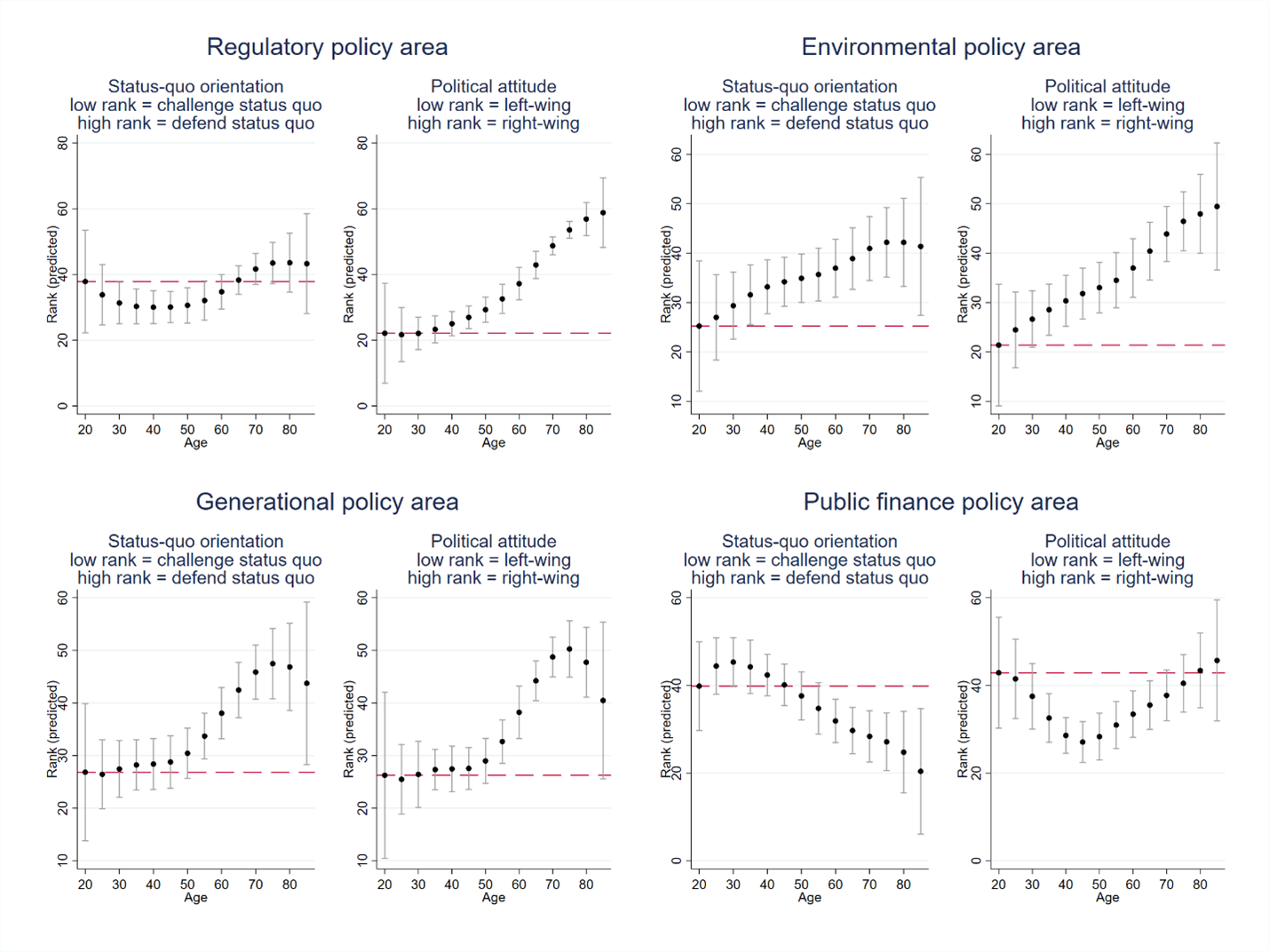
Figure 2: Semi-non-parametric estimates of rank by age and policy area. 95% confidence intervals based on standard errors clustered on cohort fixed effects. Source: [10].
In general, the ageing effect on attitude ranks controlling for cohort effects is in line with the cross-sectional evidence presented in Figure 1, reaffirming that a causal age effect is driving the intergenerational divide. Comparing the age effects on political attitude and status-quo orientation ranks in the regulatory and public finance policy areas indicates that voters’ shift in political attitudes is more likely due to age-dependent utility-maximisation than habituation. The strong retirement effect in the generational policy area further supports this interpretation.
Conclusion
We document the existence of a generation gap in voting outcomes using post-vote survey data covering 305 Swiss referenda held since 1981. We find older voters to less likely support policies that aim to protect the environment or benefit the younger population, including families with children. These differences in voter attitudes are causally linked to ageing effects – different socioeconomic and political experiences across cohorts cannot explain the intergenerational divide. Consequently, it will become increasingly difficult for ageing societies to win majorities for forward-thinking reform projects in direct polls, such as policies aimed at mitigating climate change, improving the quality of education, and providing sustainable infrastructure.
References
2. Galasso V, Profeta, P. The political economy of social security: A survey. European Journal of Political Economy. 2002;18(1):1-29.
3. Sørensen RJ. Does aging affect preferences for welfare spending? A study of peoples’ spending preferences in 22 countries, 1985-2006. European Journal of Political Economy. 2013;29:259-271.
4. Messner M, Polborn MK. Voting on majority rules. Review of Economic Studies. 2004;71(1):115-132.
5. Tepe M, Vanhuysse P. Elderly bias, new social risks and social spending: change and timing in eight programmes across four worlds of welfare, 1980-2003. Journal of European Social Policy. 2010;20(3):217-234.
6. Ahlfeldt GM, Maennig W, Steenbeck M. Direct democracy and intergenerational conflicts in ageing societies. Journal of Regional Science. 2019;60(1):1-27.
7. Bearse P, Cardak BA, Glomm G, Ravikumar B. Why do education vouchers fail at the ballot box? European Journal of Political Economy. 2013;32:26-37.
8. Cattaneo MA, Wolter SC. Are the elderly a threat to educational expenditures? European Journal of Political Economy. 2009;25(2):225-236.
9. Ryder N. The Cohort as a Concept in the Study of Social Change. American Sociological Review. 1965;30(6):843-861.
10. Ahlfeldt GM, Maennig W, Mueller SQ. The generation gap in direct democracy: Age vs. cohort effects. European Journal of Political Economy. 2022 Mar 1;72:102120.
11. Sinn HW, Uebelmesser S. Pensions and the path to gerontocracy in Germany. European Journal of Political Economy. 2003;19(1):153-158.
12. Montén A, Thum M. Ageing municipalities, gerontocracy and fiscal competition. European Journal of Political Economy. 2010;26(2):235-247.
13. Krosnick JA, Alwin DF. Aging and Susceptibility to Attitude Change. Journal of Personality and Social Psychology. 1989;57(3):416-425.
14. Mannheim K. The Problem of Generations. Essays on the Sociology of Knowledge. 1952;24(19):276-322; 22–24.
15. Hessami Z, Resnjanskij S. Complex Ballot Propositions, Individual Voting Behavior, and Status quo Bias. European Journal of Political Economy. 2019;58(June):82-101.
16. Samuelson W, Zeckhauser R. Status quo bias in decision making. Journal of Risk and Uncertainty. 1988;1(1):7-59.
17. Fienberg SE, Mason WM. Specification and implementation of age, period and cohort models. In: Cohort analysis in social research. Springer: New York, NY. 1985; pp. 45-88.