

Abstract
Background: Multigene next-generation sequencing (NGS) has transformed molecular diagnostics in oncology over the past decade, increasingly replaced single-gene approaches such as Sanger sequencing. Although NGS is now integral to precision oncology, differences in laboratory infrastructure, workflow standardization, and quality assurance persist. This study evaluated regional laboratory performance in pan-cancer NGS testing, examined practical barriers to implementation, and identified strategies to improve diagnostic accuracy.
Methods: A multicenter RING Trial including external quality assessment (EQA) was conducted across five laboratories in Argentina, Brazil, Chile, Colombia, and Peru. Each laboratory analyzed 30 artificial FFPE reference samples containing predefined oncogenic variants using routine local workflows. Performance was centrally assessed by concordance between expected and reported variants. Findings were further contextualized through an expert discussion and a follow-up structured survey examining workflows, technical limitations, and bioinformatics practices.
Results: All five laboratories completed testing of the full sample set, yielding 150 evaluable laboratory-sample observations. The overall mean genotyping score was 1.46 out of 2.00 (range: 0.20–2.00). Performance was highest for less complex samples and declined for specimens with multiple concurrent alterations, splice-related events, or fusion-rich profiles. Thirty-five critical genotyping errors were recorded overall, an error rate of 23.3%. Expert discussion and survey findings indicated pre-analytical variability, early-stage wet-lab implementation, differences in bioinformatics filtering, and inconsistent reporting practices were major contributors to performance variability.
Conclusions: This regional EQA ring trial demonstrated that important implementation gaps in multigene NGS persist across Latin America, particularly for detecting molecularly complex alterations. Findings underscore EQA's value not only as a benchmarking tool but as a practical implementation support mechanism for laboratories introducing comprehensive genomic profiling. Strengthening pre-analytical standardization, bioinformatics governance, interpretive review, and regionally adapted quality frameworks may improve diagnostic accuracy and support more equitable access to high-quality precision oncology across Latin America.
Keywords
Next-generation sequencing, Latin America, Precision oncology
Introduction
Over the past decade, multigene next-generation sequencing (NGS) has transformed molecular diagnostics in oncology and largely replaced traditional single-gene testing approaches such as Sanger sequencing. NGS enables the simultaneous detection of multiple genomic alterations, including somatic mutations and germline variants, across a range of assay formats, such as whole-genome sequencing, whole-exome sequencing, and targeted gene panels focused on clinically relevant regions [1,2]. This capability has improved diagnostic precision, refined prognostic assessment, and enabled biomarker-driven treatment selection across multiple tumor types [3–6]. As a result, NGS-based molecular testing has become an integral component of routine clinical practice.
Successful implementation of NGS requires robust analytical validation and quality assurance [7–9]. Although internal validation establishes assay performance under controlled conditions, it does not fully capture the variability found in routine clinical practice. Differences in sample quality, sequencing platforms, and bioinformatics pipelines can introduce analytical artifacts and affect the accuracy of test results. External quality assessment (EQA) programs provide an independent benchmark of laboratory performance using standardized reference materials and have been shown to reduce error rates and improve reproducibility [10,11]. Participation in ring trials further supports quality improvement by providing participating laboratories with objective performance feedback and identifying opportunities to strengthen the testing workflow [12,13].
Despite broader adoption in other regions, implementation of multigene NGS across Latin America (LATAM) could benefit from further optimization. Laboratories operate within heterogeneous health care systems characterized by variable infrastructure, limited access to standardized technologies, and differences in accreditation and quality oversight [14–16]. In several countries, the absence of mandatory national certification contributes to variability in testing quality and reporting practices [17].
This study synthesizes findings from a regional EQA ring trial, together with expert discussion and survey data, to characterize the current state of multigene NGS implementation in LATAM. The objectives were to evaluate regional laboratory performance in pan-cancer NGS testing, identify recurrent analytical and operational challenges, define major error patterns and likely root causes, and propose practical, regionally adaptable strategies to improve diagnostic accuracy in real-world laboratory settings.
Methods
A multicenter EQA ring trial was conducted to evaluate the performance and implementation of pan-cancer NGS testing across laboratories in LATAM. The initiative consisted of an analytical EQA ring trial, followed by an expert discussion and a structured survey designed to characterize workflows, technical limitations, and bioinformatics practices (Figure 1). The ring trial was coordinated by EMQN CIC and included five laboratories from Argentina, Brazil, Chile, Colombia, and Peru, representing a range of molecular diagnostic facilities within the region.
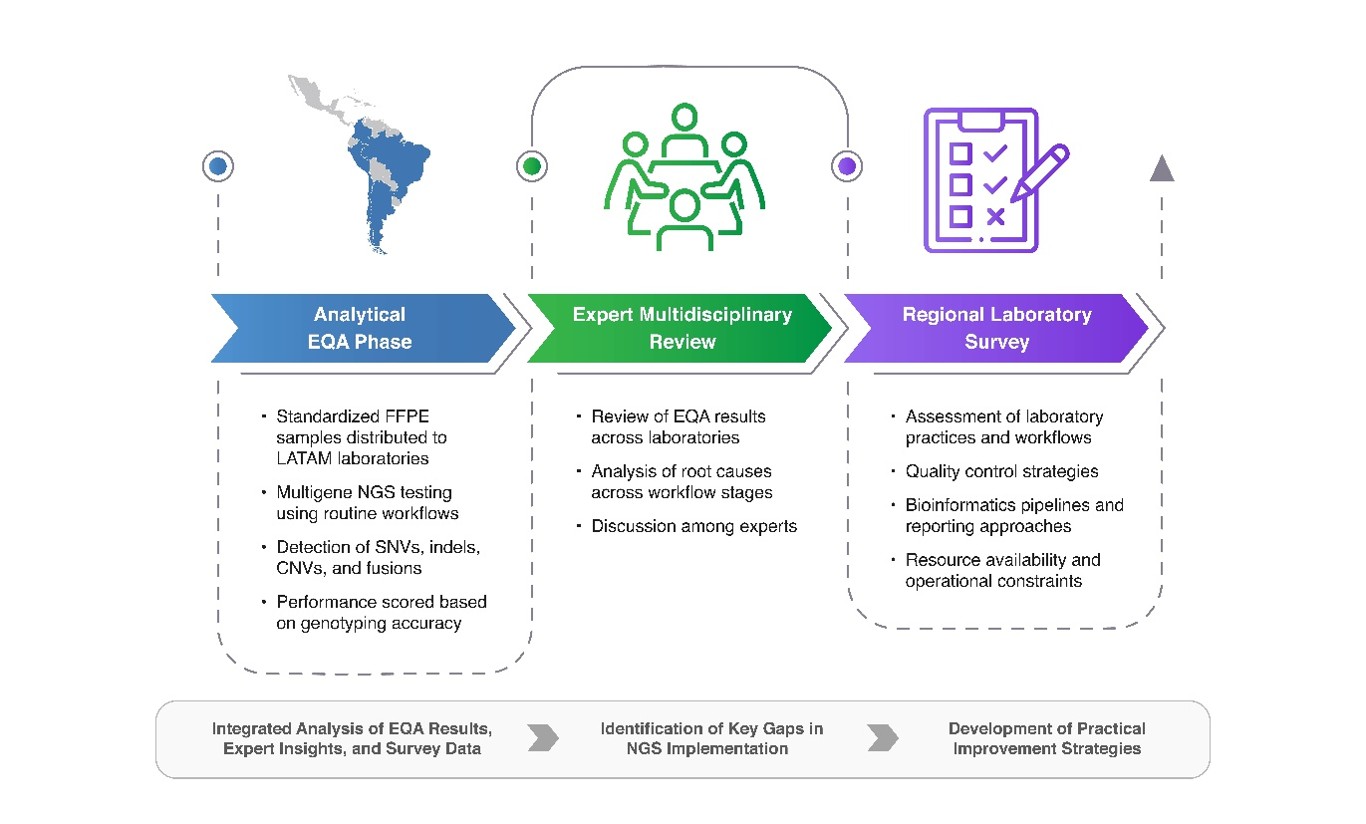
Figure 1. Schematic representation of the LATAM multi-tumor NGS quality assessment initiative. (A) Analytical EQA phase involving multi-tumor NGS testing across LATAM laboratories. (B) Expert multidisciplinary discussion to review performance. (C) Supplementary survey assessing regional technical and analytical workflows.
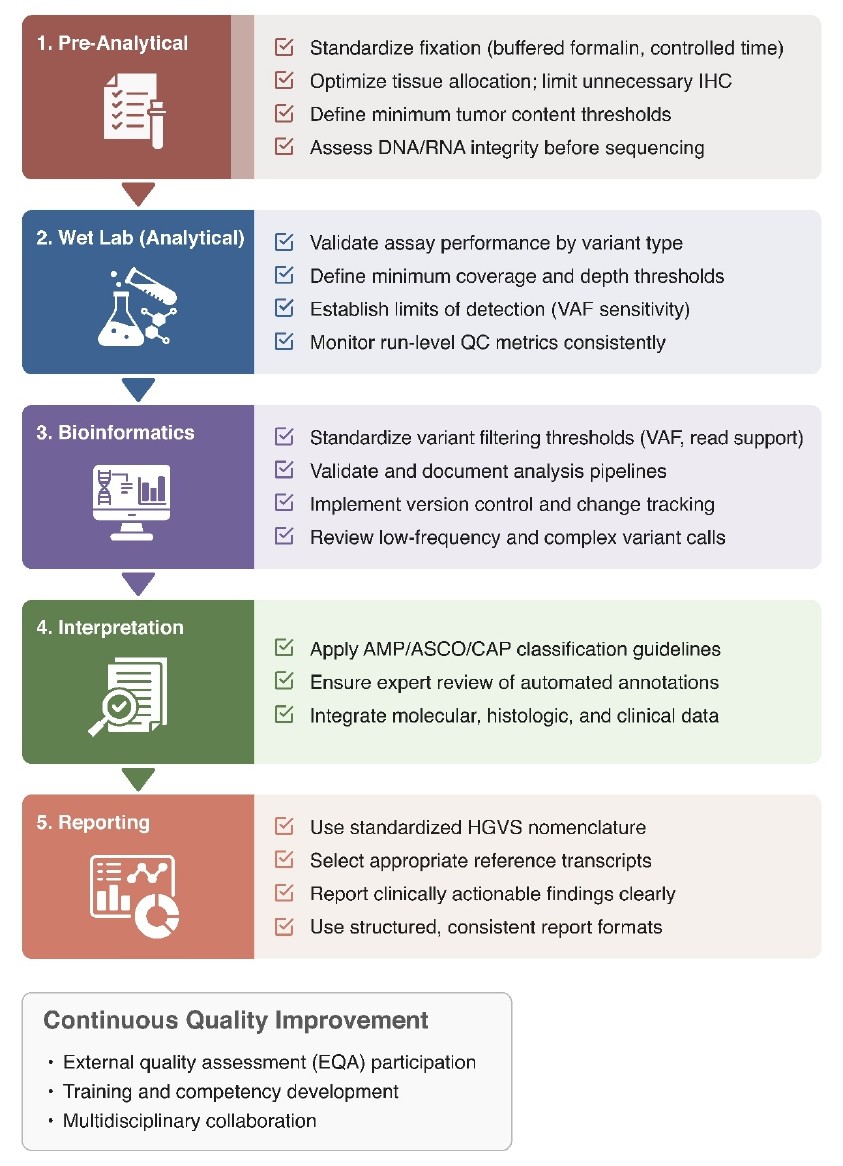
Figure 2. Visual roadmap summarizing actionable steps across the workflow (pre-analytical, wet lab, bioinformatics, interpretation, and reporting).
Each participating laboratory received 30 artificial formalin-fixed, paraffin-embedded (FFPE) reference samples containing predefined oncogenic variants across multiple tumor types. The materials consisted of established EMQN CIC EQA samples and commercially manufactured artificial FFPE reference standards (Horizon Discovery Biosciences Ltd). Variant composition was designed to reflect mutation types and allele frequencies encountered in routine practice. Samples were processed locally according to each laboratory’s internal procedures for FFPE handling, nucleic acid extraction, and NGS library preparation. Laboratories used one of two commercially available NGS panel assays: the SOPHiA DDM™ Pan|Tumor Custom Solution or the Illumina TruSight Oncology 500 DNA/RNA panel with a homologous recombination deficiency (HRD) add-on.
Results were submitted to EMQN CIC for centralized evaluation. Laboratory performance was assessed by concordance between reported and expected variants using a standardized framework incorporating sensitivity, specificity, and overall accuracy. Nonmatching results, including false negatives, false positives, and reporting inconsistencies, were systematically recorded. Individual performance reports were issued to each laboratory, and a consolidated summary report was prepared to identify cross-laboratory trends and common analytical challenges.
A virtual Steering Committee meeting was held in December 2025 with nine representatives from participating laboratories: Brazil (n = 2), Argentina (n = 2), Chile (n = 2), Colombia (n = 2), and Peru (n = 1). The discussion focused on interpretation of the ring trial results, implementation challenges, and potential improvement strategies. To further assess sources of variability, a structured online questionnaire was administered between January and February 2026 to 10 respondents from Brazil (n = 4), Chile (n = 2), Colombia (n = 2), Peru (n = 1), and Argentina (n = 1). The questionnaire collected additional information on technical challenges, bioinformatics workflows, and quality control (QC) practices (Appendix).
Results
Overall analytical performance
All five participating laboratories completed testing and submitted results for the full set of 30 artificial FFPE reference samples, yielding 150 evaluable sample observations. There were no withdrawals, no missing submissions, and no assay-level test failures, indicating that the distributed materials were technically compatible with the panels used across sites.
Performance was assessed using a genotyping score with a maximum value of 2.00 per sample, where a critical genotyping error resulted in a 2-point deduction. Across the participating laboratories, the overall mean genotyping score was 1.46 out of 2.00. Per-sample mean scores ranged from 0.20 to 2.00, with the lowest scores observed for the most complex multiplex samples and 12 of the 30 samples (40%) achieving a perfect mean score of 2.00. At the laboratory level, estimated mean scores ranged from approximately 1.27 to 1.87, reflecting between 2 and 11 critical genotyping errors per laboratory across the 30 samples, indicating that some laboratories already perform at a level consistent with established testing services. Performance varied substantially by sample complexity, with higher scores for simpler samples and lower scores for more complex ones containing multiple mutations, splicing variants, or gene fusions.
Critical genotyping errors
Across all 150 laboratory-sample observations, encompassing 84 individual expected genetic events across the 30 samples (420 laboratory-event assessments in total), 35 critical genotyping errors were recorded, corresponding to an error rate of 23.3% at the sample level and 8.3% at the individual-event level. These comprised 13 false-negative results (8.7%), 19 false-positive results (12.7%), and 3 results with both false-negative and false-positive findings (2.0%) (Table 1). It should be noted that, given the small cohort of participating laboratories, the observed error rates should be interpreted with some caution, as they may be disproportionately influenced by the performance of individual sites rather than reflecting the broader regional landscape. Absolute error counts per laboratory are provided in Table 1.
|
|
Lab A |
Lab B |
Lab C |
Lab D |
Lab E |
|
CGE / 30 samples |
2 |
11 |
10 |
2 |
10 |
|
False positive results |
0 |
1 |
7 |
1 |
10 |
|
False negative results |
2 |
10 |
0 |
1 |
0 |
|
Recurrent technical errors |
1 |
4 |
5 |
1 |
4 |
|
Interpretive errors |
0 |
1 |
1 |
0 |
4 |
False-negative errors were primarily driven by failure to detect clinically relevant variants and fusions at variant allele frequencies (VAF) that were not uniformly low. Missed alterations included PIK3CA p.(Glu542Lys) at 18.5% and 14.5%, EGFR p.(Cys797Ser) at 9%, BRCA2 p.(Ile2675AspfsTer6)at 9.4%, JAK2 p.(Val617Phe) at 11%, BRAF p.(Val600Arg) at 14%, MET splice-site/exon 14-skipping-associated variants at 15% and 28%, KIT p.(Asp816Val) at 8.9% and 9.6%, and QKI::NTRK2 fusion events. Notably, these false-negative results occurred at VAF ranging from 9% to 28%, values that sit significantly above the established biochemical limits of detection for both testing platforms used in this cohort. This indicates that the physical sequencing process successfully captured the mutated DNA fragments. Consequently, we can classify these omissions not as wet-lab or biochemical failures, but as downstream bioinformatic or interpretive diagnostic drops.
False-positive findings mainly reflected reporting of variants or fusions that were not present. These included incorrect reporting of EGFR p.(Leu858Arg), AKT1 p.(Glu17Lys), KRAS p.(Gly13Cys), BRCA1 p.(Asp1151MetfsTer4), and several absent fusion events such as RPS6KB1::VMP1, GPSM1::NOTCH1, BRCA2::BRCA1, and EZR::ROS1.
Recurrent technical and interpretive error patterns
Analysis of the noncritical error summaries identified several recurring patterns across the participating laboratories. First, 3 out of 5 sites consistently overcalled additional BRAF substitutions, most frequently V600M, V600E, or V600G, alongside the correct variant. These concurrent calls occurred within the identical codon and read families, demonstrating a pattern of artifactual sequence decomposition during the bioinformatic alignment phase rather than true biological intra-tumor heterogeneity. Second, complex small variants were sometimes split or miscalled (e.g., KRAS p.(Gly13Glu) delins events were reported as one or two separate single-nucleotide substitutions). Third, some clinically actionable alterations were classified as variants of uncertain significance, including KIT p.(Val654Ala), EGFR p.(Cys797Ser), and MET exon 14-related splice alterations. Fourth, nomenclature and structural annotation issues were observed in fusion and splice-event reporting, including reversed fusion orientation (ALK::EML4 instead of EML4::ALK) and mischaracterization of a MET splicing alteration as a deletion rather than a splice-site event.
Some laboratories also reported benign or nonactionable findings, such as KIT p.(Met541Leu) and EGFR c.1881-2A>G. While most laboratories correctly applied HGVS nomenclature for single-nucleotide variants and small indels, performance was lower for fusion reporting, which reinforces the need for more specific guidelines for the classification and nomenclatures of gene fusions.
Taken together, these findings indicate that the primary challenges in this ring trial were not related to sample compatibility or assay completion, but to the detection and interpretation of complex alterations. The most significant performance gaps involved multiplex samples, gene fusions, and MET exon 14-related events, along with recurrent false-positive fusion calls and variants misclassification.
Discussion
Underlying causes of the observed technical gaps
The expert discussion suggested that the performance issues seen in the EQA ring trial were not primarily the result of assay failure but rather reflected the expected challenges of introducing a complex multigene NGS workflow into routine practice. This interpretation is in line with the EMQN summary, which noted that most participating laboratories were still in the early stages of implementing the test and highlighted the need for careful verification and ongoing participation in EQA programs. EMQN also pointed out that higher error rates are common when a new assay is first introduced, and that these typically improve as workflows become more established and laboratories gain experience through repeated quality assessments. Importantly, some participants similarly described their services as newly established and still being refined and viewed the ring trial as a useful opportunity to evaluate their reporting and identify areas for improvement. Furthermore, for other participants, although somatic testing has long been part of the routine workflow, this interlaboratory assay was performed as part of the validation process for the comprehensive genomic tumor profiling test they were implementing. Due to the wide variety of alterations contained in the ring trial samples, it was possible to identify the areas requiring the most attention and address them before the test was implemented routinely.
A recurring point in the discussion was that most errors were observed at the analysis and reporting stages, rather than failure to detect the underlying alteration, corroborating the importance of the learning curve during the implementation of a new test. More complex variant types were consistently described as particularly challenging. Divergent bioinformatic pipelines, specifically variable filtering stringencies, drove the observed inter-laboratory discordance.
Pre-analytical factors
The expert discussion highlighted pre-analytical factors as a relevant cause of reduced performance, particularly in the context of fusion detection. Participants noted that fusion analysis was especially challenging for some laboratories, largely because it had only recently been introduced into routine workflows and processes were still being refined at the time of assessment.
These challenges were closely linked to tissue handling before sequencing and to the inherent fragility of RNA. Variable fixation practices and the use of non-buffered formalin can further damage nucleic acids in FFPE material, with RNA being particularly vulnerable. Because fusion detection depends on adequate RNA preservation and transcript quality, degradation during fixation and tissue processing can directly reduce sensitivity to detect true fusions. In routine practice, this issue is especially relevant when tissue is limited, when specimens are received from external institutions, or when much of the material has already been used for histology and immunohistochemistry before molecular testing is requested. As several experts noted, these constraints tend to affect RNA-based analyses the most, as DNA results may still be obtainable from borderline samples while fusion testing fails or becomes less reliable.
Laboratories described a range of approaches to manage these risks, including review of sample- and gene-level coverage, reassessment of unexpected findings, repeat extraction where possible, and orthogonal confirmation of discordant results. In practice, however, these measures might not be feasible, especially because orthogonal methods are not always available for all different changes detected. Also, dealing with FFPE samples is a work in progress; the experience of the professionals involved in the technical, bioinformatic, and analytical processes allows them to anticipate weaknesses at certain steps, as well as ensure better performance when dealing with tissues of borderline quality and more complex genetic events.
The frequency of pre-analytical factors in LATAM laboratories emphasizes the need to promote educational events for pathology laboratories, sharing data and feedback on results, and encouraging participation in laboratory certification and accreditation programs, for continuous process improvement and ensuring better tissue quality for molecular tests.
Analytical and wet-lab factors
The expert discussion indicated that most wet-lab issues were associated with the initial stages of workflow implementation and laboratories described the ring trial as part of their assay validation and continuous improvement. Several sites explicitly stated that the exercise helped identify specific technical challenges and staff training needs.
Differences in local practices are relevant because extraction chemistry, RNA recovery efficiency, library preparation robustness, and built-in QC checkpoints can all influence performance in low-input, degraded, or fusion-rich samples. At the same time, the discussion supported the broader conclusion that platform choice alone does not determine performance.
Most sites used the Illumina TruSight Oncology 500 DNA/RNA panel, while one site used the SOPHiA DDM Pan-Tumor Custom Solution. Extraction workflows varied, with reagents from Promega, Qiagen, Roche, and Thermo Fisher. These differences can be relevant, as factors like extraction chemistry, RNA recovery, library preparation, and QC steps may affect panel performance, especially with low-quality or limited samples. Importantly, the discussion suggested that panel choice alone is insufficient; performance ultimately depends on how well the full wet-lab process has been validated, optimized, and adapted locally. A related theme was the balance between automation and cost-efficiency in the regional context. While greater automation can help improve standardization and reduce hands-on variability, laboratories in LATAM may need to weigh these benefits against reagent costs, instrument access, and the cost of repeat testing. Hands-on wet-lab training was also highlighted as a potential area for improvement. Library preparation for a capture-based enrichment NGS methodology requires detailed training and close monitoring.
Bioinformatics and reporting
Both the expert discussion and the follow-up survey identified bioinformatics filtering and variant classification as the main sources of error. The presence of high-VAF false negatives—specifically the MET splice variant at 28% and the PIK3CA mutation at 18.5%—proves that the sequencing architecture yielded sufficient read depth and quality at these genomic loci. The data existed within the raw sequencing files. The diagnostic failure occurred because automated variant-calling pipelines discarded these true positives before human review, driven by overly stringent strand-bias filters or elevated quality score cutoffs. This reliance on unoptimized out-of-the-box software settings creates a significant diagnostic blind spot, demonstrating that bioinformatic filtering strategy is just as critical to patient outcomes as wet-lab execution.
To mitigate these risks, laboratories reported a move toward combining automated filtering with manual review rather than relying on software alone. All sites confirmed the use of standard operating procedures and "double-review" systems to ensure consistency across the team. Although variant-calling thresholds were generally considered appropriate, participants noted that these settings require further refinement, particularly for complex or borderline events. Currently, thresholds are based on a mix of control materials, historical data, and vendor defaults.
The recurrent overcalling of concurrent BRAF substitutions exposes a distinct bioinformatic vulnerability regarding complex multinucleotide variants (MNVs) and adjacent indels. Standard local alignment algorithms routinely process genomic data through an isolated single-nucleotide prism. When these pipelines encounter a complex multi-base alteration within codon 600, they frequently fail to parse the modifications as a single, phase-linked haplotype event. Instead, the software computationally splits the MNV into separate, independent single-nucleotide variants (SNVs), synthesizing artificial 'ghost' calls like p.V600M or p.V600G directly adjacent to the true driver mutation.
Resolving this issue requires shifting from simple error tracking to active bioinformatic troubleshooting. Laboratories using these assays must transition to phase-aware, haplotype-based variant callers or integrate specific curation scripts that recognize overlapping nucleotide changes within a single codon as a unified event. Upgrading local pipeline architectures to recognize phase-linked variations will drastically reduce false-positive noise and prevent the mischaracterization of complex oncogenic drivers across regional testing networks.
Limitation
A limitation of this ring trial is that the artificial FFPE reference materials, while designed to harbor clinically relevant variants at defined allele frequencies, contained combinations of concurrent alterations that are uncommon in real-world tumor samples. This design maximizes the breadth of variant types assessed but may not fully reflect the variant complexity and co-occurrence patterns typically encountered in routine clinical specimens, where extreme multiplexing of this kind is rare.
Improvement opportunities and practical strategies
The discussion identified a need for a multilevel quality-improvement framework that spans the entire testing process, including pre-analytical, analytical, bioinformatics, and interpretive phases.
Short-term strategies
Mandating strict pre-analytical nucleic acid quality thresholds will immediately mitigate downstream sequencing failures. Some laboratories already assess DNA and RNA integrity before sequencing to predict sample performance, a strategy that is especially useful when incoming specimen quality varies. Establishing clear acceptance criteria before library construction would reduce avoidable sequencing failures and ensure more consistent results. The experts also noted that while current analytical thresholds are generally functional, they still need refinement for low-level or borderline events. A practical next step would be to harmonize the minimum criteria for variant allele frequency and mutant read counts, particularly for gene fusions. Defining clear "triggers" that indicate when a case needs additional expert review would also help standardize reporting.
Finally, EQA programs were repeatedly highlighted as one of the most effective tools for strengthening NGS implementation. Participation in these programs helps laboratory teams understand their analytical performance, identify technical challenges, and support staff training. Broader participation in EQA across the region would offer an efficient way to support laboratories at different stages of NGS implementation within a shared quality framework [14,18].
Medium- to long-term strategies
Given that bioinformatics was identified as a critical area for optimization, participants emphasized the need for structured training programs focusing on data analysis, filter optimization, and the interpretation of complex fusions or discordant results. Long-term quality assurance depends on the implementation of formal Standard Operating Procedures (SOPs) to manage software versioning, database updates, and the validation of new analytical releases. Although some laboratories have already implemented controlled change-management processes, the discussion suggested that this level of formalization is not yet consistent across the region. Establishing standardized bioinformatics governance is essential to ensure reproducibility and strengthen the reliability of longitudinal clinical reporting.
Another key opportunity lies in strengthening communication along the diagnostic pathway. The discussion highlighted that earlier and closer coordination between pathologists, oncologists, and laboratory teams could help ensure that small or limited samples are used more carefully, avoiding unnecessary depletion of tissue and better balancing morphological and molecular testing needs. Stronger multidisciplinary communication would also make it more likely that molecular testing is considered earlier in the diagnostic process.
At the regional level, the experts emphasized the need for implementation standards that reflect local realities. Best-practice guidance tailored to Latin America could help align expectations for tissue handling, reporting criteria, and documentation. Unreliable reimbursement landscapes severely restrict the clinical sustainability of comprehensive genomic testing across the region. In addition, concerns were raised about the lack of consistently enforced accreditation and certification requirements for upstream pathology processes. In the experience of some laboratories, accreditation/certification by a national and/or international institution allowed for the development and maintenance of a continuous improvement process, which brought consistency to the implementation of new genomic tests.
Overall, the findings support a regional improvement strategy built on four pillars: (1) standardizing sample handling and tissue quality, (2) strengthening laboratory workflows and technical validation, (3) encouraging multidisciplinary collaboration, and (4) creating regional guidelines and expanding education.
Conflicts of Interest
E.A., E.B., A.F.A., F.M., A.F., J.C.R.M., M.D.M.B., F.M.M., and F.D.G. have no conflicts of interest to declare. J.K.R.A. has received honoraria from AstraZeneca, travel support from Illumina and Sophia Genetics, and has served on advisory boards for Johnson & Johnson, AstraZeneca, and ACHO.
Funding
The authors acknowledge AstraZeneca for providing funding for this project. AstraZeneca was given the opportunity to review the manuscript for scientific accuracy and to ensure the protection of proprietary information but had no influence over the content, the authors' conclusions, or the decision to submit the manuscript for publication.
Acknowledgements
The authors would like to thank MphaR for their assistance in the virtual meeting, and Christina Ioannidou of MphaR for providing medical writing and editorial support during the manuscript preparation.
Author Contributions Statement
All authors are listed alphabetically to reflect equal contributions to the work, except for F.M., first and corresponding author, who served as the Chair of the Steering Committee, providing leadership for the manuscript’s framework and moderating the live video deliberations. All authors contributed equally to the development of this work. Every member of the Steering Committee participated in the asynchronous discussions and live video meeting, contributed to the iterative drafting process, and provided critical revisions. All authors have reviewed and approved the final manuscript.
Appendix
Supplementary questionnaire.
References
2. Bewicke-Copley F, Arjun Kumar E, Palladino G, Korfi K, Wang J. Applications and analysis of targeted genomic sequencing in cancer studies. Comput Struct Biotechnol J. 2019 Nov 7;17:1348–59.
3. Del Vecchio F, Mastroiaco V, Di Marco A, Compagnoni C, Capece D, Zazzeroni F, et al. Next-generation sequencing: recent applications to the analysis of colorectal cancer. J Transl Med. 2017 Dec 8;15(1):246.
4. Kris MG, Johnson BE, Berry LD, Kwiatkowski DJ, Iafrate AJ, Wistuba II, et al. Using multiplexed assays of oncogenic drivers in lung cancers to select targeted drugs. JAMA. 2014 May 21;311(19):1998–2006.
5. Nagahashi M, Shimada Y, Ichikawa H, Kameyama H, Takabe K, Okuda S, et al. Next generation sequencing-based gene panel tests for the management of solid tumors. Cancer Sci. 2019 Jan;110(1):6–15.
6. Mohd Zuhdi NF, Siddig A, Mohd Nafi SN, Md Salleh MS, Yahya MM, Wan Zain WZ, et al. Next-generation sequencing in breast cancer: current clinical applications and future directions. Ann Med. 2025 Dec;57(1):2569989.
7. Singh RR, Luthra R, Routbort MJ, Patel KP, Medeiros LJ. Implementation of next generation sequencing in clinical molecular diagnostic laboratories: advantages, challenges and potential. Expert Rev. Precis. Med. Drug Dev. 2016 Jan 2;1(1):109–20.
8. Jennings LJ, Arcila ME, Corless C, Kamel-Reid S, Lubin IM, Pfeifer J, et al. Guidelines for Validation of Next-Generation Sequencing-Based Oncology Panels: A Joint Consensus Recommendation of the Association for Molecular Pathology and College of American Pathologists. J Mol Diagn. 2017 May;19(3):341–65.
9. Endrullat C, Glökler J, Franke P, Frohme M. Standardization and quality management in next-generation sequencing. Appl Transl Genom. 2016 Jul 1;10:2–9.
10. Laudus N, Nijs L, Nauwelaers I, Dequeker EMC. The Significance of External Quality Assessment Schemes for Molecular Testing in Clinical Laboratories. Cancers (Basel). 2022 Jul 28;14(15):3686.
11. Deans ZC, Bilbe N, O'Sullivan B, Lazarou LP, de Castro DG, Parry S, et al. Improvement in the quality of molecular analysis of EGFR in non-small-cell lung cancer detected by three rounds of external quality assessment. J Clin Pathol. 2013 Apr;66(4):319–25.
12. Keppens C, Schuuring E, Dequeker EM. Managing Deviating EQA Results: A Survey to Assess the Corrective and Preventive Actions of Medical Laboratories Testing for Oncological Biomarkers. Diagnostics (Basel). 2020 Oct 18;10(10):837.
13. EMQN. Why EQA participation is important: identify missed variants and drive protocol optimization. Manchester: EMQN; [cited 2026 Jul]. Available from: https://www.emqn.org/casestudies/why-eqa-participation-is-important-identify-missed-variants-and-drive-protocol-optimisation/
14. de Castilla EMR, Mayrides M, González H, Vidangossy F, Corbeaux T, Ortiz N, et al. Implementing precision oncology in Latin America to improve patient outcomes: the status quo and a call to action for key stakeholders and decision-makers. Ecancermedicalscience. 2024 Jan 8;18:1653.
15. Alvarez-Gomez RM, De la Fuente-Hernandez MA, Herrera-Montalvo L, Hidalgo-Miranda A. Challenges of diagnostic genomics in Latin America. Curr Opin Genet Dev. 2021 Feb;66:101–9.
16. Torres-Narvaez ES, Mendivelso-González DF, Artunduaga-Alvarado JA, Ortega-Recalde O. Cancer genomics and bioinformatics in Latin American countries: applications, challenges, and perspectives. Front Oncol. 2025 Jul 9;15:1584178.
17. German RJ, Atkinson E, Storch EA, Soler-Alfonso C, Margarit S, Lupo PJ, et al. Genetics services in Latin America: a descriptive study of availability and utilization of genetics in healthcare. J Community Genet. 2025 Dec;16(6):721–30.
18. Migliarino GA. External Quality Assessment Schemes in Latin America. EJIFCC. 2015 Nov 27;26(4):226–37.