

Commentary
The conspecific killing of offspring by nonparental individuals occurs broadly in the animal kingdom, from invertebrates to mammals [1-3]. It includes neonaticide if a neonate is killed on the first day of the birth [4], and infanticide if such tragedy occurs in the first year of life [5]. As for the occurrences in mammals, they have been recorded on the rodents, artiodactyls (even-toed ungulates), carnivores, perissodactyls (odd-toed ungulates), and primates [6]. A most recently observed case was killing an infant with albinism by a wild group of the Chimpanzee (Pan troglodytes schweinfurthii)[7]. Such behavior has been proposed to be associated with alternative benefit strategies for the killers, such as increasing reproductive chances and success, maintaining the limited nutritional resources and territories, removing potential competitors for a power struggle, and keeping more effective reproductive investment [8,9]. Although rare, human parents also perform such tragedies [10-13], called filicide. It could be related to the pandemic disasters, such as Corvid-19 [14], famine, drought, and other social disasters [11,12].
Compared with neonaticide, infanticide more prevalently occurs, committed by males and females, but primarily by males, which is supposed to remove the potential competitors for social status and resources and increase reproductive success. That is applied principally to the taxa with a strictly hierarchical social system [6].
Infanticide by females mainly occurs in nonhuman primates and humans, which could be initiated by infant transfer between females in the same group (nonhuman primates). A mother can easily retrieve her infant back through so-called shared "aunt care" in most cases. However, her infant can be "kidnapped" by the females with higher social status in the group. That has been reported on rhesus macaques (Macaca mulatta) [15], colobus monkeys (Colobus guereza, and C. polykomos) [16], termed as maternal possessiveness by dominant females, which could result in infant fatality [9]. Such events have been proposed to be related to food shortage, the limited nest space or territories, and diminishing the competition between their offspring and others not sired by them [17,18], referring to what occurred to 25 species of mammals of carnivores, lagomorphs, and rodents [8].
Although maternal infanticide is extremely rare, it mostly happens in humans in developed countries [10,13] and developing countries [19]. In addition to reducing external pressures, such as natural disasters, famine, and wars, such a tragedy or criminal activity is tightly associated with excessive social-economic burdens, such as marriage dowry [20] and culture [12].
Neonaticide was reported on rats, which is considered related to postpartum depression [21]. Our recent study reports the three cases (one male and two females) of parturient-initiated neonaticide conducted by Qinling golden takins (Budorcas taxicolorbedfordi) in China. Two events were recorded by the surveillance cameras (Figure 1), and another was recorded by a caretaker [22]. According to the images, the three born neonates are defective; they failed to stand up after birth, although their mothers had tried to help them within about 55 minutes in which normal neonates can stand up. In other words, it was pretty difficult for them to survive if they were supposed to live in the wild.
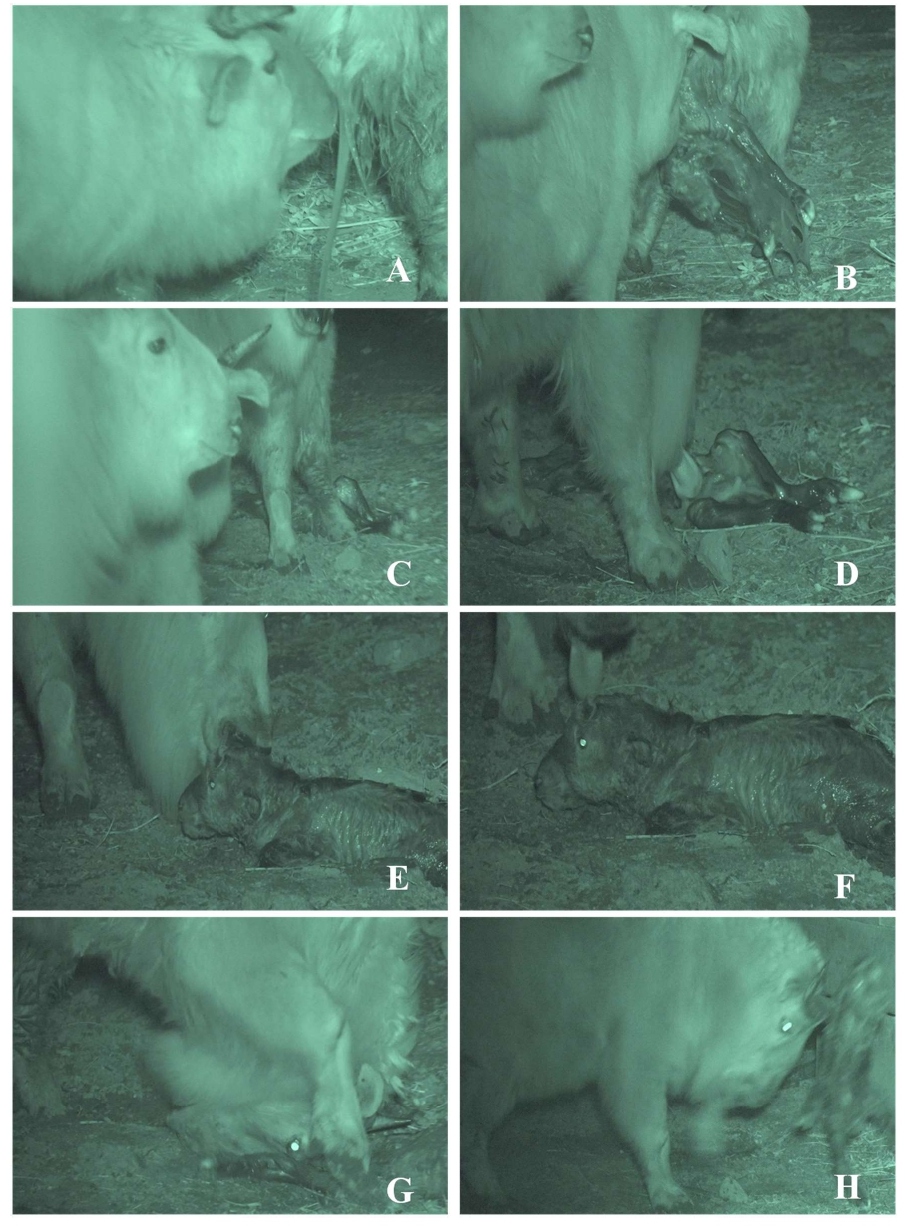
Figure 1: Video images showing the birthing process and maternal neonaticide, composed of the two isolated events carried out by the two takin parturients. A: the ruptured amniotic fluid; B and C: neonate delivery process; D and E: parturient licked the mucus on a male neonate and tried to help him stand up; F: neonate remained on the ground and failed to stand up within about 55 minutes; and G and H: maternal attack to one of the neonates, leading to its death (cited from Zhao et al. [22] with permission).
According to previous studies [1,11,23], maternal neonaticide in humans has been proposed to be related to the following causes: 1) postpartum depression or psychosis so that parturients lost cognitive ability; 2) evolutionary consequence in the case of killing defective neonates that are considered to unable to survive appropriately under the principle of natural selection and environmental adaptation; 3) cultural selection and government policy, explicitly applying to female neonates under the pressure of male-preferred society and stringent penalty against the One-Child policy in China from the later 1980s to 2016, which drove maternal neonaticide, particularly toward female neonates [11]. Consequently, such phenomena have resulted in significant unbalanced sex ratios; the related ratio (male/female) was 115 by 1990 and 120 by 2010 [24]; and 4) excessive social-economic burdens on the families.
As for the takin parturients committed neonaticide, they had experienced 4, 3, and 3 normal births, separately, and they continued to have normal neonates after the events. Thus, it’s unlike they were suffered from postpartum depression or psychiatric syndrome or due to accident (Figure 1) – which usually occurs to young parturients without caring experience [25]. Further, they were not pressured for food resources by living in captivity, and that is to say that they were normal healthy female takins. Thus, we propose that the stimulation of the neonaticide was triggered by evolutionary strategy – their offspring are maladaptive to the environment, against the principle of natural selection and environmental adaption. On the other hand, killing an unhealthy infant allows the mothers to invest energy more effectively for normal offspring and gain more profitable reproductive opportunities.
Acknowledgments
We thank the Research Center of the Qinling Giant Panda, Shaanxi Academy of Forestry, and Shaanxi Louguantai Experimental Forest Farm, China, for carrying out this study. We greatly appreciate our assistants' indispensable support during this research, especially all teachers and students from the Primate Research Center of Northwest University, China.
Funding Source
This study was supported by the Strategic Priority Research Program of the Chinese Academy of Sciences (XDB31020302), National Key Program of Research and Development, Ministry of Science and Technology (2016YFC0503200), Key Program of the National Natural Science Foundation of China (31730104), National Natural Science Foundation of China (31801981, 31800319), Shaanxi Innovation Capability Support Plan (2020KJXX-008), Special Foundation of Shaanxi Academy of Sciences, China (2021k-5, 2018K-16-04), Shaanxi Key Research and Development Program (2018PT-04), and Open Foundation of Key Laboratory of Beijing Zoo (ZDK202004).
References
2. Elgar MA, Crespi BJ. Cannibalism. Ecology and evolution among diverse taxa. Journal of Evolutionary Biology. 1994;7(1):121-3.
3. Packer C, Pusey AE. Adaptations of female lions to infanticide by incoming males. The American Naturalist. 1983 May 1;121(5):716-28.
4. Resnick PJ. Murder of the newborn: a psychiatric review of neonaticide. American Journal of Psychiatry. 1970 Apr;126(10):1414-20.
5. Friedman SH, Horwitz SM, Resnick PJ. Child murder by mothers: a critical analysis of the current state of knowledge and a research agenda. American Journal of Psychiatry. 2005 Sep 1;162(9):1578-87.
6. Ebensperger LA. Strategies and counterstrategies to infanticide in mammals. Biological Reviews. 1998 Aug;73(3):321-46.
7. Leroux M, Monday G, Chandia B, Akankwasa JW, Zuberbühler K, Hobaiter C, et al. First observation of a chimpanzee with albinism in the wild: Social interactions and subsequent infanticide. American Journal of Primatology. 2021 Jul 16:e23305.
8. Wolff JO. Population regulation in mammals: an evolutionary perspective. Journal of Animal Ecology. 1997 Jan 1:1-3.
9. Hrdy SB. Infanticide among animals: a review, classification, and examination of the implications for the reproductive strategies of females. Ethology and Sociobiology. 1979 Oct 1;1(1):13-40.
10. Oberman M. Mothers who kill: coming to terms with Modern American Infanticide. Am. Crim. L. Rev.. 1996;34:1.
11. Jimmerson J. Female infanticide in China: An examination of Cultural and Legal Norms. UCLA Pac. Basin LJ. 1990;8:47.
12. Lee BJ. Female infanticide in China. Historical Reflections/Réflexions Historiques. 1981 Oct 1:163-77.
13. Marks MN, Kumar R. Infanticide in Scotland. Medicine, Science and the Law. 1996 Oct;36(4):299-305.
14. Mamun MA, Bhuiyan AI, Manzar MD. The first COVID-19 infanticide-suicide case: Financial crisis and fear of COVID-19 infection are the causative factors. Asian Journal of Psychiatry. 2020 Dec 1;54:102365.
15. Hinde RA, Spencer-Booth Y. The behaviour of socially living rhesus monkeys in their first two and a half years. Animal Behaviour. 1967 Jan 1;15(1):169-96.
16. Horwich RH, Manski D. Maternal care and infant transfer in two species of Colobus Monkeys. Primates. 1975 Mar;16(1):49-73.
17. Sherman PW. Reproductive competition and infanticide in Belding's ground squirrels and other animals. Natural Selection and Social Behavior. 1981:311-31.
18. Hausfater G. Infanticide in langurs: strategies, counterstrategies, and parameter values. Infanticide: Comparative and Evolutionary Perspectives. 1984.
19. Hernández JC. Mother’s Killing of Children in Rural China Spurs Debate About Inequality. The New York Time. 2016 Sept 12. Available at: https://www.nytimes.com/2016/09/13/world/asia/mothers-killing-of-children-in-rural-china-spurs-debate-about-inequality.html
20. Snehi Y. Female infanticide and gender in Punjab: Imperial claims and contemporary discourse. Economic and Political Weekly. 2003 Oct 11:4302-5.
21. Peters LC, Kristal MB. Suppression of infanticide in mother rats. Journal of Comparative Psychology. 1983 Jun;97(2):167.
22. Zhao HT, Zhang WQ, Jia KS, Li JX, Bai XX, Wang XW, et al. Observation of mother-perpetrated infanticide in golden takins (Budorcas taxicolor bedfordi). Zoological Research. 2020 Jul;41(4):455.
23. Friedman SH, Cavney J, Resnick PJ. Mothers who kill: evolutionary underpinnings and infanticide law. Behavioral Sciences & the Law. 2012 Sep;30(5):585-97.
24. Poston Jr DL, Conde E, DeSalvo B. China's unbalanced sex ratio at birth, millions of excess bachelors and societal implications. Vulnerable Children and Youth Studies. 2011 Dec 1;6(4):314-20.
25. Birkeland R, Thompson JK, Phares V. Adolescent motherhood and postpartum depression. Journal of Clinical Child and Adolescent Psychology. 2005 May 1;34(2):292-300.