

Abstract
Introduction: The COVID-19 pandemic led to perceived increases in the rates of complicated appendicitis. Multiple studies have shown, both in adults and children, higher rates of complicated appendicitis among patients with Medicaid insurance. At our institution, we previously found that, contrary to statewide and nationwide findings, no differences in complicated appendicitis rates existed based on age, sex, race, insurance status, socioeconomic status, and income level. The purpose of this study was to determine if the COVID-19 pandemic altered our previous findings.
Methods: The electronic medical record of a large tertiary children’s hospital was queried for all patients with ICD 10 appendicitis codes from 1/1/2017-12/31/2020. Patient records were reviewed to determine complicated (defined as having either a hole in the appendix, extraluminal fecalith, well-formed abscess, or frank stool in the abdomen) vs. uncomplicated appendicitis. Demographic information including age, sex, race, ethnicity, and insurance type were collected. Rates of complicated appendicitis were compared across years. Correlation between rates of complicated appendicitis and demographic variables was determined both within and across years.
Results: The rate of complicated appendicitis was not significantly different across years from 2017-2020. There was no significant difference in the rate of complicated appendicitis based on age, sex, race, ethnicity, or insurance type.
Conclusion: While some U.S. centers and those abroad found a significantly higher rate of complicated appendicitis in 2020 compared to prior years, the rate of complicated appendicitis at a large tertiary children’s hospital did not change during the pandemic. No disparities exist based on age, sex, race, ethnicity, or insurance type.
Keywords
Appendicitis, Pediatric, Pandemic, COVID-19, Disparities, Equity
Introduction
Acute appendicitis is one of the most common surgical procedures performed among pediatric patients in the United States [1]. The pathophysiology of the disease begins with luminal obstruction of the appendix, leading to venous congestion, with eventual arterial inflow obstruction, and finally luminal rupture, resulting in spillage of enteric contents into the abdominal cavity. The progression is quite predictable, with the passage of time from symptom onset correlating with increasing severity of disease. Prior to appendiceal rupture, the disease is termed “uncomplicated,” and localized to the appendix only. Once the appendix has ruptured, the disease is termed “complicated,” with involvement of the abdominal cavity. Timely treatment is thus essential to prevent complicated appendicitis and the morbidity associated with intra-abdominal contamination such as abscesses, ileus, and need for further intervention.
Given the positive correlation between the duration of disease and severity, timely access to a healthcare setting is essential. It has previously been reported that barriers to timely access, including age, race, insurance type/duration, in particular Medicaid insurance, can be strongly associated with higher rates of complicated appendicitis, specifically among pediatric patients [2-7]. While certain studies have reported these findings, including some from nation- and state-wide registries, we have previously shown that at our large tertiary children’s hospital, access to timely surgical care appears to be equitable, with no increased risk of complicated appendicitis based on age, sex, race, insurance status, parental education status, and income level [8].
The arrival of the COVID-19 pandemic in 2020 however, was thought to represent yet another barrier to timely access to care, driven by patient/family fear of entering a hospital and contracting the virus. Multiple studies within the pediatric population, both in the U.S. and abroad, have demonstrated increased rates of complicated appendicitis compared to prior years [9-13]. We therefore sought to build upon our prior study in which we demonstrated equitable access to surgical care and determine if the COVID-19 pandemic modified our earlier findings. Specifically, we sought to determine if the pandemic was a universal barrier to timely care, or if it introduced particular disparities in access with regard to age, sex, race, ethnicity, or insurance type/status. We hypothesized that the COVID-19 pandemic was a universal barrier to access to surgical care of appendicitis, demonstrated by higher rates of complicated appendicitis during 2020 compared to the preceding three years. We also predicted that no disparity would be demonstrated with regard to age, sex, race, ethnicity, or insurance status.
Methods
This study (STUDY00001577) received Institutional Review Board approval as well as an approval for a waiver of informed consent. Following approval, a retrospective review of a large tertiary children’s hospital was conducted between January 2017 and December 2020 for all patients with a diagnosis of acute appendicitis. The electronic medical record (EMR) was queried for patients with ICD 10 appendicitis diagnosis codes. A manual chart review was then performed for each patient to verify the diagnosis of acute appendicitis. The type of appendicitis was then determined (uncomplicated or complicated) as well as the treatment rendered (operative or non-operative). For patients that underwent operative intervention, the operative note was reviewed for key findings indicative of complicated appendicitis: a hole visualized in the appendix intra-operatively, an extraluminal fecalith, well-formed abscess, or frank stool in the abdomen. If the patient underwent non-operative therapy, the radiographic imaging was reviewed for signs of perforation, indicative of complicated appendicitis: abscess or phlegmon with radiologist confirmed suspicion for perforation. If the patient was found to have multiple hospitalizations related to acute appendicitis, or returned at a later date for interval appendectomy, only the first hospitalization during the four years was included in an effort to only generate a list of unique patients seen over the 4 years and document the type of appendicitis present at the initial encounter. Demographic information was also obtained on each patient including age at appendicitis diagnosis, sex, race, ethnicity, and type of insurance.
Statistical analysis
Descriptive statistics were utilized to describe cohort demographics. Student's t-test, chi-square, and Fisher’s exact test were used for comparisons based on variable type and distribution. The Mann–Whitney U test was used for nonnormally distributed data. Results are presented as the median value and interquartile range or mean and standard deviation. A p-value of <0.05 and 95% CI were considered significant. All statistical analysis was performed using IBM Statistical Package for Social Sciences (IBM SPSS version 26, NY, USA).
Results
During the four-year study period, a total of 2,494 unique patients were diagnosed with acute appendicitis at our institution (n = 622; 2017, n = 653; 2018, n = 628; 2019; n = 591; 2020), (Table 1). The majority of patients were male (61.1%, n = 1525), White (77%, n = 1921), non-Hispanic or Latino (90.9%, n = 2267), and had private or commercial insurance (51.3%, n = 1279). The mean age at diagnosis was 11.42 ± 3.72 years. The majority of patients had uncomplicated appendicitis (73.5%, n = 1832), and underwent operative intervention during the index admission (90.3%, n = 2252).
|
Characteristics |
Total n = 2494 |
|
SEX |
|
|
Female |
38.9% (n = 969) |
|
Male |
61.1% (n = 1525) |
|
RACE |
|
|
White |
77% (n = 1921) |
|
Black or African American |
10.1% (n = 251) |
|
Asian |
2.6% (n = 65) |
|
Multiple Race |
4.8% (n = 119) |
|
Unknown |
5.5% (n = 136) |
|
ETHNICITY |
|
|
Not Hispanic or Latino |
90.9% (n = 2267) |
|
Hispanic or Latino |
8.6% (n = 215) |
|
Other/Unknown |
0.5% (n = 12) |
|
INSURANCE TYPE |
|
|
Medicaid/State Child Health Insurance Plan (sCHIP) |
44.1% (n = 1100) |
|
Private/Commercial |
51.3% (n = 1279) |
|
Self-Pay |
4.5% (n = 113) |
|
Other/unknown |
0.1% (n = 2) |
|
MEAN AGE AT APPENDICITIS DIAGNOSIS (Years) |
|
|
Mean Age |
11.42 ± 3.72 |
|
APPENDICITIS CASES BY YEAR |
|
|
2017 |
n = 622 |
|
2018 |
n = 653 |
|
2019 |
n = 628 |
|
2020 |
n = 591 |
|
APPENDICITIS TYPE (Proportion) |
|
|
Complicated |
26.5% (n = 662) |
|
Uncomplicated |
73.5% (n = 1832) |
|
MANAGEMENT AT INDEX HOSPITALIZATION |
|
|
Operative |
90.3% (n = 2252) |
|
Non-operative |
9.7% (n = 242) |
Looking at the four years individually, the proportion of patients with complicated appendicitis was as follows: 28.1% (2017), 23.1% (2018), 25.3% (2019), and 29.9% (2020). Comparing the proportion of complicated appendicitis in each year revealed no significant differences (Figure 1).
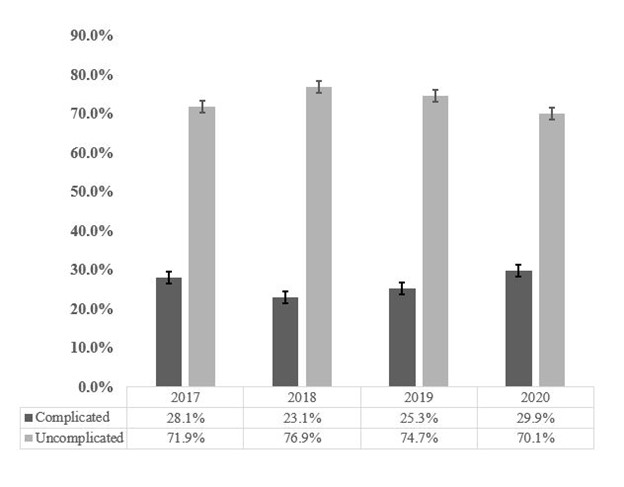
Figure 1. Trend in Appendicitis Types (complicated vs. uncomplicated). During the 4-year study period, the rate of complicated and uncomplicated appendicitis was relatively stable, with approximately three quarters of children having uncomplicated appendicitis, and one quarter having complicated appendicitis in each year. There were no statistically significant differences in the proportion of complicated or uncomplicated appendicitis between years (p > 0.05).
Stratification of complicated and uncomplicated appendicitis rates by insurance type over the 4 years did not show any significant differences between the different insurance types (Medicaid, Private, self-pay, unknown) within a given year, nor were there significant differences within insurance types across years (Table 2).
|
Complicated Appendicitis |
||||
|
Insurance Type |
2017 |
2018 |
2019 |
2020 |
|
Medicaid/sCHIP |
46.9% (n = 82) |
49% (n = 74) |
42.8% (n = 68) |
49.2 (n = 87) |
|
Private/Commercial |
49.1% (n = 86) |
46.4% (n = 70) |
51.6% (n = 82) |
44.6% (n = 79) |
|
Self-pay |
4.0% (n = 7) |
4.0% (n = 6) |
5.7% (n = 9) |
6.2% (n = 11) |
|
Other/unknown |
0% (n = 0) |
0.7% (n = 1) |
0% (n = 0) |
0% (n = 0) |
|
p-value across (0.678) p-value within (0.779) |
||||
|
Uncomplicated Appendicitis |
||||
|
Insurance Type |
2017 |
2018 |
2019 |
2020 |
|
Medicaid/sCHIP |
44.7% (n = 200) |
42.2% (n = 212) |
43.1% (n = 202) |
42.3% (n = 175) |
|
Private/Commercial |
50.6% (n = 226) |
53.6% (n = 269) |
51.8% (n = 243) |
54.1% (n = 224) |
|
Self-pay |
4.5% (n = 20) |
4.2% (n = 21) |
5.7% (n = 9) |
3.6% (n = 15) |
|
Other/unknown |
0.2% (n = 1) |
0% (n = 0) |
0% (n = 0)_ |
0% (n = 0) |
|
p-value (across): 0.415 p-value (within): 0.191 |
||||
Finally, with regard to complicated appendicitis only, there were no significant linear association between rates of complicated appendicitis by age, sex, race, or ethnicity, either within years, or between years during the four-year study period (Table 3).
|
|
2017 (n = 175) |
2018 (n = 151) |
2019 (n = 159) |
2020 (n = 177) |
P-value |
P-value (linear association) |
|
SEX |
||||||
|
Female |
37.1% (n = 65) |
37.7% (n = 57) |
42.8% (n = 68) |
35.6% (n = 63) |
0.570 |
0.990 |
|
Male |
62.9% (n = 110) |
62.3% (n = 94) |
57.2% (n = 91) |
64.4% (n = 114) |
||
|
RACE |
||||||
|
White |
76.6% (n = 134) |
82.1% (n = 124) |
73.6% (n = 117) |
73.4% (n = 130) |
0.489 |
0.162 |
|
Black |
9.7% (n = 17) |
9.3% (n = 14) |
11.9% (n = 19) |
7.9% (n = 14) |
||
|
Asian |
2.3% (n = 4) |
0% (n = 0) |
2.5% (n = 4) |
4.0% (n = 7) |
||
|
Multiple Race |
5.7% (n = 10) |
4.6% (n = 7) |
7.5% (n = 12) |
7.9% (n = 14) |
||
|
ETHNICITY |
||||||
|
Hispanic or Latino |
6.5% (n = 29) |
8.6% (n = 43) |
10.2% (n = 48) |
6.0% (n = 25) |
0.077 |
0.755 |
|
Not Hispanic or Latino |
93.1% (n = 416) |
90.2% (n = 453) |
89.3% (n = 419) |
93.7% (n = 388) |
||
|
AGE (YEARS) |
||||||
|
Age at Appendicitis |
10.2 ± 4 |
10.2 ± 3.8 |
10.1 ± 3.7 |
10.3 ± 3.7 |
0.957 |
0.885 |
Comparing the average age between patients with complicated vs. uncomplicated appendicitis over the course of the 4 years, we found that the average age of patients with complicated appendicitis was significantly younger at 10.2 ± 3.80 years compared to 11.9 ± 3.6 years (p<0.001).
Discussion
Acute appendicitis has a very predictable disease course, with a direct correlation between disease severity and duration. A delay in care, manifested by disease progression to perforated appendicitis at the time of presentation, has long been considered an indicator for access to emergent surgical care. Multiple studies, especially in the pediatric population, have demonstrated that barriers to surgical access including age, race, insurance type/duration, in particular Medicaid insurance, are strongly associated with higher rates of complicated appendicitis [2-7]. Therefore, it is plausible that a public health crisis such as the COVID-19 pandemic, that caused universal disruption in access to health services, might exacerbate disparities in access to emergency surgical care, as measured by rates of perforated appendicitis. Indeed, multiple studies have reported such findings both in the Unites States and abroad [9-13]. Accountable care organizations, however, have been shown to mitigate barriers to access to care, and in our previous work we found that at our large tertiary children’s hospital with ACO affiliation, access to emergent surgical services was equitable, with no increased risk of complicated appendicitis based on age, sex, race, insurance status, parental education status, and income level [8].
In this follow-up study we found that our previous findings were un-altered, and the COVID-19 pandemic was not a universal barrier to surgical care for the treatment of acute appendicitis. In fact, it does not appear to have been a barrier to timely intervention at all, having found no statistically significant differences in the proportion of complicated appendicitis cases, which are indicative of a delay in treatment, during the pandemic compared to years prior. Furthermore, our results indicate that this finding was universal, with no disparity in access based on age, sex, race, ethnicity, or insurance type.
As discussed in our prior study [8], and still largely applicable to the current study, the utility of a broad referral system is likely at the center of the observed trends, and the ability of our institution to maintain access to surgical services despite the challenges presented by the pandemic. Our institution is the largest children’s hospital in the state and serves as a large referral center both for the surrounding region, and neighboring states as well. Moreover, our institution has made a conscious and concerted effort to place primary care facilities in underserved regions of the state, giving them ready access to high acuity services such as emergency surgery, with around the clock access to our on-call surgeons. This system has been in place since well before our previous study in 2006, and as we previously discussed, has been largely successful in bridging the gap in healthcare access, such that, trends in disparities to access based on race, ethnicity, and insurance status seen in other large multi-center cohorts have been mitigated in our local community.
Additionally, the findings of this study may be explained, at least in part, by the influence of our hospital’s accountable care organization, Partners for Kids (PFK), that was created in 1994. The organization services Medicaid children in the central and southern regions of Ohio and functions to provide a safety net for the coordination of care of children that might not otherwise receive medical care outside of the emergency room setting. In our cohort, 44% of children had Medicaid insurance, and approximately 92% were serviced by PFK which may have been a major factor in preventing disparities with regard to insurance status, but possibly race, ethnicity, sex, and age as well. During the same time period of this current study, 2017-2020, we recently found that PFK patients did not see a significant rise in the proportion of covered children with perforated acute appendicitis in 2020 compared to prior years [14], demonstrating its ability to maintain timely access even in the setting of an unexpected crisis.
While the utility of ACOs has been an area of great debate over the years, studies have shown they are capable of improving both the quality of care delivered and reducing the cost of delivery [15], and specifically at PFK this has been shown [16]. Additionally, reduction in access disparities associated with ACO participation have been demonstrated. For example, in an adult study looking at diabetes related hospitalization rates among Latino compared to Caucasian patients, participation in an ACO clinic was associated with a significant decline in the disparity of hospitalization rates [17]. Still others have demonstrated an association of decreased disparity in access to surgical intervention among patients with spinal fractures with ACO participation [18]. Taken together, it’s possible that participation in PFK, a pediatric Medicaid ACO, like prior studies, was associated with improved access and quality of care, contributing in part to the ultimate endpoints of this study–rates of appendicitis and rates of complicated appendicitis.
For all patients, regardless of ACO influence, with regard to the pandemic not impacting patient/family behavior in seeking timely care, this may be due to established community relationships. At our institution, quality of care and, in particular, safety in care, is an emphasized value of our healthcare system. The slogan “Zero Hero” is posted throughout the institution and stands for the goal of zero iatrogenic mistakes and our commitment to safety. The culture of quality and safety is something that every patient experiences and likely has played a large part in the establishment of trust between members of our community and providers.
While not as many published studies exist, there are some single institution studies conducted abroad that also demonstrate the lack of the pandemic to influence patient/family behavior, with no alteration in the timing in which patients sought medical care for acute appendicitis in the pediatric population [19]. In the paper by Tristan et al. [19], they attributed their findings to the safety and trust families felt in coming to a strictly pediatric hospital as opposed to one in which they could be waiting in the ER with both adults and children. Additionally, they felt that their fast-track treatment of appendicitis (surgery within 24 hours) was attributed to timely management. Overall, both the studies by Tristan and our current study may be highlighting something unique to the pediatric population, and that is a firmly established connection to a trusted healthcare facility. That trust may have facilitated an unwillingness among parents to risk delaying treatment for their children, whereas for themselves, delays were observed in the adult appendicitis literature during the pandemic [20,21].
This study has several limitations including those inherent to a retrospective review. In addition, this study was purely observational and as such, root causes for the observed findings were unable to be determined with complete certainty. Further investigation into the factors that are playing a role in preventing barriers to healthcare access may be of value for other institutions seeking to replicate our results. It is possible however, that intangible and unmeasurable factors are at play, including company culture and community trust as described above, as well as the tangible factors of a large referral network that is leveraging both strategic locations in underserved areas as well as the benefits of an accountable care organization.
Conclusion
The COVID-19 pandemic was believed to have created a barrier to healthcare access for urgent/emergent disease process, likely motivated by fear of contracting the virus from entering a healthcare facility. While other studies in the pediatric population have demonstrated this finding, we found that the COVID-19 pandemic was not a barrier to timely treatment of acute appendicitis. Furthermore, our track record of providing equal access to surgical care for all patients, regardless of age, sex, race, ethnicity, or insurance status remains firmly established, such that, even a global pandemic did not create a disparity in access. A strong referral network and the establishment of primary care facilities in underserved areas, as well as the coordination of care for at risk populations through an accountable care organization, likely contributed to these observations.
Declarations
Authors contribution
Drs. Menchaca, Style, and Olutoye made substantial contributions to the conceptualization/design, methodology, investigation, supervision/oversight, data curation, data analysis, interpretation of results, and drafting/critical revision of the final manuscript. Ms. Chawla, Ms. Kouche, Ms. Burdjalov, and Mr. Kyhl made substantial contributions to the investigation, data curation, data analysis, and drafting/critical revision of the final manuscript.
Acknowledgements
None.
Declarations of Interest
None.
Disclosures
The authors report no proprietary or commercial interest in any product mentioned or concept discussed in this article.
Funding
This research did not receive any specific grant from funding agencies in the public, commercial, or not-for-profit sectors.
Data Statement
Data available upon request.
References
2. O'Toole SJ, Karamanoukian HL, Allen JE, Caty MG, O'Toole D, Azizkhan RG, et.al. Insurance-related differences in the presentation of pediatric appendicitis. Journal Of Pediatric Surgery. 1996 Aug 1;31(8):1032-4.
3. Trent SA, Valley MA, Brookler K, Haukoos JS, Zerzan JT. Potential barriers associated with increased prevalence of perforated appendicitis in Colorado's pediatric Medicaid population. The American Journal of Emergency Medicine. 2013 Mar 1;31(3):469-72.
4. Bodnar C, Buss R, Somers K, Mokdad A, Van Arendonk KJ. Association of neighborhood socioeconomic disadvantage with complicated appendicitis in children. Journal of Surgical Research. 2021 Sep 1;265:245-51.
5. Gadomski A, Jenkins P. Ruptured appendicitis among children as an indicator of access to care. Health Services Research. 2001 Apr;36(1 Pt 1):129-42.
6. Bratton SL, Haberkern CM, Waldhausen JH. Acute appendicitis risks of complications: Age And Medicaid Insurance. Pediatrics. 2000 Jul 1;106(1):75-8.
7. Smink DS, Fishman SJ, Kleinman K, Finkelstein JA. Effects of race, insurance status, and hospital volume on perforated appendicitis in children. Pediatrics. 2005 Apr 1;115(4):920-5.
8. Nwomeh BC, Chisolm DJ, Caniano DA, Kelleher KJ. Racial and socioeconomic disparity in perforated appendicitis among children: where is the problem?. Pediatrics. 2006 Mar 1;117(3):870-5.
9. Fisher JC, Tomita SS, Ginsburg HB, Gordon A, Walker D, Kuenzler KA. Increase in pediatric perforated appendicitis in the New York City metropolitan region at the epicenter of the COVID-19 outbreak. Annals of surgery. 2021 Mar 1;273(3):410-5.
10. Place R, Lee J, Howell J. Rate of pediatric appendiceal perforation at a children’s hospital during the COVID-19 pandemic compared with the previous year. JAMA network open. 2020 Dec 1;3(12):e2027948-.
11. Delgado-Miguel C, Munoz-Serrano AJ, Miguel-Ferrero M, De Ceano-Vivas M, Calvo C, Martinez L. Complicated acute appendicitis during COVID-19 pandemic: the hidden epidemic in children. European Journal of Pediatric Surgery. 2022 Jun;32(03):268-73.
12. Theodorou CM, Beres AL, Nguyen M, Castle SL, Faltermeier C, Shekherdimian S, et.al. Statewide impact of the COVID pandemic on pediatric appendicitis in California: a multicenter study. Journal of Surgical Research. 2021 Nov 1;267:132-42.
13. Schäfer FM, Meyer J, Kellnar S, Warmbrunn J, Schuster T, Simon S, et.al. Increased incidence of perforated appendicitis in children during COVID-19 pandemic in a Bavarian multi-center study. Frontiers in Pediatrics. 2021 May 7;9:683607.
14. Menchaca AD, Style CC, Wang L, Cooper JN, Minneci PC, Olutoye OO. An Accountable Care Organization Maintains Access for Appendicitis During the COVID-19 Pandemic. Journal of Surgical Research. 2023 Nov 1;291:336-41.
15. Kaufman BG, Spivack BS, Stearns SC, Song PH, O’Brien EC. Impact of accountable care organizations on utilization, care, and outcomes: a systematic review. Medical Care Research and Review. 2019 Jun;76(3):255-90.
16. Kelleher KJ, Cooper J, Deans K, Carr P, Brilli RJ, Allen S, et.al. Cost saving and quality of care in a Pediatric Accountable Care Organization. Pediatrics. 2015 Mar 1;135(3):e582-9.
17. Ortiz J, Hill M, Thomas CW, Hofler R. Accountable Care Organizations and Health Disparities of Rural Latinos: A Longitudinal Analysis. Population Health Management. 2022 Oct 1;25(5):651-7.
18. Lipa SA, Sturgeon DJ, Blucher JA, Harris MB, Schoenfeld AJ. Do Medicare accountable care organizations reduce disparities after spinal fracture?. Journal of Surgical Research. 2020 Feb 1;246:123-30.
19. Tristán JG, Romero HS, Pellitero SE, Espinera CR, Martín DA, Góngora RE, et.al. Acute appendicitis in children during the COVID-19 pandemic: neither delayed diagnosis nor worse outcomes. Pediatric Emergency Care. 2021 Mar 1;37(3):185-90.
20. Finkelstein P, Picado O, Muddasani K, Wodnicki H, Mesko T, Unger S, et.al A retrospective analysis of the trends in acute appendicitis during the COVID-19 pandemic. Journal of Laparoendoscopic & Advanced Surgical Techniques. 2021 Mar 1;31(3):243-6.
21. Scheijmans JC, Borgstein AB, Puylaert CA, Bom WJ, Bachiri S, van Bodegraven EA, et.al. Impact of the COVID-19 pandemic on incidence and severity of acute appendicitis: a comparison between 2019 and 2020. BMC emergency medicine. 2021 May 12;21(1):61.