

Commentary
Let us talk about a demographic shift that is affecting the modern world. Not only do we observe a rapid population expansion, but also a considerable change in its structure. In the last few decades, the prevalence of low birth rates and higher life expectancy have altered the demographic structure of the population to one that is much older, a phenomenon dramatically changing the shape of the EU age pyramid and making it top-heavy. Predictions in demography for the EU member states indicate that the ageing population (the number of people aged 65 and over) will almost double over the next 50 years, from 85 million in 2008 to 151 million in 2060 [1]. The pressures society faces due to an ageing population were well documented during the pandemic situation that took place all over the world from 2020. An older population is more affected by health issues, which puts much pressure on public systems that are not prepared to answer appropriately. Also, the population moving into the category of ageing and about to retire right now is part of the generation of baby boomers. This group is about to put additional pressure on governments, the working population, energy systems and society in general. Considering that the primary source of income for the elderly is their pension and that a significant percentage of baby boomers carried out activities related to agriculture, forestry, and fishing, where pensions tend to be low, severe financial constraints are predicted for this group (pensions below the minimum social level and expected to be even lower in the future) [2]. Universally, the related literature agrees on the fact that an older population spends more time at home and is more concerned about health issues and comfort, factors that considerably impact the consumption of residential energy [3-6]. Since the majority of this population is also affected by financial constraints, they will also rely more on support from governments, which puts additional pressure on public systems. Due to economic insecurity, it is also likely that the elderly, especially those with low pensions, will make severe economies related to the heating and cooling in their households, which will also put their well-being at risk [7]. For developed countries (high-income countries), the importance of the effect of an ageing population is even more significant, since global GDP is generated by countries which are facing a rapidly ageing population. In this perspective, understanding how seniors, directly or indirectly, influence the shape of their economies becomes an issue of great importance (especially those who are facing economic challenges that put much pressure on public systems). On the other hand, the goals defined in the 2030 Agenda for Sustainable Development and the Paris Climate Change Agreement in 2015 rely on a strengthened approach towards environmental, social issues, and the economy, which includes economic growth, environmental sustainability, and social inclusion [8]. Under these goals, there is a clear priority for the economies of the European Union, to address issues related to climate change that impact public systems and put pressure on the environment. For all the reasons announced, the relationship between an ageing population and energy use is receiving more and more attention from researchers all over the world, as well as from local governments and policymakers, who feel the pressure that arises from this population strata, especially in terms of energy supplies [9]. In summary, there is clear evidence in the literature that energy consumption patterns alter over the human lifespan. The general consensus is that consumption of energy rises with age because this population is less active than younger populations and spends more time at home. Furthermore, climate change, with its rising temperatures and unpredictable weather exacerbates the demand of energy for the elderly [10-13]. Additionally, since this population is more concerned about health, they also seek more comfort, adding to their energy consumption. Bearing all these factors in mind, it is paramount to research the links between two of the biggest drivers of global change today: a rapidly aging population and the demand for energy. These two challenges represent an opportunity for the adjustment of policies to propose measures that align with population needs and a new population structure. Taking all this into consideration, the purpose of this commentary is to summarize the challenges that arise due to an ageing population in terms of residential energy consumption for European Union member states[1], and the opportunities that policymakers and governments should embrace to improve this relationship more efficiently.
The research model that serves as foundation to this commentary, relies on two different approaches, divided into four articles, as presented in Figure 1 below.
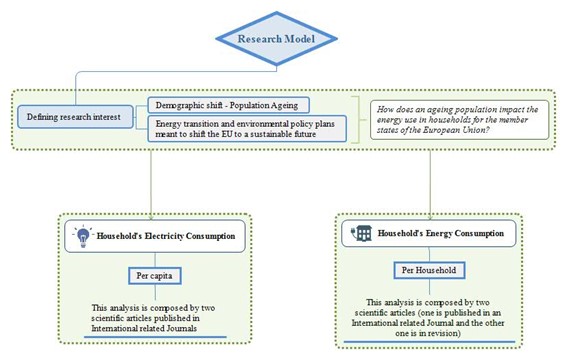
Figure 1: Research model.
1st approach: Household’s electricity consumption (per capita): period of analysis 2005 – 2016
1.1.) Households’ electricity consumption efficiency of an ageing population: A DEA analysis for the EU-28 – published in the Electricity Journal in October 2020 (DOI: https://doi.org/10.1016/j.tej.2020.106823) [14]
1.2) Determinants of household electricity consumption efficiency for an ageing population: Evidence for the EU-28 – published in the Energy Reports Journal in December 2020 (DOI: https://doi.org/10.1016/j.egyr.2020.11.193) [15]
2nd approach: Household’s energy consumption (per household): the period of analysis 2005 – 2018
2.1.) Is an ageing population impacting energy use in the European Union? Drivers, lifestyles, and consumption patterns of elderly households – published in the Energy Research & Social Science in March 2022 (DOI: https://doi.org/10.1016/j.erss.2021.102443) [16]
2.2) What are the Energy Poverty drivers for an ageing population? A Stochastic frontier analysis for the European Union – under revision in the Energy Efficiency Journal [17].
With basis on the findings of the articles, and the two different approaches used, it is evidenced that the relationship between the demographic shift that is affecting the modern world, an ageing population, and the consumption of energy, poses challenges related to climate change and sustainability. Due to technological progress, the residential sector is one of the sectors which shows the highest potential for improvement, especially with regard to efficiency measures in energy use. Also, several recommendations were proposed in each of the analyses pursued, in accordance with the results obtained. In this commentary, we summarize and compare the challenges and recommendations which arise from each analysis with the purpose of highlighting the best recommendations for the member states of the European Union that could be applied by policymakers and governments. When we are able to identify the challenges that arise from this relationship, we are able to propose some adjusted solutions. To summarise the challenges and policy opportunities that became apparent after each of the conducted analyses, mind maps are used (as presented in Figures 2, 3, and 4 below).
In Figure 2 are represented the findings raised from the Electricity per capita analysis. The main findings that were risen from the first approach are summarized as follows:
Finland and Sweden are the most efficient countries in the electricity consumption efficiency ranking but are also the countries with the highest share of electricity consumption per capita.
- The best performers show low variability between the efficiency scores across time and present the highest share of renewable electricity sources.
- Countries with a high share of an ageing population and lower values of energy consumption are the least efficient in the ranking.
- The countries presenting the lowest scores in the ranking are also affected by low incomes versus high electricity prices.
- The drivers that positively impact electricity consumption efficiency are Renewable Sources in Heating and Cooling, Government Investment in Housing and Community and Housing Overburden below 60%.
- The drivers that negatively impact efficiency levels are the Old-Age Dependency Ratio and a Housing Cost Overburden above 60%.
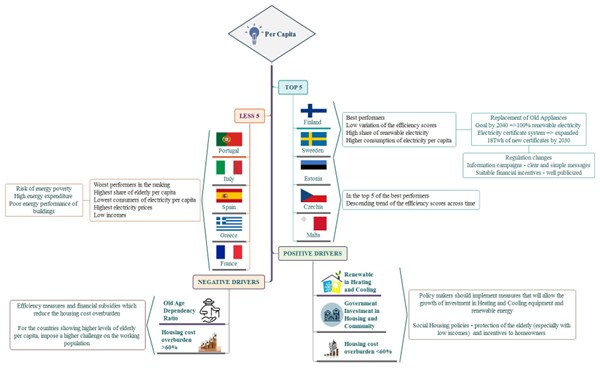
Figure 2: Summary of the main findings from the Electricity Per Capita Analysis.
Challenges – Electricity Per Capita Analyses
Main findings showed that the price of electricity is steadily rising and that this rise is not being matched with an increase on the income side. This situation puts additional pressure on older people, especially the ones with low incomes, which consequently leads to a higher risk of energy poverty for this population strata. In some countries of the EU, the prices are so high, when compared with their income levels, that it leads us to the belief that some older people, due to high financial constraints, are scared of even turning on a light because they fear they cannot afford this necessity even if they are afraid of the dark. High housing expenditure puts the elderly with lower incomes at risk of not being able to afford their basic needs. There is also the challenge that arises from high old-age dependency ratios. There is already a burden on the working population concerning the potential impact of ageing on social expenditure, which is also magnified by the negative effect on electricity efficiency. When we look at housing directives, each government is free to set its national housing policies, which can also justify some differences found in the countries’ ranking. The political response to Europe’s housing challenge remains poor, and countries which have the highest share of elderly people are also more affected because the support from governments may not be enough to support the growing needs of the elderly. The countries in which these challenges are most notorious are the ones presenting the lowest efficiency scores and the ones that need rapid intervention.
Opportunities – Electricity Per capita analyses
So how does Finland manage to have a high number of elderlies together with high efficiency scores, contradicting the remaining member states’ results? Findings suggest, that alongside Sweden, these countries present higher levels of renewable sources. This can be justified by the directives that have been put in place by the local governments, such as having 100% electricity that comes from renewable sources by 2040, as well as other directives (see Figure 2). Also, income values in these countries are higher when compared to other member states (such as the ones in the Mediterranean), and there is more equality between people aged 65 years and over. This means is that in Finland and Sweden, there is a higher propensity for the older generations to invest in efficient types of energy sources leading to savings regarding heating or cooling their own houses, which positively contributes to better comfort and health. Concerning high housing expenditure and the levels of electricity prices in relation to the income levels, and since social policies impact electricity consumption efficiency positively, there is an opportunity for policymakers to propose recommendations regarding housing directives to help local governments to address this matter properly. There is also an opportunity for policymakers to propose strategies to reconcile sustainable energies that are affecting both sides. For instance, social housing policies that protect the elderly with low income and incentives for homeowners to invest in renewable sources could be a potential solution that addresses both areas.
Challenges – Energy Per Household Analyses
Based on the results found in the first approach, there was evidence that the drivers that are affecting electricity consumption could lead to a risk of energy poverty, poor energy performance of buildings, poor social policies, high energy expenditure and higher dependency of the elderly on the working population, especially for countries where the elderly have really low incomes. Bearing these issues in mind, this approach relies on the energy consumption per household, gives us a better idea about the household perspective and answers how the elderly’s lifestyle is affecting energy use. Since there are considerable differences between the countries regarding energy needs due to climate differences, this approach considered climate corrections and a panel division in accordance to weather similarities, which is employed through the Heating and Cooling Index. In Figure 3 are summarized the main findings and the challenges and opportunities that arose from the analysis. The first main conclusion clearly shown in this analysis is that there are considerable differences between the results when the panel and the groups of countries are considered separately. This difference means that accounting for weather similarities when proposing policy recommendations is one of the main findings related to this analysis.
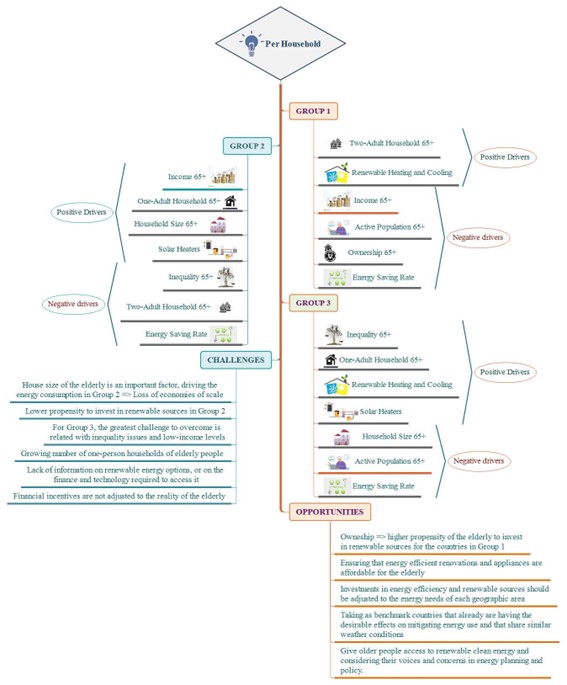
Figure 3: Summary of the main findings from the Energy Per Household Analysis – by groups.

Figure 4: Summary of the main findings from the Energy Per Household Analysis – Energy Poverty
This research clearly shows the differences found between the groups of countries and how policies should be adjusted for the geographical and weather situation. The type of investments in renewable sources should be differentiated in accordance with the weather conditions with the purpose of investing in resources that are in line with the ambient conditions. Also, there is evidence that lifestyle, as well as income levels, of the elderly, is considerably different between groups, which also noticeably affects the propensity to invest in efficiency-saving measures. This is even more notorious for the group of countries in Group 3 (low HDD and CDD), where low incomes and income inequalities are the main challenges presented for the elderly, which consequently leads to less propensity to invest in energy-saving measures, in renewable sources, risk of household energy poverty and higher carbon emissions. As shown in Figure 3 below, our results confirm that countries in Group 3 or the Mediterranean countries (as shown in the first approach) are in fact the countries which are at higher risk of energy poverty due to high expenditure, low incomes, the rise in energy prices, inefficient buildings and appliances and material deprivation. The countries which are positioned in the last places of the ranking are in line with the results retrieved from the per capita analysis.
The challenges that arise from our results, even when different approaches are considered, show the same issues over and over again. First is the problem of low incomes and increasing income inequalities that put pressure on a significant proportion of older people. Secondly, as energy prices continue to increase over time, without having the same increase in the income side, the elderly who have to survive on their pensions are at great risk. In some cases, their pensions are so low that they do not even consider investing in renewable or efficiency measures because they do not even know if they can afford the minimum level of energy in their homes or afford their basic needs. The increasing risk of energy poverty prevalence for this proportion of the population is due to their history, their lifestyle, their culture, and the tendency toward one-adult households where much pressure is put on the single adult to pay for all the expenses by his or herself. On top of that, house expenditure is also increasing exponentially. Also, this group often lacks knowledge and information about renewable energy options, or the finance and technology required to access it. Without support and other incentives (e.g., subsidies and financial incentives), they do not even know about it or how it works. All this is aggravated by social pressure and the fact that, in many cases, the elderly are facing loneliness that arises from how society is structured, another facet which impacts their health and well-being.
Possible Global Solutions
- Regulation change regarding prices of energy and transparent information regarding the liberalization of the electricity market prices
- Clear and concise information regarding subsidies and financial incentives
- Better regulation of the housing market, with general directives defined at EU level with the production of clear objectives for reducing material poverty and energy poverty
- Providing better support for low incomes households, with the purpose of reducing housing expenditure (especially for households with single adults)
- Government support for the replacement of old appliances together with better housing insulation
- Provide access to renewable energy solutions which can be understood by the elderly by offering transparent information financial incentives in line with their needs
- Involving the elderly in the discussion of policy and planning – hear their voices and consider their lifestyle and culture in recommendations
The strategy pillar supported by the EU to reinforce sustainable development is based on renewable energy sources and efficiency-saving measures. However, as can be seen in the results, investment in renewable sources or energy-saving measures could be unfeasible for some countries due to the low levels of income, risk of poverty and loss of economies of scale. In this sense, political answers should align with these differences, and proposals should be adjusted to meet individual needs. However, the reality is that the political response is still poor for addressing elderly issues, which aggravates the problems that emerge concerning social and health impacts on the elderly – poverty, social exclusion, and well-being. There is an urgency to address the income inequalities that are at this moment impacting some EU countries before measures related to energy-saving and building efficiency can even be considered. These countries also share the fact that they have the largest share of an ageing population in comparison to other member states, as well as where population ageing is projected to occur rapidly in the coming decades. Taking all of these factors into account, there is already a certainty that in these countries, these issues are projected to increase in the following years. Despite positive impacts derived from the measures taken by the EU to date, there is still a long way to go before attaining the goals proposed pertaining to renewable and efficiency measures. It should not be overlooked that there is potential for the elderly to be involved, especially homeowners since they could make a considerable difference in reaching those goals. In this case, the enforcement of legislation that promotes energy cooperatives at a European level, accounting for the vulnerabilities associated with an ageing population could also be a solution to attain these goals at an EU level for this population strata.
Acknowledgment
This work was financially supported by the Research Unit on Governance, Competitiveness and Public Policies (UIDB/04058/2020) + (UIDP/04058/2020), funded by national funds through FCT - Fundação para a Ciência e a Tecnologia.
References
2. Eurostat. People in the EU – statistics on an ageing society. Statistics Explained. December 2017; 1–20. Retrieved from https://ec.europa.eu/eurostat/statistics-explained/index.php?title=Archive:People_in_the_EU_-_statistics_on_an_ageing_society&oldid=368475
3. Tsemekidi-Tzeiranaki SP, Bertoldi P, Labanca N, Castellazzi L, Serrenho T, Economidou M, et al. Energy consumption and energy efficiency trends in the EU-28 for the period 2000–2016. JRC Science for Policy Report. 2018 Dec.
4. Tsemekidi Tzeiranaki S, Bertoldi P, Diluiso F, Castellazzi L, Economidou M, Labanca N, et al. Analysis of the EU residential energy consumption: Trends and determinants. Energies. 2019 Mar 19;12(6):1065.
5. World Health Organization. World Report on Ageing and Health. World Health Organization. 2015; 4-260. Accessed from: https://apps.who.int/iris/handle/10665/186463.
6. Deutsch M, Timpe P. The effect of age on residential energy demand; In Proceedings of ECEEE 2013 summer study on energy efficiency 2013; 2177–2188.
7. Romanach L, Hall N, Meikle S. Energy consumption in an ageing population: exploring energy use and behaviour of low-income older Australians. Energy Procedia. 2017 Sep 1;121:246-53.
8. United Nations, Department of Economic and Social Affairs, Population Division. Living Arrangements of Older Persons: A Report on an Expanded International Dataset (ST/ESA/SER.A/407) 2017; 1-50.
9. Estiri H, Zagheni E. Age matters: Ageing and household energy demand in the United States. Energy Research & Social Science. 2019 Sep 1;55:62-70.
10. Filippini M, Hunt LC. US residential energy demand and energy efficiency: A stochastic demand frontier approach. Energy economics. 2012 Sep 1;34(5):1484-91.
11. Ürge-Vorsatz D, Cabeza LF, Serrano S, Barreneche C, Petrichenko K. Heating and cooling energy trends and drivers in buildings. Renewable and Sustainable Energy Reviews. 2015 Jan 1;41:85-98.
12. Otsuka A. Determinants of efficiency in residential electricity demand: stochastic frontier analysis on Japan. Energy, Sustainability and Society. 2017 Dec;7(1):1-0.
13. Kim J, Seo B. Aging in population and energy demand. InProceedings of the 3rd IAEE Asian Conference, Kyoto, Japan 2012 Feb 20 (pp. 20-22).
14. Pais-Magalhães V, Moutinho V, Robaina M. Households’ electricity consumption efficiency of an ageing population: A DEA analysis for the EU-28. The Electricity Journal. 2020 Oct 1;33(8):106823.
15. Pais-Magalhaes V, Moutinho V, Robaina M. Determinants of the household electricity consumption efficiency of an ageing population: Evidence for the EU-28. Energy Reports. 2020 Dec 1;6:415-22.
16. Pais-Magalhães V, Moutinho V, Robaina M. Is an ageing population impacting energy use in the European Union? Drivers, lifestyles, and consumption patterns of elderly households. Energy Research & Social Science. 2022 Mar 1;85:102443.
17. Pais-Magalhães V, Moutinho V, Robaina M. What are the Energy Poverty drivers for an ageing population? A Stochastic frontier analysis for the European Union. Under Revision in the Energy Efficiency Journal.