

Abstract
Cervical spine involvement frequently occurs in patients with Psoriatic Arthritis (PsA) even in absence of sacroiliitis. Long disease duration, high disease activity in the first five years and presence of peripheral involvement are all predictors of this peculiar articular involvement. We describe the case of a PsA patient, with an initial oligoarthritis pattern of disease highly responsive to etanercept monotherapy and long-standing clinical remission, who developed cervical spine involvement with bone marrow edema of odontoid process and early atlo-axial instability. Notably, she did not exhibit any other clinical symptom or sign of disease activity and was highly responsive to switching to a second anti-TNF drug (adalimumab). The case stresses the importance of strict monitoring PsA patients and considering the possible changing pattern of disease. Early identification of cervical spine involvement requires proper use and interpretation of imaging techniques. Interestingly different articular manifestations of PsA may show different response to therapy even in the same patient.
Keywords
Psoriatic arthritis, Cervical spine arthritis, Adalimumab, Etanercept
Introduction
Psoriatic arthritis (PsA) is a heterogeneous disease with different patterns of joint involvement that can also change over time [1,2]. Cervical spine involvement is rather common and has been reported in 35-75% of patients [3]. Typical cervical spine lesions are apophyseal joint erosions, vertebral plate erosions and atlantoaxial subluxation using conventional radiography with some studies showing a similar pattern to that observed in rheumatoid arthritis [4]. According to Blau and Kaufman classification [5], PsA patients can be divided in patients with inflammatory involvement (erosions and/or subluxations evidence), patients with cervical ankylosing disease (apophyseal joint sclerosis or fusion, anterior or posterior calcification, and/or syndesmophyte formation), and patients with normal cervical spine radiograph. Long disease duration, active disease and the presence of peripheral involvement have all been reported as predictors of cervical spine involvement [3], which is not related to the severity of skin or nail disease [6], and can occur in patients with normal sacroiliac joints [3].
Therapeutic management of PsA is challenging due to its clinical heterogeneity and treatment recommendations are focused on preliminary identification of the prevalent pattern of disease [7].
The ultimate goal of therapy should be to achieve remission or low disease activity in all domains in order to improve quality of life and prevent structural damage. Patient assessment should be multidisciplinary and treatment individualized, taking into account disease activity as well comorbidity and previous therapy. A key-point is that optimal care in an iterative process.
Anti-TNF therapy should be used in PsA patients with peripheral arthritis not responsive to first-line therapy with synthetic disease-modifying anti-rheumatic drug (DMARDs) as well as in those with axial disease not responsive to non-steroidal anti-inflammatory drugs (NSAIDs) [7]. Observational and real-life data support switching to a second anti-TNF as a therapeutic option in patients non responsive to a first anti-TNF drug [8-12].
We describe a woman with PsA and peripheral oligoarthritic at presentation, with long-standing remission while on etanercept therapy, who developed cervical spine disease and was highly responsive to switching to adalimumab.
Case Report
A 67-year-old woman presented at her scheduled outpatient control on February 2019 complaining of progressive inflammatory cervical pain with morning stiffness and limited rotation in all planes.
She had been diagnosed palmo-plantar psoriasis twenty years before and peripheral arthritis involving knees and wrists ten years later. Her siblings had skin psoriasis and her medical history was remarkable for hypertension and chronic obstructive pulmonary disease.
Rheumatoid factor and anti-citrullinated peptide antibody were both negative. According to CASPAR criteria [1], she had been classified as peripheral psoriatic arthritis. At the beginning she was successfully treated with methotrexate (MTX) 15 mg weekly.
In 2013 MTX was stopped due to gastrointestinal intolerance and partial loss of efficacy. We started monotherapy with etanercept 50 mg weekly which achieved rapid and sustained articular and cutaneous remission. Notably our patient had never complained of spine pain and did not show radiographic sacroiliitis.
On February 2019, she unexpectedly developed severe cervical pain with frequent awakenings in the night and prolonged morning stiffness. These symptoms had started suddenly, in the absence of any precipitating factors, without fever or decline in general condition. On clinical examination, neck mobility was severely impaired with limited rotation (40°) on both sides. There were no symptoms or signs of peripheral arthritis or enthesitis, neither low back pain. Neurological examination was normal. Laboratory examination showed elevated signs of inflammation: erythrocyte sedimentation rate (ESR) was 77 mm/h and C-reactive protein (CRP) was 12 mg/l, with normal blood count.
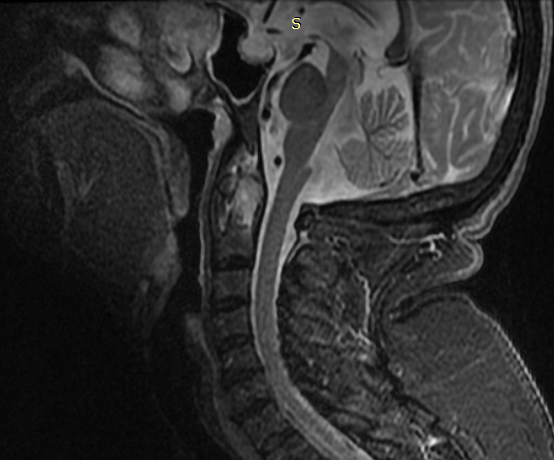
Figure 1: MRI of the cervical spine with sagittal acquisition at first evaluation. STIR sequences show high intensity signal of the odontoid process (arrow) and of the transverse ligament complex (arrow head) detecting bone marrow edema of the dens and of surrounding ligaments.
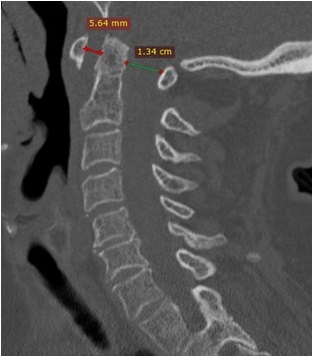
Figure 2: CT scan of the cervical spine with sagittal multiplanar reconstruction. Atlanto-dental distances: anterior atlanto-dental interval, red line is 5.64 mm (normal <3 mm) indicating atlo-axial early instability and implying transverse ligament damage. Posterior atlanto-dental interval (PADI), green line is 1.34 cm. PADI <1.4 cm is a sensitive method of predicting cord compression
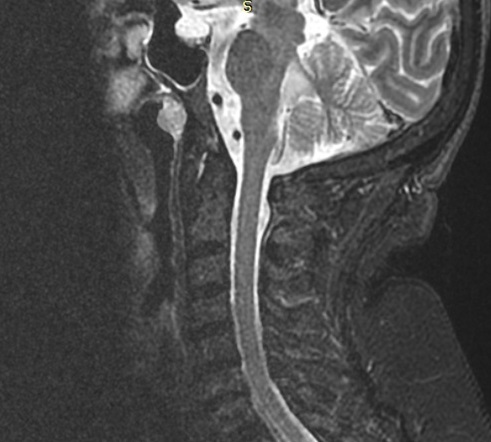
Figure 3: MRI of cervical spine with sagittal acquisition six months after switching to adalimumab. STIR sequences show normal intensity signal of the odontoid process with complete regression of bone marrow edema of the dens.
Discussion
PsA is a heterogeneous disease and pattern of joint involvement may change over time [1,2,7]. Cervical spine arthritis is not uncommon, may occur without other signs of spondylitis and may be clinically relevant with 7-21% of patients developing anterior atlanto-axial subluxation [3,15]. Conventional radiography discloses different lesions that are sometimes similar to that observed in rheumatoid arthritis with peri odontoid synovial pannus mass, few cases of atlantoaxial subluxation and erosions of odontoid process [3,15-18].
In our patient we observed the acute onset of cervical pain occurring many years after diagnosis. She was on etanercept monotherapy and long-standing remission, without any sign of peripheral arthritis or psoriatic skin lesions.
Notably, cervical pain was associated with marked elevation of ESR and CRP, as reported in other studies with cervical spine spondylitis due to PsA [5,18]. We performed an exhaustive imaging evaluation which disclosed inflammatory lesions and early atlantoaxial instability, implying transverse ligament damage. Moreover, MRI showed intense bone edema of the odontoid process and of the transverse ligament complex with surrounding synovitis. Our findings support the hypothesis that in PsA different pathogenic mechanisms may play a role in cervical involvement and the primum movens could be bone edema of the odontoid process (rather than synovial pannus as observed in rheumatoid arthritis) or entheseal involvement of the transverse or alar ligaments (as generally occurs in spondyloarthropathies). Early occurrence of atlo-axial instability in a patient on apparent disease remission highlights the importance of prompt assessment of cervical pain in PsA using adequate imaging techniques.
In our patient there was no response to adding NSAIDs to etanercept therapy and we decided to switch to adalimumab with rapid clinical response of cervical symptoms and persistent remission of peripheral arthritis. Moreover, MRI confirmed the complete regression of bone edema of the cervical joint. The unusual course of symptoms and response to treatment of this case confirm that PsA is a protean disease and any patient may need an individualized diagnostic and therapeutic approach.
Authors Contributions
Giuseppe Provenzano made substantial contribution in managing the patient and writing the manuscript. Maria Concetta Miceli contributed in managing the patient and revising the manuscript. Livia Bruno made substantial contribution in imaging studies. Chaira Arcuri contributed in reviewing literature and revising the manuscript.
Competing Interest
Giuseppe Provenzano served as advisory board member and/or received lecture grants from AbbVie, Biogen, BMS, Grunenthal, Lilly, MSD, Roche, Sandoz, Sanofi, UCB.
Maria Concetta Miceli served as advisory board member and/or received lecture grants from Sanofi, Novartis, UCB, Roche, BMS, Lilly.
Chiara Arcuri served as advisory board member and/or received lecture grants from Celgene, Roche, UCB, Novartis, MSD, BMS.
Patient consent
Obtained
References
2. Gladman DD. Psoriatic arthritis. Rheumatic Disease Clinics of North America. 1998 Nov 1;24(4):829-44.
3. Salvarani C, Macchioni P, Cremonesi T, Mantovani W, Battistel B, Rossi F, Capozzoli N, Baricchi R, Portioli I. The cervical spine in patients with psoriatic arthritis: a clinical, radiological and immunogenetic study. Annals of the Rheumatic Diseases. 1992 Jan 1;51(1):73-7.
4. Van Tilt I, Lories RJ, Westhovens R, De Vlam K. Unusual cervical spine involvement in psoriatic arthritis: a case series. Clinical Rheumatology. 2009 Nov 1;28(11):1343-6.
5. Blau RH, Kaufman RL. Erosive and subluxing cervical spine disease in patients with psoriatic arthritis. The Journal of Rheumatology. 1987 Feb;14(1):111.
6. Bobek D, Babić-Naglić Đ, Potočki K, Kern J, Badovinac O, Ćurković B. The cervical spine involvement in patients with psoriatic arthritis. Reumatizam. 2007 Jul 1;54(1):12-5.
7. Coates LC, Kavanaugh A, Mease PJ, Soriano ER, Laura Acosta‐Felquer M, Armstrong AW, et al. Group for research and assessment of psoriasis and psoriatic arthritis 2015 treatment recommendations for psoriatic arthritis. Arthritis & Rheumatology. 2016 May;68(5):1060-71.
8. Glintborg B, Østergaard M, Krogh NS, Andersen MD, Tarp U, Loft AG, et al. Clinical Response, Drug Survival, and Predictors thereof in 548 Patients With Psoriatic Arthritis Who Switched Tumor Necrosis Factor α Inhibitor Therapy: Results From the Danish Nationwide DANBIO Registry. Arthritis Rheum 2013; 65 (5): 1213-23;
9. Saad AA, Ashcroft DM, Watson KD, Hyrich KL, Noyce PR, Symmons DP, British Society for Rheumatology Biologics Register. Persistence with anti-tumour necrosis factor therapies in patients with psoriatic arthritis: observational study from the British Society of Rheumatology Biologics Register. Arthritis research & therapy. 2009 Apr 1;11(2):R52.
10. Coates LC, Cawkwell LS, Ng NW, Bennett AN, Bryer DJ, Fraser AD, et al. Sustained response to long-term biologics and switching in psoriatic arthritis: results from real life experience. Annals of the Rheumatic Diseases. 2008 May 1;67(5):717-9.
11. Jani M, Macphie E, Rao C, Moore S, Mirjafari H, Mcloughlin Y, et al. Effectiveness of switching between biologics in psoriatic arthritis-results of a large regional survey. Clinical Medicine. 2014 Feb;14(1):95.
12. Kristensen LE, Lie E, Jacobsson LT, Christensen R, Mease PJ, Bliddal H, et al. Effectiveness and feasibility associated with switching to a second or third TNF inhibitor in patients with psoriatic arthritis: a cohort study from southern Sweden. The Journal of Rheumatology. 2016 Jan 1;43(1):81-7.
13. Roche CJ, Eyes BE, Whitehouse GH. The rheumatoid cervical spine: signs of instability on plain cervical radiographs. Clinical Radiology. 2002 Apr 1;57(4):241-9.
14. Ramos-Remus C, Gomez-Vargas A, Guzman-Guzman JL, Jimenez-Gil F, Gamez-Nava JI, Gonzalez-Lopez L, et al. Frequency of atlantoaxial subluxation and neurologic involvement in patients with ankylosing spondylitis. The Journal of Rheumatology. 1995 Nov 1;22(11):2120-5.
15. Ouédraogo DD, Palazzo E, Nlomé-Nzé M, Somogyi N, Ballard M, Hayem G, et al. Predominant cervical involvement in patients with psoriatic arthritis: report of two cases. Joint Bone Spine. 2007 Mar 1;74(2):175-8.
16. Quarta L, Corrado AD, Melillo N, Trotta A, D’onofrio F, Maruotti N, et al. Cervical myelopathy caused by periodontoid synovial pannus in a patient with psoriatic arthritis: a case report. Clinical Rheumatology. 2007 Aug 1;26(8):1380-2.
17. Lu K, Lee TC. Spontaneous regression of periodontoid pannus mass in psoriatic atlantoaxial subluxation: case report. Spine. 1999 Mar 15;24(6):578-81.
18. Laiho K, Kauppi M. The cervical spine in patients with psoriatic arthritis. Annals of the Rheumatic Diseases. 2002 Jul 1;61(7):650-2.