

Abstract
Background: The outcome of interventional pain procedures may be influenced not only by technical and patient-related factors but also by contextual factors arising from the physician–patient interaction. Patient expectations and physician communication have been associated with pain outcomes in experimental and clinical settings, but their relevance in CT-guided interventional pain treatment remains insufficiently understood.
Objectives: This study aimed to investigate the associations between patient expectations, perceived physician competence, physician communication, and treatment success in patients undergoing CT-guided periradicular therapy (PRT) for specific low back pain.
Methods: A prospective observational study was conducted between April 2018 and March 2020. A total of 114 patients underwent 467 CT-guided PRT procedures. Before each intervention, patients rated their current pain intensity, expected treatment success, and perceived competence of the treating physician. During the intervention, an independent observer documented physician–patient communication, including whether the physician expressed confidence in treatment success and whether positive, neutral, or negative wording was used. Treatment success was defined as a reduction of at least 0.5 points on the Visual Analog Score (VAS) between the pre-intervention score of the respective session and the final score obtained after completion of the treatment course. Associations between the investigated contextual factors and treatment success were evaluated using random-effects logistic regression models accounting for clustering at the patient and physician levels.
Results: Treatment success was observed in 255 of 467 interventions (54.6%). Higher perceived physician competence was significantly associated with treatment success (age- and sex-adjusted OR 1.62, 95% CI 1.37–1.93; fully adjusted OR 1.39, 95% CI 1.17–1.67). Physician communication of confidence in treatment success was also associated with improved treatment outcomes (fully adjusted OR 1.84, 95% CI 1.17–2.91). The strongest association was observed for positively framed language during the intervention compared with predominantly negative wording (fully adjusted OR 4.31, 95% CI 2.30–8.07). In contrast, patient expectations were not significantly associated with treatment success after adjustment for the investigated contextual factors (OR 1.05, 95% CI 0.94–1.17).
Conclusions: The findings suggest that physician-related contextual factors may be associated with treatment outcomes in CT-guided PRT. Positive physician communication, expression of confidence in treatment success, and higher perceived physician competence were associated with greater odds of pain reduction, whereas patient expectations showed no significant independent association after full adjustment. Physician–patient communication represents a potentially modifiable factor that may be relevant to pain management. Further prospective interventional studies are warranted to determine whether targeted communication strategies can improve outcomes following interventional pain procedures.
Keywords
Expectation effect, Physician-patient communication, CT-guided therapy, Low back pain, Periradicular therapy
Introduction
Pain is one of the most important symptoms in medicine. It has been defined, among other things, as a "distressing experience associated with actual or potential tissue damage with sensory, emotional, cognitive, and social components"[1]. This multidimensional nature makes pain a subjective experience influenced by various factors. Pain can be acute, subacute, or chronic [2,3].
Low back pain is a common cause of pain in industrialized countries. In the general adult population in Germany, 52.9% report having experienced low back pain in the preceding twelve months, making it a prevalent health problem that leads patients to consult orthopedic surgeons, family physicians, pain management specialists, radiologists, and other physicians [4]. On a global level, Hoy et al. estimated a lifetime prevalence of 38.9% and a one-month prevalence of 23.2% after adjusting for methodological variation across 165 studies from 54 countries [5].
This variability complicates diagnosis, because MRI findings often correlate poorly with patient-reported symptoms [6–8]. If low back pain persists despite about six weeks of appropriate conservative care, radiological imaging is recommended. Imaging may be appropriate when it is likely to change management, or sooner if serious pathology is suspected [9,10]. Careful examination of the correlation between the patient's symptoms and the morphological findings allows the selection of patients for whom targeted therapeutic intervention is appropriate [11]. In these cases, symptomatic, specific back pain can be treated by CT-guided periradicular therapy (PRT) or by image-guided facet joint therapy [12]. CT guidance enables precise needle placement and standardized delivery of medication to the affected nerve root, contributing to reproducible procedural conditions [13].
Nevertheless, clinical outcomes following CT-guided PRT vary substantially, even when procedures are technically successful and performed under standardized conditions [12]. In addition to patient-related characteristics and prior treatment experiences, increasing attention has been directed toward the role of physician–patient interaction in modulating clinical outcomes [14]. Verbal and non-verbal communication may influence pain perception and therapeutic response, potentially affecting the effectiveness of interventional pain procedures [14,15].
Increasing evidence suggests that verbal and non-verbal physician–patient communication plays a critical role in modulating pain and treatment efficacy. The physician plays an important role in the physician-patient interaction, by building the patient's trust in the treatment and, in the case of interventions, also in the team carrying out the treatment [16].
The patient's expectations can also have an influence on the outcome of the treatment [17,18]. Experimental studies have shown that a patient's expectation has an influence both on the perception of pain and on the evaluation of pain [19]. Pain patients, especially those with chronic or recurrent pain, often have extensive experience with different treatments. It is therefore difficult to determine how verbal and non-verbal factors operate and how patients' own expectations contribute, since previous treatment experiences shape the current therapy [20,21].
However, few studies have directly quantified the influence of physician–patient communication and patient expectations on outcomes in interventional pain therapy. The aim of this paper is to examine whether patient expectations, shaped by previous treatment experiences and physician communication, influence perceived effectiveness and pain relief after standardized CT-guided PRT.
Methods
In the period from April 2018 to March 2020, after approval by the ethics committee of the University of Witten/Herdecke with the number 72/2016, a prospective study on the possible effects of patient and physician expectations in CT-guided pain treatment was conducted. Patients who were referred with specific back pain to two Tertiary-care radiology practices in the Dortmund metropolitan area for CT-guided periradicular therapy were consecutively recruited for participation in the study. Written informed consent was obtained before inclusion in the study. Patients were each asked to indicate or mark their current pain score on a visual analog scale (VAS) ranging from 0 to 10. "0" meant "no pain", "10" meant "worst imaginable pain". Patients were excluded if they had previously undergone CT-guided pain therapy or spinal surgery, had a history of malignancy, had taken pain medication within 12 hours before the interview, or were taking regular analgesic medication for back pain between CT-guided sessions. CT-guided periradicular therapy was performed by one of five board-certified radiologists according to clinical availability. Two female and three male physicians with experience in CT-guided interventions ranging from 4 to 20 years completed the interventions. The injection site was marked, disinfected, and locally anesthetized with 1% lidocaine. Using a 22-gauge needle, the periradicular injection was performed CT- guided with a “step and shoot” technique. The needle tip was positioned adjacent to the affected nerve root near the neuroforamen. After verifying periradicular spread with a contrast agent, 0.5 ml of triamcinolone acetonide (40 mg/ml) was injected [13]. A highly experienced colleague retrospectively controlled the distribution of the drug mixture. This physician evaluated the submitted examinations in a “blind” manner, without knowledge of the patient or the performing physician. Before each intervention, the physician briefly introduced themselves, asked about the patient's current complaints, and gave additional explanations about the planned intervention according to their requirements. After this, the patient was interviewed by a trained research assistant. The patient was asked to indicate their current pain score and what success they expected from the upcoming therapy: "To what percentage will the therapy we are carrying out lead to freedom from symptoms for you? 0% = everything remains as it is— the therapy does not work. 100% = complete freedom from symptoms— I am well again and completely free of pain." Using a scale from zero to ten, the patient was also asked how they assessed the competence of the attending physician: "How competent do you consider the attending physician? 0 = totally incompetent. 10 = totally competent, greater competence is not imaginable.” The research assistant, as a silent observer, accompanied the CT-guided therapy. During the intervention, the research assistant observed the physician-patient interaction and documented physician communication according to predefined categories. Two aspects were documented separately. First, it was recorded whether the physician expressed confidence in the success of the intervention. Second, it was recorded how the procedure itself was described: positively, neutrally or unclearly, or predominantly negatively. Examples of positive, neutral, and negative wording were “a little walk”, “uncertain,” and “painful”, respectively. An expression of confidence was documented whenever the physician verbally indicated before or during the intervention that they expected the treatment to be successful, for example by stating that the procedure would help the patient. Physicians were not instructed to use specific positive or negative verbal formulations. Communication during the intervention occurred naturally in routine clinical practice and was documented by an independent observer. Classification was performed by a single trained observer, and inter-rater reliability was not formally assessed. Pain intensity was assessed using a VAS before each intervention. The pain score was reassessed prior to subsequent interventions to document interim changes. After completion of treatment, patients were contacted 1–12 weeks later and a final pain score was obtained. The pre-specified primary outcome was treatment success at the intervention level, defined as a reduction of at least 0.5 points on the VAS between the pre-intervention score and the score obtained after completion of the treatment course. Because every session was evaluated against the same end-of-course score, treatment success is defined at the intervention level, whereas the outcome itself is assessed at the end of the treatment course.
The patient’s personal success of treatment was assessed on the basis of the patient's self-reported evaluation, and therapy was terminated at the patient's request. Random-effects logistic regression models were used to analyze associations between contextual variables and treatment outcome, with random intercepts for patients and physicians to account for the clustering of examinations within both levels. Odds ratios (ORs) with 95% confidence intervals (CIs) were estimated. Data were complete for the primary outcome and the main explanatory variables in 467 of 469 interventions; two interventions with incomplete observer documentation were excluded from the regression analyses. Because patients contributed a variable number of interventions, and because this number differed between patients with and without treatment success, the random intercept for patients accounts for the correlation between repeated interventions within the same patient. A first model was adjusted for age and sex. A second, fully adjusted model additionally included all exposure variables. Potential confounding by pre-intervention pain intensity and by the varying number of interventions per patient was addressed by including both variables as covariates in the fully adjusted model. Because the random intercepts for patients account for the correlation between repeated interventions within the same patient, the models appropriately reflect the clustered structure of the data. We could not adjust for morphological severity, duration of symptoms, physician-rated prognosis, or patients' prior treatment expectations, as these were not documented. Because of the observational design, we cannot exclude the possibility of residual confounding of the association between physician communication and outcome. Physicians may, for example, have expressed confidence more often when they judged the intervention likely to succeed.
Results
A total of 114 patients (67 females, 47 males; mean age 58.9 ± 13.6 years, range 26–88) underwent 467 CT-guided periradicular interventions (286 in females, 181 in males). Six of these patients completed a second treatment course, yielding 120 treatment courses overall. According to the primary outcome definition (see Methods), 255 of 467 interventions (54,6%) were classified as successful (Responder-Group, R-Group), 212 (45,4%) as unsuccessful (Non-Responder-Group, NR-Group) (Table 1).
Influence of physician-patient interaction
Treatment success was associated with the patient’s perception of physician competence. In the age- and sex-adjusted model, the odds ratio (OR) for pain reduction was 1.62 (95% CI: 1.37–1.93), and in the fully adjusted model, OR = 1.39 (95% CI: 1.17– 1.67). Average physician competence scores were 8.22 ± 1.05 in the R-Group versus 7.46 ± 1.51 in the NR-Group.
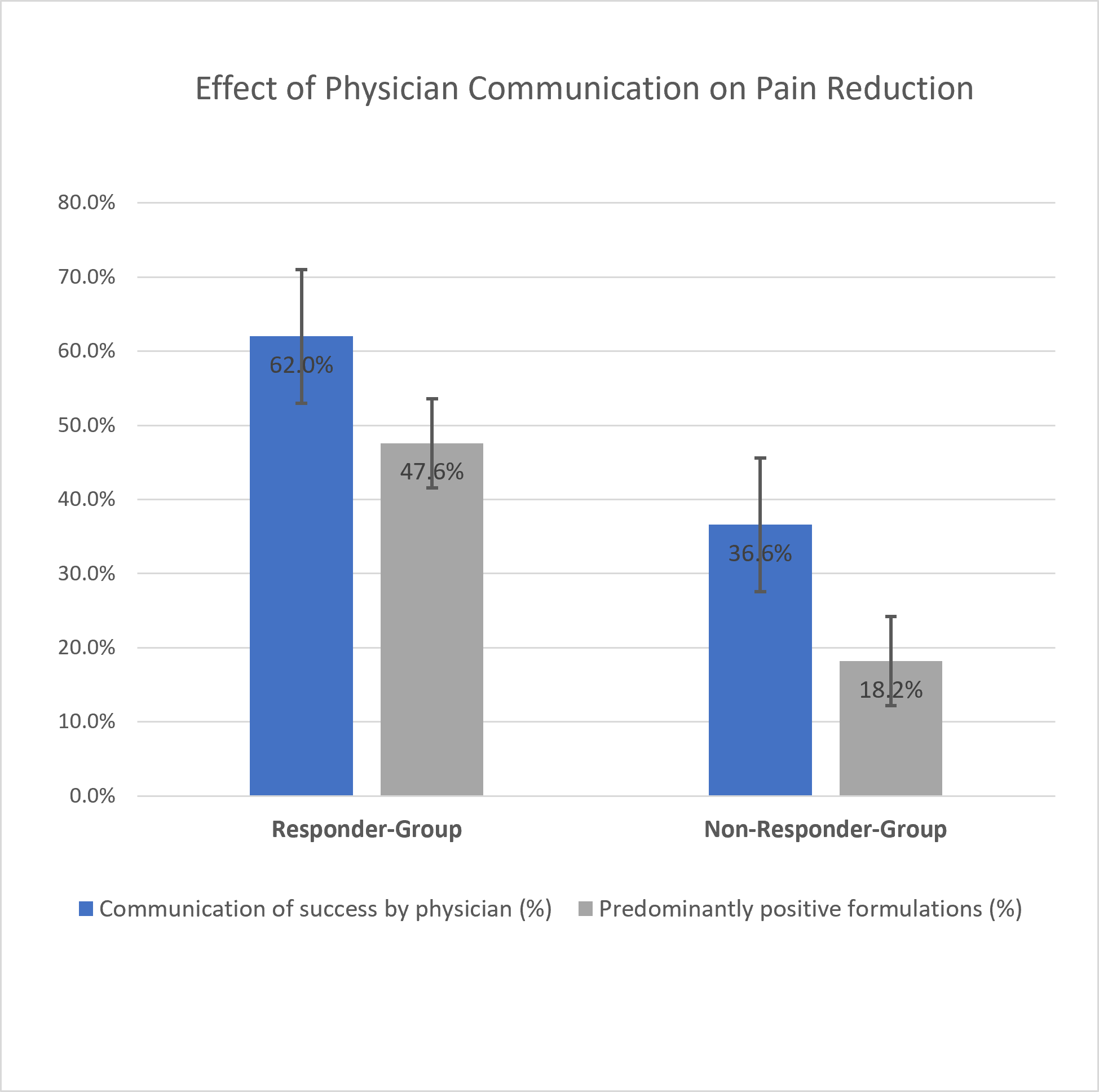
When the physician expressed confidence before the intervention that the treatment would be successful, the odds of treatment success were significantly higher than when no such confidence was expressed (OR = 2.82, 95% CI: 1.86–4.27; fully adjusted OR = 1.84, 95% CI: 1.17–2.91) than in the reference group in which the physician did not announce treatment success. When the treating physician used positive terms while performing the intervention, the odds of treatment success were higher than with negative phrasing (OR = 6.43, 95% CI: 3.52–11.76; fully adjusted OR = 4.31, 95% CI: 2.30–8.07). A generally positive attitude combined with neutral or ambiguous wording during the intervention was associated with a lower likelihood of a favorable outcome than consistently clear positive wording (OR = 1.85, 95% CI: 1.08–3.18; fully adjusted OR = 1.64, 95% CI: 0.94–2.86). In the fully adjusted model, the confidence interval includes 1, so the association is no longer statistically significant at the 5% level. In 62% of cases in the R-Group, the physician previously stated that they considered the upcoming treatment to be promising, whereas in the NR-Group, this was only done in 37% of cases. Overall, the treating physicians communicated that they believed the treatment would be successful in half of the interventions performed (50.4%). The attending physician used positive wording during treatment in the R-Group in 48% of cases, compared to only 18% of cases in the NR-Group (Figure 1). Overall, 34.3% of interventions involved exclusively positive phrasing, 45.4% neutral phrasing, and 20.3% predominantly negative phrasing (Table 1).
Figure 1. Effect of physician communication on pain reduction.
|
Study Characteristics |
||
|
Sex (n=114, (%)) |
Male Female |
47 (41.2%) 67 (58.8%) |
|
Age (years) (n=114) |
58.9 ± 13.6 |
|
|
Number of measurements per therapy course a (n = 120, (%)) |
1 2 3 ≥ 4 |
24 (20.0%) 13 (10.8%) 20 (16.7%) 63 (52.5%) |
|
Perceived expertise of the doctor b |
7.9 ± 1.3 |
|
|
Expected success by the patient c |
69.1 ± 20.6 |
|
|
Announced success by the doctor (n= 467, (%)) |
Yes No |
236 (50.4%) 231 (49.5%) |
|
Formulation used by the doctor (n=467, (%)) |
positive neutral negative |
160 (34.3%) 212 (45.4%) 95 (20.3%) |
|
VAS before the respective intervention d |
5.14 ± 2.38 |
|
|
VAS at final assessment after completion of the treatment course d |
4.24 ± 2.49 |
|
|
Treatment success e (n=467, (%)) |
255 (54.6%) |
|
|
No Success (n=467, (%)) |
212 (45,4%) |
|
|
a 6 Patients underwent a second therapy b On a scale ranging from 0 to 10 (10=highest perceived expertise) c On a scale ranging from 0 to 100% (100%=expected success by the patient) d On a scale ranging from 0 to 10 (10=highest pain) e Treatment success defined as a reduction of ≥0.5 points on the VAS between the pre-intervention score of the respective session and the final score after completion of the treatment course |
||
Influence of patient expectations
Patients' expected treatment success showed minimal association with outcome (OR = 1.17, 95% CI: 1.06–1.30; fully adjusted OR = 1.05, 95% CI: 0.94–1.17) (Figure 1). In the R-Group, patients reported an expected success rate of 72.3% ± 18.4, whereas in the NR-Group, the expectation of success was 65.4% ± 22.6.
Overall outcomes
Primary outcome (intervention level). 255 of 467 interventions (54.6%) met the primary outcome definition (≥0.5-point VAS reduction; R-group n = 255, NR-group n = 212). Secondary, exploratory outcome (patient level). On average, patients achieved a VAS reduction of 2.7 points (mean reduction per intervention: 0.9 points), and 76% of patients met the conventional MCID for chronic pain. Patients with treatment success received on average 3.9 interventions, patients without success 1.3 interventions.
Discussion
The present study extends evidence from the pain literature showing that contextual factors such as patient expectations and physician communication can influence clinical outcomes after interventional pain therapy. Specifically, positive physician–patient interaction and perceived physician competence were associated with improved pain reduction, whereas patients' pre-treatment expectations had only a minor effect on outcome. This pattern is consistent with research demonstrating that contextual and expectation effects contribute to treatment responses beyond the specific physiological effects of a given intervention [15]. In our study, higher success rates were observed when positive language and confidence in the treatment were used.
Our findings add to this evidence by examining CT-guided interventional pain procedures, in which such effects have been studied less systematically. Importantly, all included interventions were technically successful and performed under standardized conditions, suggesting that the observed differences in outcomes are unlikely to be explained by procedural variability alone. Instead, our results indicate that nontechnical factors may play a relevant role in determining treatment success in interventional pain management.
Comparable results have been found in other fields of medicine. For example, Müller et al. showed a significant improvement in the effect of a placebo preparation in chronic pain patients and in a group of control patients when verbal communication about the expected analgesic effect was provided [18]. Moreover, neurobiological research indicates that positive expectations activate endogenous pain modulatory systems, thereby enhancing analgesia [22]. Although our study did not include a placebo arm, the observed association between positive communication and better outcomes is consistent with these mechanisms, suggesting that expectation-related processes may contribute to improved outcomes in real-world interventional pain therapy.
The results of the study also have practical relevance, because positive communication with the patient regarding the success of treatment is easy to implement and involves little additional time or cost. In our observational setting, physicians who framed the treatment positively and expressed confidence in its success were more likely to achieve treatment success. Whether this association can be translated into a recommendation to use affirmative formulations before and during treatment remains to be tested prospectively. Our findings also resonate with meta-analytic evidence that contextual effects significantly influence musculoskeletal pain interventions [23].
In our study, the patient's expected pain reduction or the patient's expected success of the treatment showed only a slightly positive effect on the outcome. Another study demonstrated a positive analgesic effect when patients had a positive expectation of the therapy [17]. That study is not directly comparable, however, because it examined only healthy participants exposed to experimentally varied pain stimuli. By contrast, our study included patients with low back pain of differing severity. Moreover, we included not only one examination or intervention but the entire treatment of a patient, with usually more than one therapeutic intervention. Because prior experiences also strongly interact with pain perception and processing, which may explain why patient expectation accounted for only a smaller proportion of therapeutic outcomes in our study [18].
Various approaches have been proposed for shaping verbal communication so as to foster positive expectations, particularly in patients with pain. It is recommended to provide a realistic and positively formulated assessment of the upcoming therapy’s effects, ideally supplemented by a brief explanation of the underlying mechanisms of action [14,24–27].
From a clinical perspective, these findings are of particular relevance. Physician communication represents a modifiable factor that can be optimized without additional costs, time, or changes to procedural technique. Simple strategies such as using positively framed language and expressing realistic confidence in treatment success were associated with better outcomes in this observational setting. These findings are hypothesis-generating and do not establish that adopting such language causally improves outcomes.
Whether incorporating structured communication approaches into routine care or physician training programs improves outcomes following interventional pain procedures remains to be tested prospectively.
In this study we assessed two aspects only: first, whether the treating physician expressed a positive assessment of success, and second, whether the content and framing of communication during the intervention were positive, negative, or inconsistent. The mechanisms of action of the treatment were presented in the respective educational talks by the physician; this was not considered and evaluated in the present study. The observer's notes do, however, indicate that in many cases the physician briefly explained the procedure to the patient once more.
We deliberately refrained from influencing physicians towards using positive phrases during the intervention because the initial aim of this study was to investigate a possible effect of verbal and nonverbal communication on outcome. Other studies, however, suggest that a better result can be achieved with trained physician-patient communication [28,29].
We defined treatment success as a reduction of at least 0.5 VAS points which is below the minimal clinically important difference (MCID) usually reported for pain and for specific low back pain for two reasons. First, PRT is not a single intervention but a series: with pain scores recorded before each session, discrete improvements accumulate across the treatment course, as reflected in a mean reduction of 2.7 VAS points overall versus 0.9 points per intervention. Second, our aim was not to establish the efficacy of PRT against a control intervention but to quantify the association between contextual factors and outcome. The reported odds ratios therefore describe associations and should not be interpreted as causal effects. The primary outcome was therefore defined at the intervention level. To address the timing of the outcome assessment and provide a clinically anchored sensitivity analysis, we additionally report a patient-level analysis using the conventional MCID for chronic pain [30,31]. 76% of patients achieved a mean reduction of 2.7 VAS points, clearly exceeding this threshold. This patient-level result is reported as a secondary, exploratory outcome. The primary analysis remains the intervention-level definition, so that the results can be interpreted at the level of the individual intervention and at the level of the treatment course as a whole.
A limitation of the present study is the inability to determine causal pathways between perceived physician competence, physician communication, and pain reduction. Although greater reported competence was associated with better outcomes, the directionality remains unclear. Patients may perceive physicians as more competent because of improved pain, or vice versa. The number of interventions per patient differed between patients with and without treatment success (mean 3.9 vs. 1.3), so patients who responded contributed more observations than those who did not. This imbalance may have influenced the estimated associations and should be taken into account when they are interpreted. Future longitudinal and interventional studies should investigate whether targeted communication training can causally enhance pain outcomes in interventional pain therapy. This would align with work showing that pre-consultation impressions of physician competence shape patient expectations and trust, with downstream effects on outcomes [32].
Patient expectations and the rating of physician competence were assessed after the pre-intervention consultation with the treating physician, so they capture the patient's state at the end of that consultation rather than a pre-existing expectation formed beforehand. These variables may therefore lie on the pathway between physician communication and treatment outcome, which may explain why patient expectations showed no independent association after adjustment for the contextual factors.
Communication was documented by a single trained observer. Inter-rater reliability was not assessed, and misclassification of the three framing categories cannot be excluded. Because a single observer classified both the communication and the outcome-related context, observer expectations cannot be fully ruled out as a source of bias.
The interval between the last intervention and the final pain assessment varied (1–12 weeks), which may have introduced variability into outcome ascertainment. Future studies should therefore use fixed assessment intervals and prespecified communication protocols to test these associations prospectively.
Randomized controlled designs would be particularly valuable to further clarify the role of physician-related factors in interventional pain management.
In summary, our findings highlight the importance of physician–patient interaction and contextual effects in interventional pain therapy. Positive communication and perceived competence were associated with better pain outcomes, aligning with an emerging body of literature emphasizing the relevance of contextual factors in clinical pain management. To our knowledge, this is among the first reports to demonstrate these relationships in the context of image-guided interventional pain procedures.
Funding Declaration
This research did not receive funding.
References
2. Bicket MC, Mao J. Chronic Pain in Older Adults. Anesthesiol Clin. 2015 Sep;33(3):577–90.
3. Rehart S, Henniger M, Arndt M. Acute pain therapy in orthopedics/trauma surgery. Orthopade. 2018 Oct;47(10):883–96.
4. von der Lippe E, Krause L, Porst M, Wengler A, Leddin J, Müller A, et al. Prevalence of back and neck pain in Germany. Results from the BURDEN 2020 Burden of Disease Study. J Health Monit. 2021 Mar 10;6(Suppl 3):2–14.
5. Hoy D, Bain C, Williams G, March L, Brooks P, Blyth F, et al. A systematic review of the global prevalence of low back pain. Arthritis Rheum. 2012 Jun;64(6):2028–37.
6. Kalichman L, Kim DH, Li L, Guermazi A, Hunter DJ. Computed tomography-evaluated features of spinal degeneration: prevalence, intercorrelation, and association with self-reported low back pain. Spine J. 2010 Mar;10(3):200–8.
7. Wiesel SW, Tsourmas N, Feffer HL, Citrin CM, Patronas N. A study of computer-assisted tomography. I. The incidence of positive CAT scans in an asymptomatic group of patients. Spine (Phila Pa 1976). 1984 Sep;9(6):549–51.
8. Brinjikji W, Diehn FE, Jarvik JG, Carr CM, Kallmes DF, Murad MH, et al. MRI Findings of Disc Degeneration are More Prevalent in Adults with Low Back Pain than in Asymptomatic Controls: A Systematic Review and Meta-Analysis. AJNR Am J Neuroradiol. 2015 Dec;36(12):2394–9.
9. Hutchins TA, Peckham M, Shah LM, Parsons MS, Agarwal V, Boulter DJ, et al. ACR Appropriateness Criteria® Low Back Pain: 2021 Update. J Am Coll Radiol. 2021 Nov;18(11S):S361-S379.
10. National Institute for Health and Care Excellence. Low Back Pain and Sciatica in Over 16s: Assessment and Management: NICE Guidelines. London: National Institute for Health and Care Excellence (NICE); 2016. Available from: https://www.nice.org.uk/guidance/ng59
11. Brinjikji W, Luetmer PH, Comstock B, Bresnahan BW, Chen LE, Deyo RA, et al. Systematic literature review of imaging features of spinal degeneration in asymptomatic populations. AJNR Am J Neuroradiol. 2015 Apr;36(4):811–6.
12. Stueckle CA, Talarczyk S, Hackert B, Wawro M, Haage P, Weger U. CT-guided Interventional Therapy of Back Pain - Predictors of Success in Treatment. Rofo. 2021 Jan;193(1):42–8.
13. Maurer MH, Froeling V, Röttgen R, Bretschneider T, Hartwig T, Disch AC , et al. MRI-guided and CT-guided cervical nerve root infiltration therapy: a cost comparison. Rofo. 2014 Jun;186(6):559–66.
14. Benedetti F. Placebo and the new physiology of the doctor-patient relationship. Physiol Rev. 2013 Jul;93(3):1207–46.
15. Caliskan EB, Bingel U, Kunkel A. Translating knowledge on placebo and nocebo effects into clinical practice. Pain Rep. 2024 Mar 25;9(2):e1142.
16. Náfrádi L, Kostova Z, Nakamoto K, Schulz PJ. The doctor-patient relationship and patient resilience in chronic pain: A qualitative approach to patients' perspectives. Chronic Illn. 2018 Dec;14(4):256–70.
17. Schenk LA, Sprenger C, Geuter S, Büchel C. Expectation requires treatment to boost pain relief: an fMRI study. Pain. 2014 Jan;155(1):150–7.
18. Müller M, Kamping S, Benrath J, Skowronek H, Schmitz J, Klinger R, et al. Treatment history and placebo responses to experimental and clinical pain in chronic pain patients. Eur J Pain. 2016 Oct;20(9):1530–41.
19. Sinke C, Schmidt K, Forkmann K, Bingel U. Expectation influences the interruptive function of pain: Behavioural and neural findings. Eur J Pain. 2017 Feb;21(2):343–56.
20. Council JR, Ahern DK, Follick MJ, Kline CL. Expectancies and functional impairment in chronic low back pain. Pain. 1988 Jun;33(3):323–31.
21. Reicherts P, Gerdes AB, Pauli P, Wieser MJ. Psychological Placebo and Nocebo Effects on Pain Rely on Expectation and Previous Experience. J Pain. 2016 Feb;17(2):203–14.
22. Rossettini G, Carlino E, Testa M. Clinical relevance of contextual factors as triggers of placebo and nocebo effects in musculoskeletal pain. BMC Musculoskelet Disord. 2018 Jan 22;19(1):27.
23. Saueressig T, Owen PJ, Pedder H, Tagliaferri S, Kaczorowski S, Altrichter A, et al. The importance of context (placebo effects) in conservative interventions for musculoskeletal pain: A systematic review and meta-analysis of randomized controlled trials. Eur J Pain. 2024 May;28(5):675–704.
24. Benedetti F, Carlino E, Pollo A. How placebos change the patient's brain. Neuropsychopharmacology. 2011 Jan;36(1):339–54.
25. Amanzio M, Pollo A, Maggi G, Benedetti F. Response variability to analgesics: a role for non-specific activation of endogenous opioids. Pain. 2001 Feb 15;90(3):205–15.
26. Bingel U, Wanigasekera V, Wiech K, Ni Mhuircheartaigh R, Lee MC, Ploner M, et al. The effect of treatment expectation on drug efficacy: imaging the analgesic benefit of the opioid remifentanil. Sci Transl Med. 2011 Feb 16;3(70):70ra14.
27. Colloca L, Barsky AJ. Placebo and Nocebo Effects. N Engl J Med. 2020 Feb 6;382(6):554–61.
28. Stewart M, Brown JB, Donner A, McWhinney IR, Oates J, Weston WW, et al. The impact of patient-centered care on outcomes. J Fam Pract. 2000 Sep;49(9):796–804.
29. Staiger TO, Jarvik JG, Deyo RA, Martin B, Braddock CH 3rd. BRIEF REPORT: Patient-physician agreement as a predictor of outcomes in patients with back pain. J Gen Intern Med. 2005 Oct;20(10):935–7.
30. Farrar JT, Young JP Jr, LaMoreaux L, Werth JL, Poole MR. Clinical importance of changes in chronic pain intensity measured on an 11-point numerical pain rating scale. Pain. 2001 Nov;94(2):149–58.
31. Dworkin RH, Turk DC, Wyrwich KW, Beaton D, Cleeland CS, Farrar JT, et al. Interpreting the clinical importance of treatment outcomes in chronic pain clinical trials: IMMPACT recommendations. J Pain. 2008 Feb;9(2):105–21.
32. Peerdeman KJ, Hinnen C, van Vliet LM, Evers AWM. Pre-consultation information about one's physician can affect trust and treatment outcome expectations. Patient Educ Couns. 2021 Feb;104(2):427–31.