

Keywords
CXCL17, Auto immunities, T cells, IL-23
Abbreviations
BALF: Bronchoalveolar Lavage Fluid; CLP: Common Lymphoid Progenitor; CNS: Central Nervous System; DP: Double Positive; EAE: Experimental Autoimmune Encephalomyelitis; LN: Lymph Nodes; LTHSC: Long-term Hematopoietic Stem Cells; MHC: Major Histocompatibility Complex; MOG: Myelin Oligodendrocyte Glycoprotein; STHCS: Short-Term Hematopoietic Stem Cells; TCR: T cell Receptor
Text
We recently published an article describing the importance of CXCL17 in T cell responses [1]. In summary, we observed the following:
1) Cxcl17 is necessary to maintain normal ratios of T cell subpopulations in lymph nodes (LN).
2) Cxcl17-/- mice develop more intense inflammatory responses than wild type mice.
Cxcl17 is a mucosal chemokine predominantly expressed in mucosal tissues of the respiratory tract and digestive system [2-4]. However, it is also expressed in primary immune tissues such as bone marrow and thymus (where its function is currently unknown- Table 1). Microarray data from the Immgen database of 298 purified immune cell subpopulations, and consistent with the analysis shown in table 1, indicates that Cxcl17 is expressed in the thymus. In this tissue, the highest expression of CXCL17 is by cortically and medullary epithelial cells (Table 2). Given that these represent relatively small thymic cell populations, this accounts for the relatively low levels of CXCL17 mRNA expression detected in the (whole) thymus (as reported in the Immgen database).
|
Cell type |
Tissue |
|
Medullary epithelial cells |
Thymus |
|
Lymphatyic Endothelial cells |
Subcutaneous Lymph Node |
|
Common Lymphoid Progenitor (Pro B) |
Bone Marrow |
|
Long Term Hematopoietic Stem Cell |
Bone Marrow |
|
preT DN1 thymocyte |
Thymus |
|
Red pulp macrophages |
Spleen |
|
Brain Microglia macrophages |
Central Nervous System |
|
NKT |
Spleen |
|
Regulatory T cells |
Spleen |
|
Mast cells |
Peritoneal Cavity |
|
Peritoneal macrophages |
Peritoneal Cavity |
|
Subpopulation |
RNA Normalized Values |
|
Cortical Epithelial Cells |
269.85 |
|
Medullary Epithelial Cells |
181.00 |
|
DP thymocytes |
124.39 |
|
T gd Vg2+ mature |
110.74 |
|
preT DN3-4 thymocytes |
110.68 |
|
DP intermediate thymocytes |
107.26 |
|
preT DN3A thymocytes |
104.88 |
|
iNKT precursor |
103.81 |
|
preT ETP-2A thymocytes |
98.60 |
|
T DN4 thymocytes |
95.66 |
In bone marrow, Cxcl17 is expressed by precursor long-term hematopoietic cells (LTHSC), short-term hematopoietic cells (STHSC), and pro B common lymphoid progenitors (CLP). In blood, Cxcl17 is observed in progenitor cells, but at very low levels in differentiated cells. To confirm that Cxcl17 is not expressed in cells other than progenitors cells in blood, we compared Cxcl17 and Ccl2 (another important chemoattractant for myeloid cells) expression levels in subpopulations analyzed by the Monaco dataset (Figure 1). These results help explain the absence of CXCL17 in serum from healthy donors (data not shown). However, it is detectable in several types of cancer in which a source of cells with the capacity of self-renewal, prolonged survival and ability to generate more differentiated cells is needed [5-11].
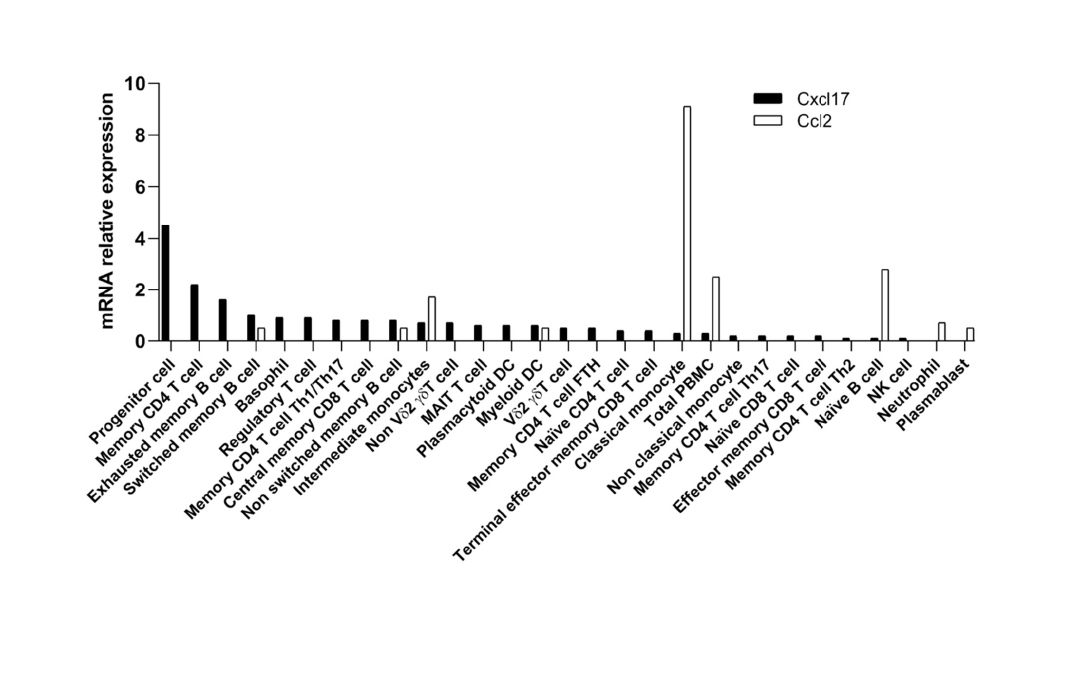
Figure 1: Cxcl17 is expressed by progenitor cells in the periphery. Comparison of the expression of Cxcl17 and Ccl2, both myeloid cell chemoattractants, shows the low expression of Cxcl17 in differentiated cells, but its higher expression in cells with renewal capacity (progenitor cells) and long-term survival capacity (memory CD4 and B cells subpopulations).
Based on these results, we proposed that the abnormalities we observed in T cell responses and T cell populations in immune tissues are likely due to abnormal T cell development. TCR-peptide-MHC interaction between thymocytes and cortically and medullary epithelial cells, expressing CXCL17, mediate positive and negative selection in the thymus [12]. We therefore propose that CXCL17 may be involved in the thymocyte selection process and development of central tolerance, probably by mediating intra-thymic migration of certain thymocyte subpopulations during the selection process.
Healthy Cxcl17-/- mice have a higher number of CD4+ single positive (SP) thymocytes, as well as more CD4+ and CD8+ T cells in the spleen and lymph nodes (LN) than wild type mice.
Further evidence concerning a potential role for CXCL17 in T cell development comes from another study using primary T-cell acute lymphoblastic leukemia double positive CD4+CD8+ (DP) cells. These authors found that Cxcl17 is upregulated upon Notch over-expression, as observed in the GeoProfile data set GDS4303 [13]. The Notch signaling pathway is very important in the thymus since it is involved in several processes related to cell fate specification, differentiation, proliferation, and survival. It is also involved, under homeostatic conditions, in the maturation of both CD4+ and CD8+ cells in the thymus [14].
In an inflammatory environment, such as in the induced EAE (Experimental autoimmune encephalomyelitis) disease model used in our study, we analyzed how Cxcl17-/- mice handle the disease. We found that CD8+ and CD4+ cell populations were significantly altered in LN. CD4+ effector subpopulations (CD4+ IFNγ+, CD4+ IL-17+ and CD4+ FoxP3+) were the most affected ones in Cxcl17-/- mice (when compared to wild type mice). We not only observed an accumulation of T cells in LN but also a defect in their capacity to migrate to the CNS (Central Nervous System), the tissue ultimately damaged in EAE. These results suggest that an alternative CXCL17 receptor to GPR35 (a receptor mainly expressed on monocytes, macrophages, dendritic cells and neutrophils), may be expressed on activated T cells. Other studies have documented the capacity of CXCL17 to attract regulatory CD4+ T cells to injured skin through myeloid cells in a psoriasis mouse model [15]. In a herpesvirus infection model, the absence of CXCL17 resulted in a defect to recruit GPR35+ CD8+ effector memory T cells to the vagina [16]. Another observation supporting the relevance of CXCL17 in T cells responses was the exacerbated response of Cxcl17-/- splenocytes activated with anti-CD3 and anti-CD28, which resulted in pronounced production of several cytokines and chemokines (compared with the cytokine production observed in splenocytes from wild type animals). The T cell cytokines and chemokines produced at considerable higher levels by activated splenocytes from Cxcl17-/- mice included IFNγ, TNFα, IL-2, CCL3 and CCL4. These cytokines had an effect on monocyte-chemokine production as observed with CXCL9 and CXCL10 (induced by IFNγ signaling) and, CCL2, IL-1β and TNFα, (considered classic monocyte inflammatory molecules). This result suggests a direct role for CXCL17 in limiting lymphocyte inflammatory responses and it supports similar conclusions that have been described for myeloid cells [1,17].
We hypothesize that the strong expression of CXCL17 in mucosal and barrier tissues such as stomach, esophagus, lung, salivary gland and vagina may reflect an anti-inflammatory environment present in these tissues under homeostatic conditions. This along with CXCL17’s microbicidal activity [2], likely represent homeostatic functions of CXCL17 aimed at protecting the organism from pathogens while inhibiting damage in the body through the control of mucosal inflammatory responses. We should clarify, however, that this may only be applicable under homeostatic conditions, since CXCL17 likely has different functions during inflammation.
In an autoimmunity context, CXCL17 may be limiting T cell function, and therefore its presence could be related to better prognosis. In our study, Cxcl17-/- mice could not control systemic inflammation at the peak of the disease (day 18 post MOG peptide injection), resulting in death of the experimental mice. At that point, the only cytokine with significantly higher levels in serum was IL-23. This result likely reflects the higher number of CD4+ IL-17+ cells found in LN at the onset of the disease (day 9 post MOG injection). IL-17 and IL-23 have been associated with several autoimmune diseases including psoriasis, rheumatoid arthritis, atopic dermatitis, multiple sclerosis, encephalomyelitis and Crohn’s disease [18-20]. We should note, however, that a Cxcl17-/- mouse is not a ‘normal’ model because this mouse has developed in the complete absence of Cxcl17. As such, its immune system is likely not ‘normal’ and instead exhibits abnormalities derived from the absence of Cxcl17 during the development of its immune system. Therefore, we should use care in extrapolating these results to wild type (normal) mice.
High levels of CXCL17 have also been observed in mucosal pathologies, for example, in tears from patients with Sjögren’s syndrome [21], bronchoalveolar lavage fluid (BALF) samples from patients with IPF (idiopathic pulmonary fibrosis) [2], and BALFs samples from patients with SARS-Cov2 infection [22]. However, the role of CXCL17 in these inflammatory states is not yet clear, and it could be playing different roles. One of the possible roles for CXCL17 in these inflammatory diseases likely includes the recruitment of large numbers of myeloid cells which may play important roles in the development and pathogenesis of these diseases and the prognosis of the patients. Inhibition of CXCL17 should prevent recruitment of these myeloid populations, likely changing the course of the inflammatory or fibrotic mechanisms operating in these diseases. For this reason, CXCL17 is a very attractive target for future research aimed at establishing whether it may be an important therapeutic target for these diseases, some of which, (i.e. IPF) currently do not have many therapeutic options.
References
2. Burkhardt AM, Tai KP, Flores-Guiterrez JP, Vilches-Cisneros N, Kamdar K, Barbosa-Quintana O, et al. CXCL17 is a mucosal chemokine elevated in idiopathic pulmonary fibrosis that exhibits broad antimicrobial activity. The Journal of Immunology. 2012 Jun 15;188(12):6399-406.
3. Burkhardt AM, Maravillas-Montero JL, Carnevale CD, Vilches-Cisneros N, Flores JP, Hevezi PA, et al. CXCL17 is a major chemotactic factor for lung macrophages. The Journal of Immunology. 2014 Aug 1;193(3):1468-74.
4. Hernández-Ruiz M, Zlotnik A. Mucosal chemokines. Journal of Interferon & Cytokine Research. 2017 Feb 1;37(2):62-70.
5. Ohlsson L, Hammarström ML, Lindmark G, Hammarström S, Sitohy B. Ectopic expression of the chemokine CXCL17 in colon cancer cells. British Journal of Cancer. 2016 Mar;114(6):697-703.
6. Guo YJ, Zhou YJ, Yang XL, Shao ZM, Ou ZL. The role and clinical significance of the CXCL17-CXCR8 (GPR35) axis in breast cancer. Biochemical and Biophysical Research Communications. 2017 Nov 25;493(3):1159-67.
7. Yao H, Lv Y, Bai X, Yu Z, Liu X. Prognostic value of CXCL17 and CXCR8 expression in patients with colon cancer. Oncology letters. 2020 Sep 1;20(3):2711-20.
8. Hsu YL, Yen MC, Chang WA, Tsai PH, Pan YC, Liao SH, et al. CXCL17-derived CD11b+ Gr-1+ myeloid-derived suppressor cells contribute to lung metastasis of breast cancer through platelet-derived growth factor-BB. Breast Cancer Research. 2019 Dec 1;21(1):23.
9. Matsui A, Yokoo H, Negishi Y, Endo-Takahashi Y, Chun NA, Kadouchi I, et al. CXCL17 expression by tumor cells recruits CD11b+ Gr1 high F4/80− cells and promotes tumor progression. PloS One. 2012 Aug 29;7(8):e44080.
10. Rashad Y, Olsson L, Israelsson A, Öberg Å, Lindmark G, Hammarström ML, et al. Lymph node CXCL17 messenger RNA: A new prognostic biomarker for colon cancer. Tumor Biology. 2018 Sep;40(9):1010428318799251.
11. Li L, Yan J, Xu J, Liu CQ, Zhen ZJ, Chen HW, et al. CXCL17 expression predicts poor prognosis and correlates with adverse immune infiltration in hepatocellular carcinoma. PloS One. 2014 Oct 10;9(10):e110064.
12. Kondo K, Ohigashi I, Takahama Y. Thymus machinery for T-cell selection. International Immunology. 2019 Mar;31(3):119-25.
13. Ntziachristos P, Tsirigos A, Van Vlierberghe P, Nedjic J, Trimarchi T, Flaherty MS, et al. Genetic inactivation of the polycomb repressive complex 2 in T cell acute lymphoblastic leukemia. Nature Medicine. 2012 Feb;18(2):298-302.
14. Harman BC, Jenkinson EJ, Anderson G. Entry into the thymic microenvironment triggers Notch activation in the earliest migrant T cell progenitors. The Journal of Immunology. 2003 Feb 1;170(3):1299-303.
15. Oka T, Sugaya M, Takahashi N, Takahashi T, Shibata S, Miyagaki T, et al. CXCL17 attenuates imiquimod-induced psoriasis-like skin inflammation by recruiting myeloid-derived suppressor cells and regulatory T cells. The Journal of Immunology. 2017 May 15;198(10):3897-908.
16. Srivastava R, Hernández-Ruiz M, Khan AA, Fouladi MA, Kim GJ, Ly VT, et al. CXCL17 Chemokine-Dependent Mobilization of Memory CXCR8+ CD8+ TEM and TRM Cells in the Vaginal Mucosa is Associated with Protection Against Genital Herpes. Journal of Immunology (Baltimore, Md.: 1950). 2018 Apr 15;200(8):2915.
17. Lee WY, Wang CJ, Lin TY, Hsiao CL, Luo CW. CXCL17, an orphan chemokine, acts as a novel angiogenic and anti-inflammatory factor. American Journal of Physiology-Endocrinology and Metabolism. 2013 Jan 1;304(1):E32-40.
18. Lubberts E. The IL-23–IL-17 axis in inflammatory arthritis. Nature Reviews Rheumatology. 2015 Jul;11(7):415.
19. Hawkes JE, Yan BY, Chan TC, Krueger JG. Discovery of the IL-23/IL-17 signaling pathway and the treatment of psoriasis. The Journal of Immunology. 2018 Sep 15;201(6):1605-13.
20. Duvallet E, Semerano L, Assier E, Falgarone G, Boissier MC. Interleukin-23: a key cytokine in inflammatory diseases. Annals of Medicine. 2011 Nov 1;43(7):503-11.
21. Hernández-Ruiz M, Zlotnik A, Llorente L, Hernandez-Molina G. Markedly high salivary and lacrimal CXCL17 levels in primary Sjögren's syndrome. Joint Bone Spine. 2018 May;85(3):379.
22. Zhou Z, Ren L, Zhang L, Zhong J, Xiao Y, Jia Z, et al. Heightened innate immune responses in the respiratory tract of COVID-19 patients. Cell Host & Microbe. 2020 May 4.