

Commentary
p38 MAPK is a multifunctional signaling kinase. It is a responder to stress stimuli performing various pleiotropic functions ranging from maintenance of cellular homeostasis to contributing to cellular dysfunction, depending on the tissue environment. The p38 MAPK family consists of four isoforms: p38α, p38β, p38γ, and p38δ, each with distinct roles in cellular signaling. Among these, p38α is the most extensively studied and has been implicated in the pathogenesis of various diseases due to its expression in almost all cellular types [1]. p38 kinase mediates a known canonical activation pathway called MAPK pathway. It is activated through dual phosphorylation by an MAP2K, which in turn is phosphorylated by an MAP3K. MAP3K contains several members. Different MAP3Ks are activated by different signals, which allow the pathway to integrate a wide range of stimuli, and mediate versatility of biological activities to the response. Once activated, MAP3Ks phosphorylate the MAP2Ks MKK3 and MKK6. They are highly specific for p38 kinases. The activation of p38 kinase by MAPK2 depends on the cell type and the stimulus [2]. MAP2K-catalysed phosphorylation of Thr and Tyr residues in the activation loop (Thr180 and Tyr182 in p38α) is crucial for kinase activity. Given that p38 controls a plethora of functions, dysregulation of this pathway could result in different diseases such as inflammation, immune disorders or cancer, indicating the possibility that targeting p38α could be of therapeutic interest [3]. However, application of p38α inhibitors in the clinical setting has not been successful so far. The lack of success in applying p38α inhibition in the clinic setting may range from the widespread use in initial studies of SB203580 [4,5]. It has been widely used in research and clinical trial because it is a potent inhibitor of the kinase but with clear non-specific effects. In the use of models that did not faithfully recapitulate the actual disease environment, thereby generating preclinical results that did not align with the drug application in the patient setting [6]. The great majority of protein kinase inhibitors that have been developed bind at or near the ATP binding site. Since this site is very conserved among MAPK family, the off target effects is obvious. An alternative strategy to generate highly selective p38 inhibitor is to block the specific interaction in the p38 signal pathway. Based on the hypothesis that specific binding peptides targeting on the docking groove would interfere the intrinsic interaction between p38 and its partners, Fu et al. have designed a fusion peptide containing 12aa p38 docking sequence derived from MKK3b and 11aa HIV-TAT transmembrane sequence to form a cell permeable peptide [7]. The peptide specifically binds to p38 and aborts its interaction with upstream kinase as well as downstream substrates, and thus to inhibit p38 phosphorylation and its signaling. The peptide does not inhibit other MAPK family members such as JUN and ERK. Furthermore, the induction and secretion of TNFα and other inflammatory factors by LPS are blocked in peptide treated cells and mice. Finally, the peptide has been shown to significantly inhibit ear oedema in mice. Therefore, the peptide holds great potential as an anti-inflammation agent for the treatment of inflammation and its related diseases. This work indicates that targeting p38 by this peptide is specific and this approach could avoid the side effect resulting from the targeting ATP binding pocket, since the interaction between protein and protein mediated by very specific amino sequence. Recently, an interesting paper titled ‘Self-assembling p38 peptide inhibitor nanoparticles ameliorate the transition from acute to chronic kidney disease (CKD) by suppressing ferroptosis’ has been published [8]. The authors construct a novel self-assembling peptide nanoparticle with above mentioned peptide targeting p38. They induced the self-assembly of the above peptides using tyrosinase, resulting in the formation of TAT-MKK3b nanoparticles (TMNPs). Transmission electron microscopy observations revealed that TMNPs were predominantly spherical, with an average diameter of 122 nm, and exhibited excellent biocompatibility. They suggest that this modification improves the stability of the original peptide, thereby optimizing the therapeutic potential. The authors demonstrate that TMNPs preferably accumulated in renal tubular epithelial cells (RTECs) and strongly improved the reduced renal function of ischemia-reperfusion injury (IRI)-induced acute kidney injury (AKI) mice and suppressed AKI-to-CKD transition. Mechanically, TMNPs inhibited ferroptosis via its solute carrier family 7member11 (SLC7A11)/glutathione peroxidase 4 (GPX4) axis-inducing capacity and synergistic potent antioxidant property in AKI. These findings indicate that the multifunctional TMNPs exhibit renal targeting, ROS-scavenging and ferroptosis-mitigating capabilities, which might serve as a promising therapeutic agent for the treatment of AKI and its progression to CKD. In recent years, integrating nanoscience and pharmaceutical sciences has demonstrated promising prospects and rapid development [9]. Although the application of nanotechnology in the treatment of acute kidney injury (AKI) is still in its early stages, it holds great potential for development [10]. Notably, nanoparticle-based drug delivery systems leverage the unique physiological and pathological conditions of renal tissues, which may selectively accumulate in the renal intrinsic cells, enabling the targeted treatment of kidney diseases [11]. Previous reports have extensively discussed various mechanisms by which nanoparticles locate in renal tissues, including nanoparticle size, shape, charge, and material composition [10-12]. Of note, recent studies identified protein corona as an important factor in determining the localization of nanomedicine in vivo, which has been neglected in the past [13]. Upon entering the circulatory system, these nanoparticles bind to surrounding serum proteins to form a protein corona, which may be recognized and cleared by immune system. Therefore, the type, quantity, and conformation of proteins on the nanoparticle surface are key factors regulating the biocompatibility and ultimately determining the fate of nanomaterials both in vitro and in vivo [14]. For example, the adsorption of immunoglobulins (IgG) and complement proteins on the surface accelerates the clearance of nanoparticles by the mononuclear phagocyte system [15]. Conversely, a protein corona with affinity for specific cellular receptors may provide an opportunity to enhance the biodistribution of nanoparticles to specific organs [16]. Therefore, improving the serum stability of nanoparticles in circulation and minimizing nonspecific protein adsorption are critical issues in the development of intravenously administered nanoparticle formulations.
The Renal Targeting Capacity of TMNPs
Based on these critical issues, the development of TMNPs exemplifies the novel application of these principles. TMNPs have demonstrated exceptional capability of stability and selective targeting, specifically accumulating in renal tubular epithelial cells (RTECs), the most vulnerable cells during AKI. One key mechanism of its selective targeting is the formation of a specific protein corona on the surface of TMNPs via absorbing albumin in the bloodstream. Albumin, being an endogenous protein, offers excellent stability and minimal immunogenicity, which helps to inhibit serum proteins adsorption and complement activation, thereby extending the in vivo circulation time of nanoparticles [15]. Additionally, the megalin receptor, which is highly expressed in RTECs, is a critical receptor for albumin reabsorption and endocytosis [17,18], facilitating the targeting of TMNPs to RTECs. This targeting strategy ensures that TMNPs are preferentially delivered to RTECs, thereby enhancing therapeutic efficacy while minimizing off-target effects.
TMNPs-Mediated Ferroptosis-Inhibiting Ability
Ferroptosis, a form of regulated cell death characterized by iron-dependent lipid peroxidation, plays a significant role in the pathology of AKI and its progression to CKD [19,20]. Therefore, inhibiting ferroptosis has been identified as a crucial therapeutic strategy in mitigating the transition from AKI to CKD [20,21]. Further, several studies have elucidated the molecular mechanisms governing ferroptosis, emphasizing the important role of the P38 mitogen-activated protein kinase (MAPK) pathway in ferroptosis [22,23]. The P38 MAPK inhibitor SB202190 has been shown to alleviate N-methyl-D-aspartate-induced ferroptosis in rat retinal ganglion cells and improve visual function [24]. Thus, inhibiting the P38 MAPK pathway can serve as a strategy to protect cells from ferroptosis. TMNPs inhibit the activation of P38 MAPK pathway and enhance the SLC7A11-GPX4 axis, thereby reducing ferroptosis in RTECs. In addition to regulating specific molecular pathways, TMNPs possess intrinsic antioxidant properties. The design of these nanoparticles enables them to directly scavenge reactive oxygen species (ROS), reducing oxidative damage to cellular membranes and organelles. This broad-spectrum antioxidant effect is crucial for protecting RTECs from the oxidative stress that triggers ferroptosis, further enhancing the therapeutic potential of TMNPs. This targeted inhibition is vital for preventing the occurrence and progression of ferroptosis in the context of kidney injury.
Potential Clinical Advantages of TMNPs
Additionally, TMNPs offer several potential clinical advantages over traditional therapies, facilitating their transition from the laboratory to clinical settings. One major advantage is their targeted therapeutic effect. Traditional therapies often lack specificity, for example, corticosteroids are considered as the first-line treatment for nephrotic syndrome due to their effectiveness in controlling inflammation and immune responses [25]. However, these drugs are systemically distributed, which can lead to a range of complications such as osteoporosis, hyperglycemia, and immunosuppression [25]. TMNPs selectively accumulate in RTECs and concentrate at the injury site, thereby enhancing efficacy. This precise targeting is particularly beneficial for treating kidney diseases, since precise treatment may improve therapeutic outcomes.
Another advantage of TMNPs is their reduced toxicity. Traditional chemical inhibitors of P38 MAPK typically function by binding to the ATP-binding site of the kinase, which can inadvertently inhibit other kinases that share similar ATP-binding sites, leading to unintended side effects [26]. For instance, the diphenylurea compound BIRB796, a P38 inhibitor, also inhibits the kinase activities of c-Jun N-terminal kinase 2 (JNK2), ribosomal protein S6 kinase A1 (RSK1), and t and Src family tyrosine kinase (Lck), resulting in hepatotoxicity [27,28]. These drawbacks have greatly hindered the development and clinical application of P38 inhibitors as potential drugs. In contrast, TMNPs, as peptide-based nanoparticles, are composed of amino acids, the basic unit of natural proteins. This composition endows them with higher biocompatibility and a lower likelihood of eliciting immune reactions compared to synthetic or non-organic materials [26]. TMNPs leverage this biocompatibility to reduce the risk of toxicity and adverse reactions, which is crucial for long-term therapeutic use, particularly in vulnerable organs such as the kidneys.
Finally, the multifunctionality of TMNPs further enhances their therapeutic efficacy. The design of TMNPs is inherently versatile, they can not only deliver P38 peptide inhibitors to suppress the activation of P38 MAPK pathway associated with ferroptosis but also possess intrinsic antioxidant properties. This dual functionality allows TMNPs to address multiple pathways involved in kidney injury, providing a comprehensive therapeutic approach. By simultaneously inhibiting the P38 pathway and scavenging ROS, TMNPs can effectively mitigate inflammation and oxidative stress, the two primary drivers of AKI [29]. Consequently, TMNPs are more effective than therapies targeting only one aspect of the disease process.
Clinical Challenges and Future Research Directions
Despite their tremendous potential, the clinical application of TMNPs faces several challenges. Future research should focus on optimizing the design, bioavailability, and targeting efficiency of these nanoparticles. Additionally, quantifying the degree of inhibition of p38 phosphorylation and Ferroptosis by TMNPs in cells or tissues will help to deepen the understanding of the mechanism. Comprehensive preclinical and clinical studies are essential to evaluate the safety, efficacy, and pharmacokinetics of TMNPs. Extensive preclinical research in large animal models followed by carefully designed clinical trials is necessary to ensure the safety and effectiveness of TMNPs in humans. These studies will provide critical data on the optimal dosing regimen, potential side effects, and long-term efficacy of TMNPs. Further, investigate the potential for non-invasive monitoring techniques to complement the therapeutic applications of TMNPs. Another important area for future research is exploring the synergistic effects of TMNPs with other therapeutic agents. Combining TMNPs with anti-inflammatory drugs, fibrosis inhibitors, or other novel therapies may lead to new combination therapeutic strategies for comprehensive protection and restoration of kidney function. Investigating these synergistic interactions will help maximize the therapeutic potential of TMNPs and expand their clinical applications.
Conclusion
In conclusion, the development of self-assembling P38 peptide inhibitor nanoparticles represent a significant advancement in nephrology, offering a novel therapeutic approach to ameliorate the transition from AKI to CKD. By targeting key anti-ferroptosis pathways involved in AKI and leveraging the advantages of nanotechnology, TMNPs hold great promise for improving patient outcomes. Overcoming the remaining challenges and translating these findings into effective clinical therapies requires ongoing research and intensive collaboration. The potential of TMNPs to transform the landscape of kidney disease treatment is immense, and their successful development and application could significantly enhance the quality of life for patients with AKI and CKD (Figure 1).
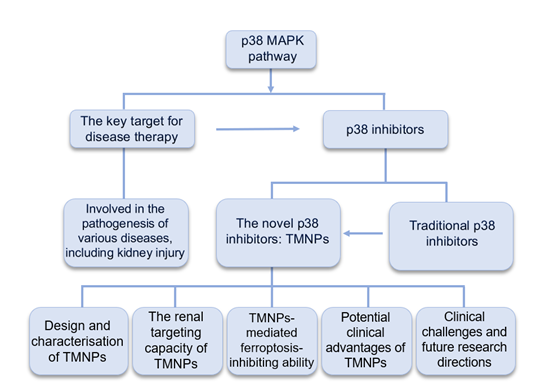
Figure 1: The flow-process diagram.
References
2. Cuadrado A, Nebreda AR. Mechanisms and functions of p38 MAPK signalling. Biochem J. 2010 Aug 1;429(3):403-17.
3. Canovas B, Nebreda AR. Diversity and versatility of p38 kinase signalling in health and disease. Nat Rev Mol Cell Biol. 2021 May;22(5):346-66.
4. Godl K, Wissing J, Kurtenbach A, Habenberger P, Blencke S, Gutbrod H, et al. An efficient proteomics method to identify the cellular targets of protein kinase inhibitors. Proc Natl Acad Sci U S A. 2003 Dec 23;100(26):15434-9.
5. Lee JC, Laydon JT, McDonnell PC, Gallagher TF, Kumar S, Green D, et al. A protein kinase involved in the regulation of inflammatory cytokine biosynthesis. Nature. 1994 Dec 22-29;372(6508):739-46.
6. Jones DS, Jenney AP, Joughin BA, Sorger PK, Lauffenburger DA. Inflammatory but not mitogenic contexts prime synovial fibroblasts for compensatory signaling responses to p38 inhibition. Sci Signal. 2018 Mar 6;11(520):eaal1601.
7. Fu J, Meng X, He J, Gu J. Inhibition of inflammation by a p38 MAP kinase targeted cell permeable peptide. Med Chem. 2008 Nov;4(6):597-604.
8. Xin W, Gong S, Chen Y, Yao M, Qin S, Chen J, et al. Self-Assembling P38 Peptide Inhibitor Nanoparticles Ameliorate the Transition from Acute to Chronic Kidney Disease by Suppressing Ferroptosis. Adv Healthc Mater. 2024 May 22:e2400441.
9. Shang S, Li X, Wang H, Zhou Y, Pang K, Li P, et al. Targeted therapy of kidney disease with nanoparticle drug delivery materials. Bioact Mater. 2024 Mar 21;37:206-21.
10. Chen Z, Peng H, Zhang C. Advances in kidney-targeted drug delivery systems. Int J Pharm. 2020 Sep 25;587:119679.
11. Huang Y, Ning X, Ahrari S, Cai Q, Rajora N, Saxena R, et al. Physiological principles underlying the kidney targeting of renal nanomedicines. Nat Rev Nephrol. 2024 Jun;20(6):354-70.
12. Williams RM, Jaimes EA, Heller DA. Nanomedicines for kidney diseases. Kidney Int. 2016 Oct;90(4):740-5.
13. Hajipour MJ, Safavi-Sohi R, Sharifi S, Mahmoud N, Ashkarran AA, Voke E, et al. An Overview of Nanoparticle Protein Corona Literature. Small. 2023 Sep;19(36):e2301838.
14. Rezaei G, Daghighi SM, Haririan I, Yousefi I, Raoufi M, Rezaee F, et al. Protein corona variation in nanoparticles revisited: A dynamic grouping strategy. Colloids Surf B Biointerfaces. 2019 Jul 1;179:505-16.
15. Peng Q, Zhang S, Yang Q, Zhang T, Wei XQ, Jiang L, et al. Preformed albumin corona, a protective coating for nanoparticles based drug delivery system. Biomaterials. 2013 Nov;34(33):8521-30.
16. Kim W, Ly NK, He Y, Li Y, Yuan Z, Yeo Y. Protein corona: Friend or foe? Co-opting serum proteins for nanoparticle delivery. Adv Drug Deliv Rev. 2023 Jan;192:114635.
17. Silva-Aguiar RP, Peruchetti DB, Florentino LS, Takiya CM, Marzolo MP, Dias WB, et al. Albumin Expands Albumin Reabsorption Capacity in Proximal Tubule Epithelial Cells through a Positive Feedback Loop between AKT and Megalin. Int J Mol Sci. 2022 Jan 13;23(2):848.
18. Gburek J, Konopska B, Gołąb K. Renal Handling of Albumin-From Early Findings to Current Concepts. Int J Mol Sci. 2021 May 28;22(11):5809.
19. Guo R, Duan J, Pan S, Cheng F, Qiao Y, Feng Q, Liu D, Liu Z. The Road from AKI to CKD: Molecular Mechanisms and Therapeutic Targets of Ferroptosis. Cell Death Dis. 2023 Jul 13;14(7):426.
20. Ni L, Yuan C, Wu X. Targeting ferroptosis in acute kidney injury. Cell Death Dis. 2022 Feb 24;13(2):182.
21. Gong S, Zhang A, Yao M, Xin W, Guan X, Qin S, et al. REST contributes to AKI-to-CKD transition through inducing ferroptosis in renal tubular epithelial cells. JCI Insight. 2023 Jun 8;8(11):e166001.
22. Cheng F, Dou J, Yang Y, Sun S, Chen R, Zhang Z et al. Drug-induced lactate confers ferroptosis resistance via p38-SGK1-NEDD4L-dependent upregulation of GPX4 in NSCLC cells. Cell Death Discov. 2023 May 15;9(1):165.
23. Wu Z, Chen T, Qian Y, Luo G, Liao F, He X, et al. High-Dose Ionizing Radiation Accelerates Atherosclerotic Plaque Progression by Regulating P38/NCOA4-Mediated Ferritinophagy/Ferroptosis of Endothelial Cells. Int J Radiat Oncol Biol Phys. 2023 Sep 1;117(1):223-36.
24. Feng L, Wang C, Zhang C, Zhang W, Zhu W, He Y, et al. p38 MAPK inhibitor SB202190 suppresses ferroptosis in the glutamate-induced retinal excitotoxicity glaucoma model. Neural Regen Res. 2024 Oct 1;19(10):2299-309.
25. Noone DG, Iijima K, Parekh R. Idiopathic nephrotic syndrome in children. Lancet. 2018 Jul 7;392(10141):61-74.
26. Noguchi H, Miyagi-Shiohira C, Nakashima Y, Saitoh I, Watanabe M. Novel cell-permeable p38-MAPK inhibitor efficiently prevents porcine islet apoptosis and improves islet graft function. Am J Transplant. 2020 May;20(5):1296-1308.
27. Schreiber S, Feagan B, D'Haens G, Colombel JF, Geboes K, Yurcov M, et al; BIRB 796 Study Group. Oral p38 mitogen-activated protein kinase inhibition with BIRB 796 for active Crohn's disease: a randomized, double-blind, placebo-controlled trial. Clin Gastroenterol Hepatol. 2006 Mar;4(3):325-34.
28. McCarthy D, Taylor MJ, Bernhagen J, Perry JD, Hamblin AS. Leucocyte integrin and CR1 expression on peripheral blood leucocytes of patients with rheumatoid arthritis. Ann Rheum Dis. 1992 Mar;51(3):307-12.
29. Holditch SJ, Brown CN, Lombardi AM, Nguyen KN, Edelstein CL. Recent Advances in Models, Mechanisms, Biomarkers, and Interventions in Cisplatin-Induced Acute Kidney Injury. Int J Mol Sci. 2019 Jun 20;20(12):3011.