

Abstract
Introduction: Cardiovascular patients are at increased risk of complications due to COVID19. Beside nosocomial transmission, microdroplet aerosols can be responsible for viral (SARSCoV-2) transmission. These droplets are especially important for (cardiac) diagnostic- and therapeutic procedures as medical teams operate close to the patient.
Results: We measured the aerosol persistence in different locations, among which an outpatient cardiology clinic. Aerosol persistence times vary greatly with the ventilation of the specific building or room.
Conclusion: To prevent transmission by microdroplet aerosols, space ventilation is crucial and should be at least 10 air changes per hour.
Keywords
COVID19, SARS-CoV-2, Aerosol transmission, Cardiovascular, Airborne transmission
Abbreviations
COVID19: Coronavirus Disease 2019; SARS-CoV-2: Coronavirus Severe Acute Respiratory Syndrome Coronavirus-2; WHO: World Health Organization; CCN: Cardiology Centers of the Netherlands; ACH: Air Changes per Hour; ACC: The American College of Cardiology; SCAI: Interventional Council and the Society for Cardiovascular Angiography and Interventions
Introduction
The ongoing global Coronavirus Disease 2019 (COVID19) pandemic has enormous social and economic impact. COVID19 is caused by the Coronavirus Severe Acute Respiratory Syndrome Coronavirus-2 (SARS-CoV-2) and is characterized by a high transmission rate and increased mortality from acute respiratory distress syndrome compared to other viruses. Susceptibility to SARS-CoV-2 infection and subsequent complications have been related to age, diabetes mellitus, obesity, hypertension and cardiovascular disease [1,2]. Cardiovascular patients, if infected by SARS-CoV-2, have a significant higher mortality risk compared to patients without cardiovascular disease [3]. Several mechanisms have been proposed to explain for the particularly poor outcome in these patients. SARS-CoV-2 infection destabilizes atheromatous plaque and triggers coagulation which can lead to acute coronary syndrome, stroke and (pulmonary) emboli. In addition, it may cause myocarditis and trigger a cytokine storm-related hyper-inflammation syndrome which can result in (worsening of) heart failure. A reduced cardiac reserve (left ventricular dysfunction, ischemic heart disease or arrhythmia) in cardiovascular patients may contribute to their increased mortality risk when infected with SARS-CoV-2.
SARS-CoV-2 is transmitted through respiratory droplets from infected individuals produced by coughing, sneezing, and breathing. It is believed to be transmitted in three different ways. First, it can be directly transmitted through large respiratory droplets (60-100μm in size) that come into contact with for instance the eye and mucous membranes that contain the appropriate receptors. These large drops fall on the ground within 2 meter after exhaling, which served as the scientific basis for the 2-meter social distancing, as advised by the World Health Organization (WHO), to prevent viral transmission. Second, such large droplets can also indirectly transmit the virus if they fall onto surfaces that are subsequently touched by the host and the host’s hand comes into contact with facial areas that contain receptors. Third, there is growing evidence that small aerosol microdroplets (<5μm) produced by coughing and speaking can also transmit the virus [4]. Such small droplets remain airborne and inhalable for a longer time and can travel distances significantly larger than 2 meters when airborne. Facemasks and social distancing protect against larger droplets but their effectiveness against microdroplet aerosol transmission is limited [5,6]. The much-used surgical masks, for instance, filter out only 30% of the aerosol particles in laboratory experiments and only; where much better masks (N95 or FFP2) provide good protection from aerosols [7,8]. Additionally, if an infected person wears such a high-protection mask this significantly reduces the generation of aerosols [7,8]. To limit the infection risk by aerosol particles other preventive measures, such as space ventilation in order to dilute and clear out the aerosols and minimizing residence time, need to be implemented.
To investigate the infection risk by these aerosols for the general population and specifically in high-risk cardiovascular patients, Cardiology Centers of The Netherlands (CCN), a chain of outpatients cardiology clinics, the Amsterdam University Medical Centers and the Institute of Physics of the University of Amsterdam, founded a research consortium in March 2020. The aim of this consortium was to develop methods to assess the risk of aerosol transmission of SARS-CoV-2 and propose risk-mitigating measures.
Methods
Aerosol concentration is often measured using a laser sheet diffraction technique, in which the number of pixels that light up is a measure for the number and volume of the droplets (SprayScan®, Spraying Systems, Glendale Heights, IL, USA). Practically, the laser sheet tracks the aerosols by filming the laser light scattering of the aerosol droplets directly using a CCD camera and image analysis software [9]. However, this laser technique can only be operated by highly specialized personnel and, because of laser safety issues, only in laboratory settings. Using this technique as the standard, we validated a novel method using a handheld particle counter (Fluke 985, Fluke B.V. Europe, Eindhoven, The Netherlands) which is frequently used for air quality assessment and overcomes most of the above-mentioned drawbacks of the laser sheet diffraction technique [10,11], and is shown in Figure 1.
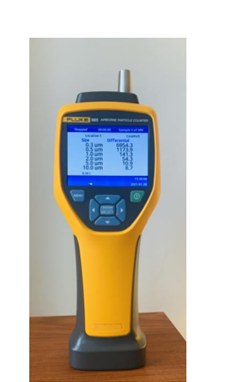
Figure 1: The particle counter, measuring the number of particles per liter of air of a given size indicated in the display. When aerosols are produced, these are visible as an increase in the different channels over the background (dust) particles. The average size of aerosols produced by human activity is around 5μm [9], after evaporation of the water contained in saliva this gives rise to aerosols of about 1-2μm. We thus use this size range also for the production of the artificial aerosols; the measurements presented below show the data for the 1um channel, however other channels give similar results and especially the same persistence time to within the experimental accuracy.
Results
We previously studied the temporal and spatial behavior of aerosol droplets, generated by healthy individuals through speaking and coughing [10,11]. We also showed how to artificially generate aerosol droplets, allowing us to measure their persistence and hence evaluate the ventilation quality of different spaces [10]. As an example of its application, here, we use the particle counting method to determine the aerosol droplet persistence over time in an outpatient cardiology clinic with varying ventilation. We do this in different rooms, and find no large variation between the rooms. Figure 2 shows a typical time trace of 1.0 micrometer particle concentrations as a function of time with normal ventilation (light blue points) and reduced ventilation (dark blue points). This measurement was done in the waiting room, where patients potentially sit for the longest time. Artificial aerosols were generated in a 5-meter radius around the particle counter that was standing on a table. It is clear from these data that the ventilation greatly reduces both the absolute concentration and the persistence time of the aerosols. The Table 1 shows the variation among the different channels for the reduced ventilation case.

Figure 2: Measured number of aerosol particles as a function of time. Aerosols are produced artificially at t=0s, and their persistence is measured to evaluate the ventilation quality. The drawn lines are exponential fits allowing to extract a characteristic time for the persistence, here <1 minute for ‘normal’ ventilation in the waiting room of the outpatient clinic, and more than double that time with reduced ventilation.
|
Size |
Characteristic time (sec) |
|
0.3μm |
123.3 |
|
0.3μm |
109.7 |
|
1μm |
113.5 |
|
2μm |
124.4 |
|
5μm |
115.2 |
|
10μm |
107.9 |
Conclusions and Implications for Cardiovascular Clinic and their Patients
We conclude [10] that proper ventilation of spaces substantially reduced the airborne time of respiratory droplets. In this specific case for the Cardiology clinic, the ventilation system has an air changes rate per hour (ACH) of 14, meaning that the total air is changed 14 times per hour, leading to the observed short persistence time; for the normally ventilated case the characteristic time if the (exponential decay of) aerosol concentration is about 1 minute. This is very different from ill-ventilated spaces such as for instance elevators where this same characteristic time can be as long as 15 minutes [10]. For the latter, a large concentration of aerosols remains minutes after an infectious person has left the elevator, implying a larger risk of transmission [10-12]. The role of respiratory aerosol microdroplets in transmission of SARS-CoV-2 can be assessed by measuring and modeling the dynamics of exhaled respiratory droplets. We measured size distribution, total numbers, and volumes of respiratory droplets, including aerosols, by speaking and coughing from healthy subjects [10]. Using the aerosol persistence times in confined public spaces the probability of infection by inhalation of aerosols when breathing in the same space can then be estimated using currently available estimates of viral load and infectivity of SARS-CoV-2. The current known reproduction numbers show a lower aerosol infectivity of SARS-CoV-2 compared to, for instance, measles, which is known to be efficiently transmitted through the air [11]. These findings nonetheless have the potential to explain why typical poorly ventilated and populated spaces, public transport and nursing homes, have been reported as sites with a high risk of viral transmission despite preventive physical distancing [13].
In general, all medical procedures that cannot be performed with at least 1.5-meter distance to the patient, especially in poorly ventilated spaces, can be considered to increase the risk of aerosol transmission of SARS-CoV-2. The American College of Cardiology (ACC) Interventional Council and the Society for Cardiovascular Angiography and Interventions (SCAI) have issued recommendations for cardiac catheterization laboratory management during the COVID-19 pandemic to mitigate SARS-CoV-2 transmission [14]. Due to the lack of quantifications of aerosol generation or clinical studies with respect to aerosol generation, no
specific guideline can be designed for these laboratories to minimize transmission risk. Cardiopulmonary exercise testing may harbor an increased risk of viral transmission due to increased and forced exhalation [15]. However, it is still unclear whether a significant number of aerosols is generated during this diagnostic procedure. It is interesting to note that a so-called high transmission risk procedure, i.e., controlled intubation and extubation, generates only a smaller number of aerosols compared to coughing [16]. Future studies are needed to quantify the risk of aerosol transmission in different cardiac diagnostic- and therapeutic procedures. From previous research it can be concluded that microdroplet aerosols can be responsible for viral (SARS-CoV-2) transmission. Notably, a recent paper [17] reports viable SARS-CoV-2 virus in aerosols produced by patients with respiratory manifestations of COVID-19, and concludes that these aerosols may thus serve as a source of transmission of the virus. These droplets are especially important for (cardiac) diagnostic- and therapeutic procedures as medical teams operate within a 1.5- or 2 - meter radius from the patient. To avoid transmission by microdroplet aerosols, space ventilation is crucial as the persistence time of the microdroplets is reduced. To minimize the risk of SARS-CoV-2 transmission during diagnostic- and therapeutic procedures, space ventilation should be at least 10 air changes per hour.
Conflicts of Interest
The authors declare that they do not have any conflict of interest.
Funding
The Authors did not receive any funding for conducting the study.
References
2. Lippi G, Wong J, Henry BM. Hypertension in patients with coronavirus disease 2019 (COVID-19): a pooled analysis. Pol Arch Intern Med 2020; 130: 304-9.
3. Nishiga M, Wang DW, Han Y, Lewis DB, Wu JC. COVID-19 and cardiovascular disease: from basic mechanisms to clinical perspectives. Nature Reviews Cardiology. 2020 Sep;17(9):543-58.
4. Liu Y, Ning Z, Chen Y, Guo M, Liu Y, Gali NK, et al. Aerodynamic analysis of SARS-CoV-2 in two Wuhan hospitals. Nature. 2020 Jun;582(7813):557-60.
5. Lewis D. Is the coronavirus airborne? Experts can’t agree. Nature. 2020 Apr 9;580(7802):175.
6. Ueki H, Furusawa Y, Iwatsuki-Horimoto K, Imai M, Kabata H, Nishimura H, et al. Effectiveness of face masks in preventing airborne transmission of SARS-CoV-2. MSphere. 2020 Oct 28;5(5).
7. Bowen LE. Does that face mask really protect you?. Applied Biosafety. 2010 Jun;15(2):67-71.
8. Leung NH, Chu DK, Shiu EY, Chan KH, McDevitt JJ, Hau BJ, et al. Respiratory virus shedding in exhaled breath and efficacy of face masks. Nature Medicine. 2020 May;26(5):676-80.
9. Somsen GA, van Rijn CJ, Kooij S, Bem RA, Bonn D. Measurement of small droplet aerosol concentrations in public spaces using handheld particle counters. Physics of Fluids. 2020 Dec 1;32(12):121707.
10. Somsen GA, van Rijn C, Kooij S, Bem RA, Bonn D. Small droplet aerosols in poorly ventilated spaces and SARS-CoV-2 transmission. The Lancet Respiratory Medicine. 2020 Jul 1;8(7):658-9.
11. van Rijn C, Somsen GA, Hofstra L, Dahhan G, Bem RA, Kooij S, et al. Reducing aerosol transmission of SARS-CoV-2 in hospital elevators. Indoor Air. 2020 Sep 23;30(6):1065-6.
12. Smith SH, Somsen GA, Van Rijn C, Kooij S, Van Der Hoek L, Bem RA, et al. Aerosol persistence in relation to possible transmission of SARS-CoV-2. Physics of Fluids. 2020 Oct 1;32(10):107108.
13. Jarvis MC. Aerosol Transmission of SARS-CoV-2: Physical Principles and Implications. Frontiers In Public Health. 2020 Nov 23;8:813.
14. Welt FG, Shah PB, Aronow HD, Bortnick AE, Henry TD, Sherwood MW, et al. Catheterization laboratory considerations during the coronavirus (COVID-19) pandemic: from the ACC’s Interventional Council and SCAI. Journal of the American College of Cardiology. 2020 May 12;75(18):2372-5.
15. Faghy MA, Sylvester KP, Cooper BG, Hull JH. Cardiopulmonary exercise testing in the COVID-19 endemic phase. British Journal of Anaesthesia. 2020 Oct 1;125(4):447-9.
16. Brown J, Gregson FK, Shrimpton A, Cook TM, Bzdek BR, Reid JP, et al. A quantitative evaluation of aerosol generation during tracheal intubation and extubation. Anaesthesia. 2020 Oct 6.
17. Lednicky JA, Lauzard M, Fan ZH, Jutla A, Tilly TB, Gangwar M, et al. Viable SARS-CoV-2 in the air of a hospital room with COVID-19 patients. International Journal of Infectious Diseases. 2020 Nov 1;100:476-82.