Loading


Archives of Clinical and Experimental Ophthalmology
ISSN: 2692-4331
Latest Articles
Surgical removal of intravitreal glass foreign bodies using nephrolith and sialolith baskets
Nishay V. Bhatnagar BA , Sydney B. Langer , Orlando G. Gonzalez-Martinez MD , Simran Ohri MD , Neelakshi Bhagat MD, MPH
Intraocular foreign bodies (IOFBs) are a major cause of visual impairment in adolescents and young adults and are associated with 18–41% of open globe injuries. Motor vehicle accidents resulting in penetrating ocular trauma are commonly associated with windshield glass IOFBs, in up to 70% of cases.
Arch Clin Exp Ophthalmol, 2026, Volume 8, Issue 1, p1-4 | DOI: 10.46439/ophthalmology.8.042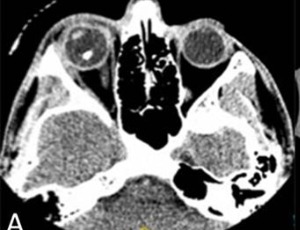
A consideration of the use of hyaluronic acid-based hydrogels in vitreous substitution
Rongrong Zhu
Vitreoretinal surgery involves the removal of the natural vitreous, which is essential for retinal adhesion, intraocular pressure (IOP) homeostasis, and optical transparency. Clinically utilized tamponades, including expansile gases, silicone oil (SO), and semi-fluorinated alkanes, necessitate face-down positioning.
Arch Clin Exp Ophthalmol, 2026, Volume 8, Issue 1, p11-13 | DOI: 10.46439/ophthalmology.8.044
An analysis of microbial keratitis organisms and in vitro antimicrobial sensitivities over a 16-year period within Bath, UK
Jon Luck , Shokufeh Tavassoli
Background: The aim of this study was to consider organism patterns and antimicrobial sensitivity over a 16-year period using brain-heart infusion broth, from a district general hospital in the south-west of the UK. Methods: This was a retrospective review of microbiological data of all cornea scrapes performed at the Royal United Hospitals, Bath, over a period from 1st January 2006 to 31st December 2022. Both direct and enrichment cultures were used. Monotherapy with a fluoroquinolone antibiotic was used as first line throughout the study period.Results: A total of 611 cornea scrapes (323/611, 52.9% culture positive) from 524 patients, were performed in the 16-year period. Organisms cultured were bacteria in 94% (68% gram-positive, 32% gram-negative), fungi in 4.4% and Acanthamoeba in 1.6% of cases. The most identified organism was Pseudomonas aeruginosa (n=70).
Arch Clin Exp Ophthalmol, 2026, Volume 8, Issue 1, p5-10 | DOI: 10.46439/ophthalmology.8.043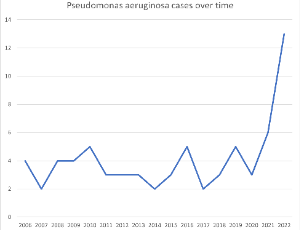
Intraocular pressure changes after Nd:YAG laser capsulotomy: a retrospective cohort study from ECWA Eye Hospital, Nigeria
Mayor Orezime Atima , Ugbede Idakwo , Oyeronke Komolafe , Ayodele Jacob Orugun , Jah Douglas Pam , Ishaya Bobga Bala , Kenneth Onosigho Ukumobe , Eisuke Shimizu , Shintaro Nakayama , Emmanuel Oluwadare Balogun , Emeka John Dingwoke
Purpose: Nd:YAG laser capsulotomy is an effective treatment for posterior capsule opacification (PCO) but may be associated with postoperative increases in intraocular pressure (IOP), particularly in high-risk patients. This study evaluated the incidence of IOP elevation following Nd:YAG laser capsulotomy, the management strategies used, and clinical outcomes at a tertiary eye hospital in Nigeria. Methods: This retrospective cohort study included 162 patients aged 40–80 years who underwent Nd:YAG laser capsulotomy for PCO and completed at least one year of follow-up. Data on demographic characteristics, IOP measurements, visual acuity outcomes, and post-procedure management were extracted from medical records. Changes in IOP and visual acuity before and after the procedure were analyzed, and outcomes were compared between patients with and without pre-existing glaucoma.
Arch Clin Exp Ophthalmol, 2026, Volume 8, Issue 1, p14-20 | DOI: 10.46439/ophthalmology.8.045
Edible plants: promising candidates for preventive and curative care in ophthalmological disorders
Acharya Balkrishna , Shreya Joshi , Rama Shankar , Rashmi Atul Joshi , Uday Bhan Prajapati
The objective of this study is to highlight the importance of edible plants commonly used in Indian households, but also medicinally acclaimed for various eye problems. Plants are a rich source of phytochemicals that, through various mechanisms fights against infections and diseases, thereby providing health benefits.
Arch Clin Exp Ophthalmol, 2026, Volume 8, Issue 1, p21-24 | DOI: 10.46439/ophthalmology.8.046
Late-stage retinoblastoma in older children: Case-based lessons and a call for early diagnosis in resource-limited settings
Orezime Mayor Atima , Emeka John Dingwoke
Retinoblastoma (RB) typically presents before age five; presentation beyond this age is uncommon but documented. We describe a 9-year-old Nigerian girl who presented with a fungating orbital mass secondary to advanced unilateral RB. The child had an 11-month history of progressive leukocoria and proptosis initially misinterpreted as an infection, followed by multiple delays at the primary-care level and prolonged use of traditional remedies. Factors contributing to the delay in diagnosis and timely presentation for specialist care included poor awareness of early RB signs, misdiagnosis, delayed referral, and sociocultural practices.
Arch Clin Exp Ophthalmol, 2026, Volume 8, Issue 1, p31-34 | DOI: 10.46439/ophthalmology.8.048
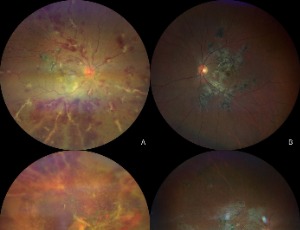
Presumed tubercular unilateral occlusive vasculitis mimicking frosted branch angiitis with bilateral serpiginous-like choroiditis: A challenging asymptomatic case
Evelien Janssen , Veerle Van Severen , Vincent M. De La Porte
Purpose: To present a challenging case of tubercular uveitis in an asymptomatic patient, featuring unilateral occlusive vasculitis with a frosted branch angiitis phenotype and bilateral serpiginous-like choroiditis. Methods: Case report with clinical photography. Results: Routine fundus examination of an asymptomatic 26-year-old Pakistani man revealed a retinal vasculitis with frosted branch angiitis phenotype in the right eye and bilateral serpiginous-like choroiditis. A positive QuantiFERON-TB Gold assay, tuberculin skin test and a chest computed tomography resulted in the diagnosis of presumed tuberculous origin of the posterior uveitis.
Arch Clin Exp Ophthalmol, 2026, Volume 8, Issue 1, p35-39 | DOI: 10.46439/ophthalmology.8.049